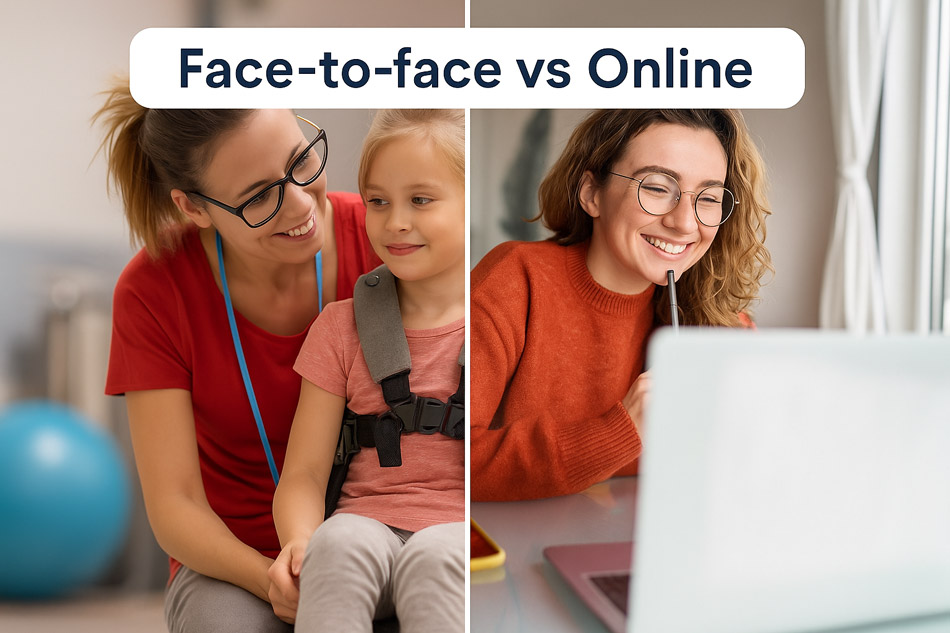
Is online therapy as good as face to face therapy? Here's what the research says.
Families ask us this every week. And it’s a completely reasonable question — if you’ve never tried online therapy before, it can be hard to imagine how it works, let alone whether it’s as effective as being in a room with a therapist.
The reassuring news is this: There is strong research showing that online therapy is just as effective as face-to-face therapy — and sometimes more effective.
The NDIS treats telehealth as a valid form of therapeutic support, as long as it is appropriate and good value for money.
OT, speech and psychology all fall under NDIS therapeutic supports.
Below is a clear explanation of the research, what it means in real life, and why many families see great results.
Psychology: Anxiety, Depression, Emotional Regulation
What the research says
Large studies comparing online CBT (Cognitive Behaviour Therapy) with in-person CBT consistently show no difference in improvement. People get better — their anxiety reduces, their mood lifts — whether they are sitting in a therapy room or joining from home.
Some studies have found people are more likely to complete therapy online, probably because sessions feel less intimidating and are easier to attend.
Key findings come from:
- Andrews et al. (2018) — Online CBT is as effective as in-person CBT.
- Carlbring et al. (2018) — Outcomes are equivalent, with some clients preferring online delivery.
- Simpson & Reid (2014) — The therapeutic relationship is just as strong online.
- Wagner et al. (2014) — Online CBT works as well as face-to-face for depression.
What this means for you
If your child, teenager or you yourself find clinic rooms overwhelming, online psychology can be a calmer and more accessible way to get the same benefits.
Speech Pathology: Speech, Language and AAC
What the research says
Online speech therapy produces outcomes equal to in-person therapy for articulation, language development and stuttering.
Research on AAC (communication devices) shows children often make even better progress online because the speech pathologist can see exactly how the device is used in daily home routines.
Key findings come from:
- Blaiser et al. (2013) — Tele-intervention is highly effective for infants and toddlers.
- Grogan-Johnson et al. (2010) — Telepractice matches in-person school therapy outcomes.
- Hall et al. (2019) — AAC telepractice is effective, especially with parent involvement.
- Wales et al. (2017) — Telehealth speech therapy works well for primary-aged children.
What this means for you
Speech therapy is highly visual and interactive. Online platforms allow therapists to use digital activities, animations and games that help keep children engaged — often for longer than in the clinic.
For AAC users, online sessions make it easy for therapists and parents to collaborate around the device in real time.
Occupational Therapy (OT): Daily Living, Regulation, Fine Motor Skills
What the research says
Studies show that online OT produces comparable improvements in fine motor skills, handwriting, sensory regulation and everyday routines.
Parent coaching — a major part of paediatric OT — is often even more effective online because therapists can see the real home environment and guide strategies directly in context.
Key findings come from:
- Camden & Silva (2021) — Telehealth OT is effective, especially for coaching parents.
- Little et al. (2018) — Online OT improves regulation and participation for autistic children.
- Suh et al. (2021) — Telehealth OT achieves outcomes equivalent to in-person OT for children with developmental delays.
What this means for you
OT is about building skills for real life — dressing, emotional regulation, morning routines, fine-motor tasks. Online OT works beautifully because it takes place where those routines actually happen.
So, Is Online Therapy “Just As Good”?
Based on dozens of high-quality studies across psychology, speech and OT:
- Online therapy is as effective as face-to-face
- Sometimes it is more effective (especially for anxiety, AAC and parent coaching)
- The NDIS recognises telehealth as legitimate therapeutic support
- Families often find online therapy easier, less stressful and more sustainable
It’s not a second-best option — it’s a different way of connecting that often fits real life better.
NDIS THERAPY FINDER - FREE SERVICE
LET US FIND YOU A SKILLED SUPPORT WORKER