Home / NDIS Eligibility & Access

NDIS Eligibility & Access

Resource Author: Bianca S. | NDIS Expert   Last Updated: 19 March 2026
NDIS

The National Disability Insurance Scheme (NDIS) is a program in Australia that provides funding for people with disabilities. It provides support and services to make their lives better and more independent. Find out more about how the NDIS works here.

The NDIS includes a number of 'stakeholders' (fancy word for interested parties) and since we often receive questions about who's who, we decided to put a resource together that covers each of them and their role:

Participants

These are the people with disability who have successfully applied for NDIS funding and after a planning meeting, receive an NDIS plan.

Related Resouces:

Planners

Before receiving a funding package (NDIS plan), Participants meet with a Planner to discuss and set their goals and aspirations so that the planner can work out what funding they need to achieve their goals.

This meeting is called a 'planning meeting'.

NDIS Planners determine where supports already exist and where further supports are required across the domains of:

  • Daily Living
  • Work
  • Home
  • Social and Community Participation
  • Health and Wellbeing
  • Relationships
  • Lifelong Learning
  • Choice and Control

Helpful Resources: 

Local Area Coordinators (LAC)

Employed by the NDIS, LACs perform 2 roles:

1. Like Planners, LACs can also meet with NDIS Participants during a 'planning meeting' to discuss their goals and the funding they need to achieve them. The LAC will then create their plan.
 

2. LACs are responsible for helping NDIS Participants 'activate their plan'. I.e. start spending your funding. 

Once you have your NDIS plan approved, you will be contacted by your local LAC to have a meeting either over the phone or in person.

Your LAC should help you understand your plan and help you to start connecting with services and supports, community activities, and other government services.

For most people aged seven years and older, a LAC will be your main point of contact at the NDIS, to discuss any questions about your plan. 

Related Resources: 

Early Childhood Early Intervention (ECEI) partners

ECEI partners are appointed by the NDIA to help families understand what supports the NDIS can offer children under 9 years old

If you have a child with a developmental delay, an ECEI partner will meet with you and your family at home or in their offices to learn about your background, your child's developmental progress and the impact on everyday life for you AND your family. 

They will help you find the supports you need. These may be basic and involve connecting with the community or they may be more complex and involve the necessity of NDIS funding

If you receive NDIS funding for a child under 7, the ECEI partner will help you apply for the NDIS and understand your NDIS plan.

Related Resources: 

Support Coordinators

The NDIS describes Support Coordination in the NDIS Price Guide as "a fixed amount for strengthening participant’s abilities to coordinate and implement supports in their plans and to participate more fully in the community."

Support Coordinators help participants:

  • Understand their NDIS Plan
  • Connect with Supports and Services
  • Build their capacity to engage supports themselves
  • Prepare for NDIS plan reviews

Not all NDIS participants receive support coordination in their NDIS plan.  

Related Resources: 

MyCareSpace offers a digital online support coordination service - helping you connect with the services you need in your local area.

Find out more

Plan Managers

Plan Managers support the participant in managing their NDIS funds by handling the day-to-day admin like processing/paying invoices and keeping track of your plan balance.

A participant has to elect to have their NDIS plan 'plan managed' and they can choose whichever plan manager they like. They can also change plan managers at any time.

A plan manager is paid by the NDIS and their fees do not come out of the participant's pool of funds - this payment is over and above the funding they receive.

A Plan Manager will help a participant by:

  • Paying all their bills - they can send them to their Plan Manager or service providers can send the bills directly to the Plan Manager for payment.
  • Send them monthly statements to help them track their plan spending.
  • Reimburse them for anything they need to pay upfront.
  • Some Plan Managers will help them with establishing service agreements with providers.

Related Resources: 

National Disability Insurance Agency (NDIA)

They are like the Lion in the zoo: in charge.

The NDIA is an independent statutory agency.

Their role is to "implement the National Disability Insurance Scheme (NDIS), which will support a better life for hundreds of thousands of Australians with a significant and permanent disability and their families and carers."

Related Resources: 

NDIS Quality and Safeguards Commission (the Zoo keeper)

"The NDIS Quality and Safeguards Commission is an independent agency established to improve the quality and safety of NDIS supports and services."

They regulate NDIS providers, provide national consistency, promote safety and quality services, resolve problems and identify areas for improvement.

They provide all regulatory requirements for NDIS registered providers. They play a role similar to the ACCC where participants that don't receive genuine NDIS services as promised can complain.

See the NDIS Quality and Safeguards Commission website

MyCareSpace

We finish by telling you a little more about the MyCareSpace free digital support coordination service. 

MyCareSpace helps participants and their families find and connect with verified local NDIS providers who have appointments available immediately.

Browse our directory yourself or use our Connections Team who do the search and connect for you.

Ask us for help now


MyCareSpace resources may be shared provided they are credited to MyCareSpace with backlinks to the original resource.

Resource Author: Bianca S. | NDIS Expert   Last Updated: 11 March 2026
NDIS

What does an Autism Assessment Involve?

How long does an Autism assessent take?

An Autism assessment can involve a number of sessions. Each session lasts up to 50 - 60 minutes and involves answering questions, carrying out various tests, including completing questionnaires, relating to the presenting concerns.  

One session will involve an appointment with the child's parent, alone, which may take between one to two hours.

Another aspect of the assessment process may include a home and/or school visit for observation in the child's natural environment.

As part of the comprehensive assessment, intellectual functioning may be assessed.  This can be helpful in identifying a child's strengths and areas where they may require support or modification in his/her learning environment to reach their full potential.  

This component of testing is usually referred to as 'cognitive testing'.

Referrals

Referrals to a paediatrician and/or other allied health professionals, for example, a speech pathologist may be provided as part of the assessment process.

What assessment tools are used?

These can differ slightly between psychologists, but Liz told us that she uses the Vineland adaptive behaviour scale and also the DSM-V criteria. She also uses the Autism Diagnostic Interview - Revised Edition, The Childhood Autism Rating Scale - 2nd Edition (CARS-2) and the Social Responsiveness Scale (SRS). 

How to prepare for the assessment

Gather together as much detail, for example previous reports from earlier assessments/test if conducted, and/or school reports.

Carefully observe your child before you go to the assessments, and look at the red flags. Take some notes, for example if your child does point, note how many times a day this happens.

Make notes on any words your child says and how the words are used.

It can be upsetting to do this, but it’s best to be 100% realistic about your child. Don’t paint a better picture or say a behaviour is common if it isn’t.

What will the results of the Autism assessment tell you

An Autism assessment includes a verbal feedback session to discuss the results, including potential diagnoses, and treatment/referral recommendations.

A comprehensive written report including the results from the assessment and treatment planning recommendations is provided. 

Details of your child's assessment are completely confidential and will not be disclosed to anyone, without prior consent.

What evidence do I need to apply for the NDIS?

Autism level 1 and 2 have automatic acceptance into the NDIS scheme. Level 1 requires more evidence.*

Types of disability evidence that can be submitted with an NDIS application (in preference order):

  • Diagnostic and statistical manual of mental disorders, fifth edition (DSM-V)
  • Vineland adaptive behaviour scale (Vineland-II)
  • World Health Organisation disability assessment schedule (WHODAS) 2.0 (17 years and over) or
  • PEDI-CAT (16 years and under)

Note that one of the above is sufficient.

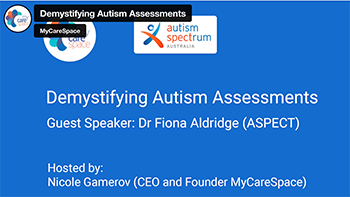
Webinar: Demystifying Autism Assessments

In this one hour webinar, CEO Nicole Gamerov will deep dive into autism assessments with expert guest speaker, Dr. Fiona Aldridge.

Fiona is a clinical psychologist with an interest in developmental disability and the assessment of neurodevelopmental conditions. She has particular experience in the assessment, diagnosis and management of autism and intellectual disabilities. Her research into autism assessment and support has been published in international journals and she has presented at international conferences.

In addition, Fiona is committed to supporting and educating new clinicians to ensure high-quality, evidence-based assessments are available to those who need them. Fiona is the Manager of Aspect’s Assessment service.

Fiona will help you understand some important elements of autism assessments, such as:

  • What is an autism assessment?
  • Who can do autism assessments?
  • What do you require for NDIS access?
  • What is the cost of an autism assessment?
  • Where can I find appointments for autism assessments?

Watch this free webinar

Watch webinar now

Related Articles

See how to apply for NDIS Funding with an Autism diagnosis

MyCareSpace resources may be shared provided they are credited to MyCareSpace with backlinks to the original resource.

Resource Author: Bianca S. | NDIS Expert   Last Updated: 11 March 2026
NDIS

What is a Disability Advocate?

Disability Advocates can speak out for themselves or for others who are at risk of being disadvantaged or treated improperly as a result of a disability. 

An advocate is someone who will speak, write or act on your behalf in order to promote, protect and defend your rights. They can be a family member, a friend, a carer or support worker or they can be a person engaged using external advocacy programs.

A great advocate will:

  • ​Not have a bias (meaning they are only doing what is right for you and not what is right for someone else)
  • Be on your side and no one else’s
  • Be focused on your wants and needs
  • Be loyal to you whilst respecting the rights of others
  • Be able to be your voice when you need it

Advocate does not:

  • Provide counselling
  • Make decisions for you
  • Provide mediation
  • Provide case management

When could you need a Disability Advocate during your NDIS journey?

The NDIS is about giving you back power in your life by ensuring you have choice and control. Some people may find it hard to speak up about what they want or need.

An advocate, like a supporter, can help you understand information, participate in phone calls and meetings with you.

During your NDIS journey you may need help from an advocate when:

  • Making your NDIS access request/application
  • Attending our NDIS planning meeting
  • Understanding your NDIS Plan
  • Preparing for or attending your NDIS plan review
  • Review of an NDIA decision and decision appeals to the AAT

How to find a Disability Advocate

An advocate could be a family member, carer, support worker or friend. Alternatively, you can find an external advocate using these links:


MyCareSpace resources may be shared provided they are credited to MyCareSpace with backlinks to the original resource.

Resource Author: Bianca S. | NDIS Expert   Last Updated: 11 March 2026
NDIS

What is the NDIS Early Childhood approach? (previously called ECEI)

Early Childhood Approach is the way the NDIS supports children aged 0-9 years who have a developmental delay or disability, and their families/carers. The NDIS Early Childhood approach will help all children with developmental delay or disability and their families to achieve better long-term outcomes through support services in their local community, regardless of diagnosis.

The NDIA have sourced experienced early childhood intervention service providers to ensure the NDIS supports all children as early as possible.

To become an access partner, service providers will need to demonstrate strong clinical expertise and utilise best-practice approaches. The NDIA will closely monitor service provider performance and outcomes to ensure all children receive the appropriate quality and level of support. 

These access partners are referred to as Early Childhood Partners.

Where do I start?

Children under 9 years old

You need to contact an Early Childhood  partner if you have:

  • a child under 6 years of age and there are concerns about their development
  • a child under 9 years old with a disability

NDIS Early Childhood Partners support is based on the impact of the disability or developmental delay on the child’s ability to participate in activities or perform tasks or activities. 

You do not need a referral from a health professional (although in some cases it may be your GP or a therapist who refers you).

You do not need a diagnosis.

You can find an NDIS Early Childhood Partner in your local area here

Find an NDIS Early Childhood Partner


Meet with an Early Childhood Partner

Your Early Childhood partner will meet with you and your family at home or in their offices. They may meet with you on multiple occasions and will discuss your concerns. They will learn about your background, your child's developmental progress and the impact on everyday life for you AND your family. 

An Early Childhood partner will get you started

It is the job of the Early Childhood Partner to help you find the supports you need. These may be basic and involve connecting with the community or they may be more complex and involve the necessity of NDIS funding. They will determine the level of support you need.

Early Childhood Partners:

  • Will connect you and your child with the most appropriate supports in your area, such as the community health centre, educational setting
  • Help you to request NDIS access if your child requires longer-term early childhood intervention supports. If your child becomes an NDIS participant the Early Childhood Partner will work with you to develop an NDIS plan.

The Early Childhood Partner will monitor and review your child’s progress against the goals you have set. Your Early Childhood Partner and service providers will support your family to improve your child’s independence and participation in everyday activities.


When can a child access the NDIS using Early Intervention Requirements?

If your Early Childhood Partner determines that your child needs longer-term support for NDIS access, they will recommend that you apply for NDIS access. 

Again, they will work with you to make this application. You’ll discuss your child’s needs and goals. You’ll talk about the support your child gets from family, friends, other services (like the education system) and community activities or service providers. And you’ll talk about how well this support works for your child.

They will have a planning meeting with you and help craft an NDIS plan that will give you the best supports to help your child.

Once the plan is approved, your child will start to get NDIS funding. You choose the providers you want to work with and start putting the plan into action.


What happens when you get your NDIS Plan?

Your Early Childhood Partner will go through your plan with you. They will help you access the MyGov Portal and help you decide how you want to manage your plan.

They will help you decide how you can spend your NDIS funds and they will monitor your progress until your plan review. At this time your plan may renew if determined that your long term support is still needed.Otherwise, you could exit the NDIS.

This continues until the child turns 7.

Find an Early Childhood  Partner

How do I know if my child has a developmental delay?

Developmental delay is a term used when a child takes longer to reach age-appropriate developmental milestones. For some children, developmental delays may be temporary. For others, it may be a sign they have another condition, such as Autism. Your Early Childhood Partner will determine this.


MyCareSpace resources may be shared provided they are credited to MyCareSpace with backlinks to the original resource.

Resource Author: Bianca S. | NDIS Expert   Last Updated: 15 June 2026
NDIS

What Diagnosis does the NDIS require for Autism

According to the NDIS autism should be diagnosed by “a specialist multi-disciplinary team, paediatrician, psychiatrist or clinical psychologist experienced in the assessment of Pervasive Developmental Disorders, and assessed using the current Diagnostic and Statistical Manual of Mental Disorders (DSM-5)”.

A diagnosis usually involves many specialists and professionals testing and assessing your child – this is called a multidisciplinary assessment. When lots of specialists work with your child, it gives your child the best chance of an accurate diagnosis. It also helps to develop the best treatment plan.

You might meet with all the professionals on the same day, in the same place. Or you might see one professional at a time – for example, you might see a speech pathologist or psychologist first and then a paediatrician at a later time.

DSM-5 lists the signs and symptoms of ASD and states how many of these must be present to confirm a diagnosis of ASD. Professionals also use standardised tests or tools to help them diagnose ASD.

When making an application to access the NDIS you will need reports that are no more than 2 years old.

Who can provide an NDIS Autism Diagnosis?

It’s vital to get a full assessment and diagnosis from a qualified and reliable professional or team of professionals using proper assessment tools. A professional who is willing to rule in or rule out something like autism with only a cursory appointment is not following the recommended diagnostic protocol.

The NDIS not fund Autism diagnoses. 

There are both government funded and private services available. Wait time for government funded services can be quite lengthy (as much as 12 months), so we recommend where possible not to wait and access the assessment services of a private centre or clinician. Find NDIS psychology support for autism assessment.

You can find a list of all the government funded diagnostic services here

You can find a list of all Autism NDIS Service Providers via the MyCareSpace website. Simply search by your postcode.

You can also contact your state-based autism association who may provide assessment services or can point you in the direction of local clinics and services (listed below).

Does the NDIS fund your Autism diagnosis?

Most state-funded assessment services have very long waiting lists and families can be left waiting for up to 12 months for an appointment. You may need or choose to use private professionals to do an assessment of your son or daughter.

Medicare

Your GP can refer you to a paediatrician or psychiatrist for diagnosis, and there is a Medicare item number which can be claimed to pay for part of this cost. It is critical to find a GP who understands autism spectrum disorder and who is across all the different Medicare rebates that can be accessed.

The paediatrician or psychiatrist can then give you referrals to see up to another four professionals for diagnostic services such as audiologists, occupational therapists, optometrists, orthoptists, physiotherapists, psychologists and speech pathologists.

The Medicare item numbers cover part of the cost of their diagnostic assessments. These must be used by the child’s 13th birthday. Information accurate as of September 2018.


State Autism Organisations

ACT

Territory autism association: Marymead Autism Centre
Web site: https://www.marymeadautismcentre.org.au/
Phone: 1800 427 920

NSW

State autism association: Autism Spectrum Australia [ASPECT]
Web site: http://www.autismspectrum.org.au
Phone: 1-800 ASPECT (1800 277 328)

NT

Territory autism association: Autism NT
Web site: www.autismnt.org.au
Phone: (08) 8948 4424

QLD

State autism association: Autism Queensland
Web site: www.autismqld.com.au
Phone: (07) 3273 0000

SA

State autism association: Autism SA
Web site: www.autismsa.org.au
Phone: (08) 8379 6976

TAS

State autism association: Autism Tasmania
Web site: www.autismtas.org.au
Phone: 03 6231 2745 (Hobart) or  03 6344 1212 (Launceston)

VIC

State autism association: AMAZE
Web site: www.amaze.org.au
Phone: 03 9657 1600

WA

State autism association: Autism Association of Western Australian
Web site: www.autism.org.au
Phone: (08) 9489 8900

Adult assessment & diagnosis

For young adults/adults seeking an assessment and diagnosis the best course of action is to meet with a psychologist and/or psychiatrist who has a deep understanding of autism and experience with the formal assessment and diagnosis process. That process is likely going to include a lot of questions about your childhood and school years, as well as experiences as an adult. As part of the assessment, there will likely be some psychological or psychiatric testing conducted.

To locate a qualified professional near you, please check out the following links:

Find A Psychologist (Under “Mental Health,” please select “Autism”)

Find A Psychiatrist


Sources:

MyCareSpace resources may be shared provided they are credited to MyCareSpace with backlinks to the original resource.

Resource Author: Bianca S. | NDIS Expert   Last Updated: 10 June 2026
NDIS

Accessing and understanding the NDIS is more difficult for people from culturally diverse backgrounds, so MyCareSpace did a little digging to see what helpful resources we could find for our multilingual community.

NDIS 

Resources in Community Languages
The NDIS has a full range of resources available in community languages (Auslan, Arabic, Greek, Korean, Simplified Chinese, Traditional Chinese, Vietnamese) and Easy English.

Language Translation Services for Providers (TIS)


Plan Hero Plan Management - a plan manager that speaks your language

The Plan Hero website has a number of easy to read important NDIS resources about things everybody finds hard in the NDIS. These resources are a must-ready for all participants, support coordinators and providers.

You can translate the entire Plan Hero website into any language you need. Find out how to browse the Plan Hero Plan Management website in your own language.


Health Translations Website

The Health Translations website is and initiative of the Victorian Government and provides health professionals and community members with reliable, accurate, and up to date health and wellbeing information in many different languages.

How it Works

You can search by language or service, and each topic is listed alphabetically including topics such as anxiety, behavioural disorders, housing, children and family services. It allows individuals to search for specific disability related concerns.

Is it just for Foreign Speaking Australians?

No, for everyone! After searching for a certain topic or language it will provide you with a list of resources and languages including an English version also.

NDIS

You can search by topic, e.g. ‘NDIS’ and language e.g. ‘Arabic’ and it will list all resources on the NDIS in Arabic. 

See these common searches:

Visit Health Translations Websites


The Multilingual Disability Hub

The Multilingual Disability Hub focuses on helping NDIS participants by providing a multilingual hotline and website that provides relevant and accessible information on disability and the NDIS in 14 languages. The directory is searchable on a state basis and not only do they provide information resources but also helplines in various languages. 

What Languages Are Included?

Resources and helplines are provided in the languages of Arabic, Assyrian, Bangla, Cantonese, Farsi, Greek, Italian, Macedonian, Mandarin, Nepali, Spanish, Tamil, Urdu and Vietnamese.

How to access this help? 

Visit the Multilingual Disability Hub Website

OR 

Call a telephone hotline in your language (9am to 5pm AEST):

Arabic
1800 960 972
Available on Monday

Assyrian
1800 960 976
Available on Wednesday

Bangla
1800 961 059
Available on Monday

Chinese (Cantonese)
1800 960 981
Available on Tuesday

Chinese (Mandarin)
1800 960 982 
Available on Wednesday

Farsi
1800 961 056
Available on Thursday

Greek
1800 960 975
Available on Monday

Italian
1800 960 973
Available on Friday

Macedonian
1800 960 978
Available on Thursday

Nepali
1800 961 060
Available on Friday

Spanish
1800 960 979
Available on Tuesday

Tamil
1800 961 057
Available on Wednesday

Urdu
1800 961 058
Available on Thursday

Vietnamese
1800 960 980
Available on Tuesday


Please add comments if you have any resources to add!


MyCareSpace resources may be shared provided they are credited to MyCareSpace with backlinks to the original resource.

Resource Author: Bianca S. | NDIS Expert   Last Updated: 11 March 2026
NDIS

At MyCareSpace we always have our ear to the proverbial NDIS ground and have heard that many participants, doctors, therapists and families have been having trouble when writing or accessing reports and assessments that are not in the correct NDIS speak. 

To write effective supporting documentation for people with disabilities and complex support needs seeking access to the NDIS (or needing to change existing plans), you need to get the words right

People with disability seeking access to NDIS funding need to meet criteria of permanent impairment. This requires health practitioners to demonstrate the connection between the health condition and the impairment, and the impact these have on the person’s ability to undertake tasks or activities (activity limitation) and their ability to participate in life roles (participation).

To meet the criteria for disability eligibility, you have to show that the impairment substantially reduces the person’s functional capacity. To do this, health practitioners need to:

  1. Use the language of diagnosis, treatment and rehabilitation to described the condition and the impairment
  2. Build on this to write about activity limitation, function and participation.

AND make sure they use the correct language required by the NDIS.

We did some searching and found 2 great guides to help join the dots between clinical language and what it focusses on, and the words required by NDIS - the language you will need to use in any supporting documentation you provide. 

1) Getting the Language Right -  Summer Foundation's guide to writing for the NDIS
Written by the Summer Foundation which is a Not for Profit organisation supporting, informing and empowering people with disability and their families.

2) Making NDIS Application and Report Writing Easier - A guide to the NDIS for individuals, practioners and families.
Written from a first hand perspective as a Participant, Ms Meredith Whitlaw

MyCareSpace resources may be shared provided they are credited to MyCareSpace with backlinks to the original resource.

Resource Author: Bianca S. | NDIS Expert   Last Updated: 11 March 2026
NDIS

If you find this confusing: how does my child transition from Early Childhood Early intervention(ECEI) to the NDIS? Well, that is because it is confusing. Here are some ideas on how to navigate this transition, with some useful links:

  1. Starting point might be to call the NDIS on 1800 800 110 and ask about your specific situation.  If you get no joy from this try the next steps.
  2. ECEI is for children 0-6 showing any sign of developmental delay. The ECEI pathway was implemented to give a 'broader gateway' - but it also acts as a 'filter' for full NDIS eligibility.
  3. We need to remember that NOT every child who shows a developmental delay in childhood goes on to get a formal diagnosis (and get support from the NDIS in the future).  
  4. Your Early Childhood Access Partner should assist in helping you to determine eligibility for ongoing support from the NDIS.
  5. In order to transition from ECEI to NDIS participant, the person will need to meet NDIS eligibility criteria via either Section 24 (Disability) or Section 25 (Early Intervention)
  6. Know your ASD level in accordance with the DSM5. It is specifically mentioned that ASD level 2 & 3 are granted access with 'no further assessments required'.  Deductively that would suggest that ASD level 1 will need to provide some sort of extra justification to determine eligibility.  Exactly what will depend on your circumstances, but we can assume that the NDIA will be looking for evidence of functional capacity across the domains of communication. social interaction, learning, mobility, self-care and self-management.  

Here are some useful links relating to Section 24 and Section 25 NDIS Eligibility criteria as well as the "definition" of Autism:

  1. Access to the NDIS - disability requirements (section 24)
  2. Access to the NDIS - early intervention requirements (section 25)
  3. The disability criteria for 0-7 years
  4. Disability criteria for 7-65 year
  5. Here is the early intervention criteria
  6.   'List A' (most likely to meet NDIS eligibility criteria)
  7. Per list A it describes Autism as 'Autism diagnosed by a specialist multi-disciplinary team, pediatrician, psychiatrist or clinical psychologist experienced in the assessment of Pervasive Developmental Disorders, and assessed using the current Diagnostic and Statistical Manual of Mental Disorders (DSM-V) diagnostic criteria as having severity of Level 2 (Requiring substantial support) or Level 3 (Requiring very substantial support)' 

MyCareSpace resources may be shared provided they are credited to MyCareSpace with backlinks to the original resource.

Resource Author: Bianca S. | NDIS Expert   Last Updated: 11 March 2026
NDIS

Did you miss our live webinar?

The three focus areas of our webinar were based on the number and nature of questions we have received from our MyCareSpace community.

These were:
• NDIS eligibility and access
• Planning for the NDIS
• Getting the most out of your NDIS plan

What a response and what an amazing event this was! Our CEO and host Nicole did a wonderful job of making sure our panelists answered as many of your questions as possible. The information covered in this session is invaluable to anyone who is juggling Autism and the NDIS.

As a MyCareSpace member you will have access to the Webinar recording (audio also available) and Resource Pack free for a limited time!

Important Links that accompany this Webinar:

MyCareSpace resources may be shared provided they are credited to MyCareSpace with backlinks to the original resource.

Resource Author: Bianca S. | NDIS Expert   Last Updated: 11 March 2026
NDIS
Lymphoedema or chronic oedema is the accumulation of excessive amounts of protein-rich fluid resulting in swelling of one or more regions of the body. This is due to a mechanical failure of the lymphatic system and occurs when the demand for lymphatic drainage exceeds the capacity of the lymphatic circulation. The condition usually affects the limb(s) although it may also involve the trunk, breast, head and neck or genital areas1. Lymphoedema may produce significant physical and psychological morbidity. Increased limb size can interfere with mobility and affect body image.
 
There is a general lack of awareness of the term lymphoedema, and a need for greater awareness and access to treatment for lymphoedema exists. Lymphoedema prevalence in Australia is unknown. Data from the UK suggests that up to 1.33 people per 1000 of the population may be affected by chronic oedema3. This suggests it may affect over 33 000 individuals in Australia (Australia’s current population estimated to be 24,577,1994.  Lymphoedema is often associated with the removal of lymph nodes related to cancer.  The best practice management for lymphoedema has a holistic, multidisciplinary approach that includes:  exercise/movement, swelling reduction and maintenance, skin care, pain and psychosocial management.
 
The Australasian Lymphology Association is responsible for registering professional lymphoedema therapists to perform these treatments.
 
Physiotherapist Moira Mannion is a qualified lymphoedema therapist who can perform manual lymphatic drainage. She was alarmed at the high number of public sector healthcare professionals attending a course on lymphoedema who were self funding their attendance. She said “it demonstrates the high need for hospitals to train their staff to in this treatment due to the increasing number of patients who require it. The treatment is very expensive to access privately for most people.” 
 
As a physiotherapist, Moira undertook a lymphoedema massage course which enables her to do specific lymphoedema massage, which works by moving fluid away from the swollen area towards functioning lymph nodes, so allowing the body to drain this excess fluid away. 
However treatment and management may take a lot of time and commitment on the patient’s behalf. The massage must be done almost every day for about half an hour as part of their daily routine, by either themselves or another. It doesn’t cure the illness but it helps them to manage it and prevent the swelling from worsening. This offers a practical way of managing the condition on a daily basis. 
Once it is at a manageable level, patients can then get special garments made similar to that of burns victims, made from elasticated thick fabric measured to fit their limb which they wear every day to help keep the inflammation down. These are available from companies such as JOBST  and others.
 
Information about state-based funding for compression garment schemes can be found here
 
Other funding and rebate options including NDIS funding has been detailed below:
 
  • Individuals are able to access 5 Medicare rebateable physiotherapy or occupational therapy appointments under the Chronic Disease Management Plan (completed by their General Practitioner), and private health extras cover will provide reimbursement on appointments and garments depending on individual health funds.
  • Due to the definition of “disability” according to the NDIS, the interaction of lymphoedema as an aspect of the disability will be assessed on a case by case basis. Experience of the NDIS roll out in the ACT has seen some individuals have lymphoedema garments included as part of their plan, if their swelling was identified as meeting the aforementioned requirements. Others have utilised “physiotherapy or therapy” as part of their plan to seek lymphoedema therapy. 
  • To meet the NDIS disability rules individuals need to have an impairment or condition that is considered permanent (lifelong) and that stops them from doing everyday things by themselves. Individual disabilities are not identified, rather the impact the disability has on the individual’s capacity to function within their daily roles and the broader community. An initial plan will be developed which identifies the reasonable and necessary supports required to meet an individual’s immediate needs. For a support to be funded it needs to be linked to an outcome identified in the individual’s plan and it also must:
  • Be associated with day-to-day living and activities that increase social or economic participation
  • Be a resource or piece of equipment, such as wheelchair, assistive technology or home and car modifications, to help live an ordinary life 
  • Any lymphoedema or chronic oedema requests as part of an individual’s plan must therefore meet the above requirements. Individuals will need to state how their lymphoedema impacts on their daily functioning.
 
For more information, the Australasian Lymphology Association is the peak professional organisation promoting best practice in lymphoedema management, including research and education in Australasia:  
 
Useful information regarding the NDIS can be found below:


References
2. Lymphoedema Framework. Best practice for the management of lymphoedema. International Consensus. London: MEP Ltd (2006)
3. Moffat C, Franks P, Doherty D, Williams A, Badger C, Jeffs E, et al.; Lymphoedema: an underestimated health problem. Q J Med. 96 (2003) 731-8.

4. Australian Bureau of Statistics – Population Clock – viewed 4 July 2017: 


Many thanks to the ALA for allowing us to share their fact sheet here.


MyCareSpace resources may be shared provided they are credited to MyCareSpace with backlinks to the original resource.

Subscribe to NDIS Eligibility & Access

Our Preferred NDIS Plan Manager

Plan Hero Plan Management is our preferred NDIS Plan Manager because they are independent and specialist Plan Managers who have both lived experience and expert NDIS knowledge. Plan Management is all they do!

Plan Hero helps you keep your funding organised and on track within each funding period, so you don’t overspend or leave funds unused. They make sure providers are paid on time and help you stay on top of your budget. Their team is easy to reach, with clear, direct communication and no waiting on hold (ever).

Plan Hero gives you the support you need to use your NDIS funding with confidence.