Home / NDIS Eligibility & Access

NDIS Eligibility & Access

Resource Author: Bianca S. | NDIS Expert   Last Updated: 11 March 2026
NDIS

The journey of applying for the NDIS can be a difficult and tumultuous time, especially for applicants who experience cognitive issues, are chronically exhausted or have other accessibility issues.

While it can be daunting, it’s important to remember that there are many different organisations, peak bodies and advocacy groups for your specific disability that can assist you in applying for the NDIS.

We’ve gathered a list of resources for some of the most common disabilities in Australia, as well as organisations that specifically assist people with their application to the NDIS.


General help with applying for the NDIS

It is not always necessary to reach out to disability-specific services when in need of support applying to the NDIS. Below is a service who can assist you access the NDIS if you are based in Victoria.

Yooralla

Yooralla is a disability support service based in Victoria. Yooralla provide services including Support Coordination, capacity building/therapy services, like accommodation, in-home support and community hubs for NDIS participants based in Victoria.

Additionally, Yooralla help prospective participants apply for the NDIS, providing free one-on-one NDIS consultations which aim to help you, or the person you care for, understand the NDIS at any step of your journey. Yooralla offer over the phone support with preparing your NDIS application, understanding your plan or implementing your next plan. 

Check out Yooralla's website for some fantastic resources, including their FREE Guide on How To Prepare For The NDIS.


Autism

Applying to the NDIS can be overwhelming and confusing. The following organisation can assist with the diagnosis process required to provide evidence to the NDIA for access to the NDIS.

Autism Spectrum Australia

Autism Spectrum Australia (also known as Aspect) is a not-for-profit organisation that can assist with providing an assessment to diagnose a child or adult with autism spectrum disorder. An assessment is completed with a Clinical Psychologist who will spend the morning with you to complete a variety of assessments. The afternoon is spent discussing your diagnosis with you and providing feedback. 4-6 weeks following your assessment, you will receive an individualised report which includes assessment results and interpretations. The report also outlines your personal strengths and support needs.

This report can be submitted to the NDIA as part of your application. This evidence will provide the NDIA with guidance on how you meet the eligibility criteria and allocating funding in your NDIS plan in approved.

Aspect can then provide a range of therapy services to you once you have your approved NDIS plan.


Psychosocial Disability

Psychosocial disabilities can often be complex and multi-faceted, making applying for help under the NDIS complicated. The following organisation offers support for those applying to the NDIS with psychosocial disabilities.

Reimagine Today

The Mental Health Coordinating Council (MHCC) have developed Reimagine Today, a platform supporting people living with mental health conditions with the NDIS.

This platform offers a wide range of resources, including the Reimagine My Life - A Workbook to Support You With the NDIS. This fantastic book is design to support people living with mental health conditions through the NDIS. It can be used by workers, supports, family, carers and more.


Spinal Cord Injury

Spinal cord injuries can require specific and complex information to be included in your NDIS application. The following organisations and advocacy groups offer support for those applying to the NDIS with spinal cord injuries.

Spinal Cord Injuries Australia

Spinal Cord Injuries Australia is a leading peak organisation for supporting those with a spinal cord injury. Providing a range of support to all disabilities living in NSW, SCIA offer an Advocacy Service to NSW residents who have not been successful in their first attempt accessing the NDIS. An advocate will assist with reviewing your documents and provide guidance on how to resubmit your application. Further support can be provided to you if you need support applying to the NDIS ATT if you are not happy with the outcome.

As the SCIA Advocacy Team offer region-based support, if they cannot assist you, you will be referred to a local advocate service near you. 


Spinal Life Australia

Spinal Life Australia is an organisation that is dedicated to helping those with a spinal cord injury live their best life. Spinal Life offer a Peer Support service, where a network of people within the spinal cord injury community assists by providing support and answering questions, informed by their lived experience with spinal cord injury. Reach out to the Spinal Life Peer Support team for guidance to navigate accessing the NDIS.


Acquired Brain Injury

Acquired Brain Injuries (ABI) are often ambiguous, multi-faceted and complex, meaning applying for support through the NDIS can be a mission. See below for support for applying to the NDIS with an ABI.

Synapse

Synapse is an organisation dedicated to supporting those with an ABI. Providing a range of support services for those who have lived experience of brain injury and disability, Synapse can also help with navigating the NDIS journey. 


Parkinson’s Disease 

With a dedicated Parkinson’s organisation in every Australian state, Parkinson’s Peak Bodies are the primary peak organisation that supports those with Parkinson’s navigate a healthy and happy life. As registered NDIS providers, they provide a wide range of support and services to those with Parkinson’s, as well as assist those applying for the NDIS.

Below is the extended list of each state’s Parkinson’s Peak Body:


Multiple Sclerosis 

Prospective NDIS participants with Multiple Sclerosis can face a number of issues when applying for support. The following organisations and advocacy groups offer support for those applying to the NDIS with Multiple Sclerosis.

MS Australia

MS Australia is one of the most renowned MS advocacy groups and peak support bodies, with over 60 years of insight into living well with progressive neurological conditions. 

The MS Plus Engagement Service is designed specifically to support you with the following:

  • understand the NDIS
  • prepare for your first interaction with the National Disability Insurance Agency (NDIA)
  • know what to ask for in your plan so you get the right support funded for your needs
  • understand what the NDIS terminology ‘reasonable and necessary supports’ means
  • understand and complete the documents required by the NDIA
  • appeal and reapply if you’re denied access to the NDIS

The MS Plus Engagement Service is FREE. You can access it via Telehealth if you live in the ACT, New South Wales, Tasmania and Victoria.

Check out the MS Australia Resource Hub, which includes a variety of podcasts, webinars and articles.

MyCareSpace resources may be shared provided they are credited to MyCareSpace with backlinks to the original resource.

Resource Author: Bianca S. | NDIS Expert   Last Updated: 11 March 2026
NDIS

Find NDIS ServicesMYCARESPACE CAN HELP YOU FIND MENTAL HEALTH SUPPORTS IN YOUR AREA

Our experienced Customer Connections team will connect you with support workers, allied health professionals and other providers that have experience with mental health and psychosocial disabilities. 

HELP ME FIND SUPPORTS
 

A Guide for Health Professionals

There is now significantly more support for NDIS applications based on Mental Health or Psychosocial disabilities (a disability that may arise from a mental health issue). 

Not everyone who has a mental health condition will have a psychosocial disability, but for people who do, it can be severe, longstanding and impact on their recovery. People with a disability as a result of their mental health condition may qualify for the NDIS.

This resource is for you to share with your clinicians, GPs and allied health professionals who are assisting and/or writing reports for your NDIS applications under a psychosocial disability or it can be used by you, if you are a professional assisting clients apply for the NDIS.


How does NDIS support mental health recovery?

The founding principles underpinning the NDIS are similar to the principles of mental health recovery.

The NDIA defines recovery as “achieving an optimal state of personal, social and emotional wellbeing, as defined by each individual, whilst living with or recovering from mental health issues”.

NDIS supports recovery and will tailor a support package to individual needs.

If eligible for NDIS funding, it is anticipated that a participant will be provided with a commitment to lifetime support with their ongoing recovery journey.


Psychosocial Disability and Eligibility

What are the NDIS eligibility requirements for people with mental health conditions?

To access the NDIS a person must meet the eligibility criteria:

  1. They must be under 65 years of age when they apply
     
  2. They must meet the residency requirements e.g. be an Australian citizen, hold a permanent visa or hold a special category visa (SCV).
     
  3. They must meet the *disability criteria 

*The disability criteria (Section 24 of the NDIS Act) require that they MUST MEET ALL of the following:

  1. The person has an impairment attributable to a psychiatric condition
     
  2. The impairment is likely to be permanent
     
  3. The impairment results in substantially reduced functional capacity
     
  4. The impairment affect the person’s capacity for social or economic participation
     
  5. The person is likely to require support under the NDIS for their lifetime


1. The person has an impairment attributable to a psychiatric condition

Evidence of disability will demonstrate that the disability is attributable to a mental health condition/s.

Details of a clinical history confirming an unspecified mental health condition is sufficient where a specific mental health diagnosis is not available/appropriate.


2. The impairment is likely to be permanent

Impairments must be specifically about loss or damage to mental function. 

An impairment can be considered likely to be permanent if there are no known, available and appropriate evidence-based treatments that would likely remedy the impairment for the individual. 

When interpreting evidence against the likely permanence of impairment requirement, the NDIA considers how long the person has had the impairment, and to what extent treatment options have been explored (noting that the impairment may alleviate with age-appropriate development). 

Information about treatment (past, current and future)

There is no requirement that treatment and/or interventions must be completed for an impairment to be considered likely permanent.

However, they must be explored to the extent that clinical recovery is no longer likely and ongoing treatment is centered on personal recovery.

The NDIA does not make recommendations for specific treatment/interventions.

The treating clinician will decide on appropriate treatment and/or interventions for an individual.

The NDIA requires evidence that provides a history of treatment and the rationale relating to any decisions made by the clinician not to pursue a known treatment/intervention option.


3. What is meant by 'substantially reduced functional capacity' under the NDIS?

Information regarding the impact of the functional impairment is usually best provided through a functional assessment completed by an allied health professional.

This could be an occupational therapist, psychologist, nurse, social worker or a mental health worker who has completed relevant Australian Mental Health Outcomes and Classification Network (AMHOCN) training. 

A person’s functional capacity is highly individualised.

Some people experience difficulties with carrying out tasks (reduced functional capacity).

But others may be unable to effectively participate in or complete a task (substantially reduced functional capacity).

The NDIS requires that the impairment(s) has/have resulted in substantially reduced psychosocial functioning to undertake activities IN AT LEAST ONE of following areas: 

  1. Communication
    Includes being understood in spoken, written, or sign language, understanding others, and the ability to express needs.
     
  2. Social interaction
    Includes making and keeping friends, interacting with the community, behaving within limits accepted by others, and the ability to cope with feelings and emotions in a social context.
     
  3. Learning
    Includes understanding and remembering information, learning new things, and practicing and using new skills. Learning does not include educational supports.
     
  4. Mobility
    Means the ability of a person to move around the home and community to undertake ordinary activities of daily living requiring the use of limbs.
     
  5. Self-care
    Relates to activities related to personal care, hygiene, grooming, feeding oneself, and the ability to care for own health care needs.
     
  6. Self-management
    Means the cognitive capacity to organise one's life, to plan and make decisions, and to take responsibility for oneself. This includes completing daily tasks, making decisions, problem solving, and managing finances.

Assistance includes things like physical assistance, guidance, supervision or prompting.

The NDIA considers the impact of the impairment on day-to-day functioning between acute episodes not at any given point in time.

It is irrelevant whether the person is acutely unwell or having a particularly good day at the time of access request.

A substantial reduction in capacity is an inability to effectively participate in or complete a task.

For a reduction to be considered substantial within at least one of the six areas of functioning described above, there must be an inability to effectively function within the whole or majority of the area, not just a singular activity.

It is not enough that a person may take longer to do an activity or may require a bigger effort to do it or have to do it in a different way to be considered a substantial reduction.

When deciding whether capacity is substantially reduced, an NDIA representative will look at what the person can do as well as what they cannot do.


4. The impairment affects the person’s capacity for social or economic participation

Access delegates are required to consider whether a person’s permanent impairment/s affect their capacity for social or economic participation e.g. finding and retaining work or going to the movies with a friend.

If a person meets the other access criteria it is highly likely their impairment will have some affect on their social and economic participation. 


5. The person is likely to require support under the NDIS for their lifetime

To access the NDIS a person must likely require lifetime support from the NDIS and that support must be most appropriately provided by the NDIS and no other service systems such as the health system.

If an impairment varies in intensity (e.g. because of the episodic nature of the condition) the person may still be assessed as likely to require support under the NDIS for the person’s lifetime, despite the variation.


What evidence is needed for an individual to access the NDIS?

The National Disability Insurance Agency (NDIA) requires evidence that the prospective participant meets the NDIS eligibility criteria.

The NDIA accepts evidence provided by anyone in any form. The below list is a guide for some evidence types for each criteria.

This is not a complete list of options however, a person may need to submit one or more of these documents to have enough detail to meet the criteria.

One document may also provide evidence over multiple criteria. It can be beneficial to have evidence provided by different people.


Different types of evidence to address the NDIS access criteria

1. Disability/Impairment
This information is usually provided by a health professional who treats the person. This might be a psychiatrist, GP or psychologist).

  • NDIS Access Request Form (ARF)/ NDIS Supporting Evidence Form (SEF)
  • Diagnosis history
  • Existing mental health reports or assessments
  • Recent government applications (e.g. Disability Support Pension)

2. Disability/Impairment is likely to be permanent
Usually provided in information from a treating health professional

  • NDIS ARF/ NDIS SEF
  • Treatment history
  • Treatment plan
  • Supporting letter from treating health professional
  • Existing mental health specific reports or assessments

3. Impairment results in substantially reduced functional capacity
Usually provided by people that know that person well and/or understand their day-to-day functioning

  • NDIS ARF/NDIS SEF
  • Participant statement/self-reporting
  • Support Worker letter
  • Carer statement (see samples)
  • Supporting letter from treating health professional
  • Recent government applications (e.g. Disability Support Pension)
  • Financial guardian or administration orders
  • Functional capacity assessments (LSP-16, WHODAS, HoNOS)
  • Occupational therapy reports

Tip: When writing support statements, a person should focus on six ‘life skill’ areas:

  • Social interaction
  • Self-management
  • Self-care
  • Learning
  • Communication
  • Mobility

It’s important for the person developing the evidence to note what a person can and cannot do within these life skill areas.

A person only has to have substantially reduced functional capacity in ONE of these SIX 6 life skill areas to meet this criteria.

TIP: The most common life skills areas considered to have substantially reduced functional capacity for people with a psychosocial disability are: social interaction; self-management; and self-care.

4. Social and Economic Participation

  • NDIS ARF/NDIS SEF
  • Participant/Carer/Support Worker statement
  • Supporting letter from treating health professional
  • DSP evidence/Work history

5. Lifelong NDIS supports

  • NDIS ARF/NDIS SEF
  • Participant/Carer/Support Worker statement
  • Supporting letter from treating health professiona
  • Existing reports or assessments

The NDIA does not make recommendations for specific treatment/interventions but requests evidence that shows a basic history of treatments/interventions explored.

If a commonly known treatment for the condition has not been explored then a statement of clinical rationale for not pursuing this treatment/intervention may be required.


Evidence of Psychosocial Disability Form

Evidence of Psychosocial Disability Form (PDF 196KB) – to be completed by your most appropriate clinician, and your support worker or appropriate person. This evidence form makes it easier for people with a psychosocial disability and supporters to collect evidence for NDIS eligibility. 

Verbal Access Request (VAR) or Access Request Form (ARF) still needs to be completed.

Everyone who applies to the NDIS must meet eligibility criteria. These include age, residency and disability requirements. You must also live in an area where the NDIS is being rolled out.

To find out more go to How to apply.


Potential participants can access the NDIS in three ways:

Defined participants

Defined participants are people who are existing clients of a state, territory, or Commonwealth disability or mental health programs.

They should meet the age and residency requirements and are eligible to become an NDIS participant.

People who are part of existing defined programs are not required to provide evidence of their disability.

The majority of people with a primary psychosocial disability will enter as a non-defined or new participant.
 

Non-defined

People listed as non-defined are existing clients of a state, territory or Commonwealth disability or mental health program.

They do not automatically meet the eligibility requirements for the NDIS and need to provide evidence to meet the access criteria.
 

New

People whose details have not been provided to the NDIA by their state, territory or Commonwealth government and wish to apply to access the NDIS are considered ‘new’ participants.

New participants, or someone who supports them, will have initiated contact with the NDIA and may have been sent out an Access Request Form and/or provided further information over the phone to support their access request.

For non-defined and new participants to access the NDIS, the NDIA will need information about the potential participant’s age, residence, impairment and disability


What if there are co-existing drug or alcohol dependency issues? 

To meet the NDIS access requirements for psychosocial disability, substantially reduced capacity must be the result of impairment caused by a mental health condition.

Where co-existing drug or alcohol dependency issues may be present, evidence must demonstrate that the substantially reduced functional capacity remains regardless of the status of the co-existing issues.

Identifying that substantially reduced capacity is the result of a mental health condition and not substance/alcohol abuse is a highly specialised task and usually occurs in the following circumstances:

  • it is confirmed by a specialist neuropsychiatrist or neuropsychologist; or
  • it is confirmed following abstinence from substance/alcohol in a controlled setting, there is no requirement for ongoing abstinence to satisfy NDIS eligibility.


What if you or your patient is not eligible for NDIS supports?

The NDIA assists people who are not eligible for individualised NDIS support to obtain information about relevant services in their community.

General support is available from a Local Area Coordinator (LAC) to assist people to access a range of supports within the mainstream and community sector.

LAC support enables the NDIS to offer peace of mind and access to practical support for every Australian – for anyone who has, or might acquire, a disability, including disability as a result of a mental health issues.

Please contact the NDIS to be linked to an LAC in your area. NDIS 1800 800 110


What if you or your patient's application is rejected and you believe the NDIS has made the wrong decision?

The first thing they need to do is contact the NDIA and ask them to explain the reasons for the decision.

If they are not satisfied with the outcome following these discussions they need to request an internal review of the decision.

An internal review of the decision is a new decision made by the NDIA, independent of the original decision.

If you are not satisfied with the review decision then you can apply to the Administrative Appeals Tribunal (AAT) to have the decision reviewed outside of the NDIA.

It is important to note that the AAT will not be able to review your decision until the NDIA has completed the internal review.

The AAT is an independent statutory body set up to provide an independent merits review of a wide range of decisions made by Commonwealth government bodies. An independent merits review means that the AAT will stand in the shoes of the original decision maker and consider all evidence provided when making a new decision.


Sources:

Find NDIS ServicesMYCARESPACE CAN HELP YOU FIND MENTAL HEALTH SUPPORTS IN YOUR AREA

Our experienced Customer Connections team will connect you with support workers, allied health professionals and other providers that have experience with mental health and psychosocial disabilities. 

HELP ME FIND SUPPORTS
MyCareSpace resources may be shared provided they are credited to MyCareSpace with backlinks to the original resource.

Resource Author: Bianca S. | NDIS Expert   Last Updated: 11 March 2026
NDIS

Help for Therapists and Health Practitioners 

Writing Reports for NDIS Access and Plan Reassessments

The primary role of NDIS reports from health practitioners is to provide evidence that assists decision-makers at the NDIS

You need to get the words right to write effective supporting documentation for people with disabilities and complex support needs seeking NDIS access or NDIS plan reviews. By 'right' we mean in the format/language the NDIA understands. 

Different systems often use different terminology and come with their own jargon. It's important to realise that the health system and the NDIS do not use the same jargon. Knowing how to convey the right information, in the right words, from the health system to the NDIS, is essential to achieve the desired outcome for NDIS participants

A person with a disability applying for NDIS funding will need to supply evidence-based reports from professional therapists (e.g. occupational therapists, psychologists, speech pathologists, and dieticians) with training, skills and expertise. 

The purpose of this resource to support therapists in writing NDIS reports in the most effective format so as to ensure participants have the best outcome.

A therapy report for the NDIS needs to contain 4 key elements

  1. explain your therapy approach and

  2. provide evidence of the outcomes achieved and

  3. demonstrate the progress made towards a participant’s goals

  4. provide detailed recommendations

Report writing tips

Explain your therapy approach

Include service details in your report that covers: 

  • type of service
  • therapeutic approach used
  • duration of supports
  • frequency of support 
  • intended outcome
  • challenges (technological, physical, administrative)use of therapeutic tools is relevant
  • justifications to support the recommendations.

Demonstrate progress towards goals

  • Does your report include a summary of the supports provided?  
  • Have you provided evidence of previous therapies trialled
  • Have you measured and provided detail about how a participant’s functional capacity (importance of functional capacity in the NDIS) is progressing towards their therapy outcomes and NDIS goals

Example:

A participant’s goal could be to increase their ability to get up from a bed or a chair and walk independently within their home.

A 25% increase in standing balance and lower limb strength (therapy outcome) will increase the participant’s ability to be independently mobile in their home (NDIS goal).  

The observed 30% improvement in mobility, strength and balance (therapy outcome) will support attendance at 50% or more volunteer activities per week (NDIS goal).

Other elements to note are:

  • Have you documented any barriers or challenges in the participant’s progress? 
  • Have you explained why the therapy outcome was not achieved?
  • Have you considered or needed to review your therapy approach to help the participant overcome these barriers or challenges? 

Define additional supports 

  • Have you considered what additional informal, community or mainstream supports could assist the participant in pursuing their goal?
  • Have you recommended or referred the participant to any informal, community or mainstream supports? 

Provide detailed recommendations 

Here are some checkpoints:

  • Have you provided clear evidence-based recommendations? 
  • Are your recommended supports linked to the participant’s therapy outcomes and NDIS goals? 
  • Do the recommended supports represent value for money? 
    • Are there other comparable low-cost options that would achieve the same outcomes? 
    • Is there evidence that the supports are likely to substantially improve the life stage outcomes for, and be of long term benefit to the participant
    • Will the supports be likely to reduce the cost of funding of supports for the participant in the long term
  • Will the support  increase the participant’s independence and reduce the participants' needs for other kinds of supports 
  • Do the supports provided enhance and coordinate well within the participant’s life and the environment? 
  • Have you stated the risk of no supports being provided?

A best practice guide on producing therapy reports for NDIS plans or plan reviews

MyCareSpace did some investigation and found 2 superb resources that help provide a best practice guide on producing excellent therapy reports to form the development of NDIS plans or plan reviews:

These resources can also be used by NDIS participants, families, Local Area Coordinators, and Support Coordinators to determine whether a report is of a high standard.

Help for NDIS Participants 

Completing an NDIS Access Request with your doctor

One of our MyCareSpace community wrote an informal, hands-on guide to help participants fill in the NDIS application forms and have their health practitioners (doctors, therapists, specialists) write application reports for NDIS in the language the NDIA expects.

It includes what to do prior to meeting your doctor and what he/she will need to write for your NDIS access request. 

It also includes advice for practitioners when writing reports for an NDIS access request or review.

MyCareSpace resources may be shared provided they are credited to MyCareSpace with backlinks to the original resource.

Resource Author: Bianca S. | NDIS Expert   Last Updated: 11 March 2026
NDIS

Does it feel like the NDIS is speaking another language? Add to this a whole lot of acronyms and we are all totally confused!

So, lets start with some NDIS slang and their definitions:

Acronyms:

AT: Assistive Technology

DES: Disability Employment Services

ECEI: Early Childhood Early Intervention

FPDN: First Peoples Disability Network

ILO: Independent Living Options

LAC: Local Area Coordinator

NAT: National Access Team

NDIA: National Disability Insurance Agency

NDIS: National Disability Insurance Scheme

SIL: Supported Independent Living

SDA: Specialist Disability Accommodation

STA: Short-Term Accommodation (Respite)

SLES: School Leaver Employment Supports


Definitions:

Access/eligibility requirements

To become an NDIS participant, certain requirements, that have been set out by the NDIA, need to be met. The requirements include: age, residence, disability and early intervention.

Advocate

Someone (an individual or part of an organisation) who may act or speak on your behalf if you have given them permission to do so. They can offer independent support to those who feel they are not being heard or may not be able to articulate their wants and needs.

Agency Managed (NDIA managed)

One of the three choices for the financial management of an NDIS plan (the other two are Plan Managed and Self-Managed). If a participant is Agency Managed then the NDIA will pay your support providers and manage your finances and paperwork on your behalf.

Assistive Technology

Any device or system that allows individuals to perform tasks they would otherwise be unable to do or increases the ease and safety with which tasks can be performed.

Carer

Someone who provides personal care, support and help to a person with disability and is not contracted as a paid or voluntary worker, often a family member or guardian.

Capacity Building Supports

An NDIS funding category designed for activities that support participants in learning new skills. These skills may include achieving some of the goals like living independently, finding a job, or getting help with NDIS plan management.

Capital Supports

An NDIS funding category that provides funding for Assistive technology and home or vehicle modifications. The NDIS is very specific in what this funding can be used for and it must be used as it is allocated.

Choice and control

A participant has the right to make their own decisions about what is important to them as well as the decision for who provides support and how that support is provided.

Community engagement

Describes the ways people are involved in the wider community.

Community services

Activities and interests (not supplied by government groups), which are available to everyone in the community e.g. social, study and sporting interests.

Complaints

If you’re unhappy with any part of the process, system, product or service provided by the NDIA, you can make a complaint (the same goes for any service providers you work with). It can be either written or verbal and can be provided by a participant, provider, family member or carer.

Core Supports

An NDIS funding category that helps participants in their everyday life. This area of an NDIS Plan has four budget categories within it, which can be flexible to accommodate individual needs.

Developmental delay

When a child develops at a slower rate than other children of the same age and doesn’t reach milestones at the expected times.

Early Childhood Partner

The NDIA partner contracted to implement the Early Childhood Early Intervention Approach. An Early Childhood Partner works with LAC's, children aged 0-6 who may have developmental delays or disability and their families during the planning process, they help to identify the child's needs and potential short-term interventions, refer the family to mainstream services and provide information about the NDIS.

Early Childhood Early Intervention (ECEI)

The ECEI approach is for children aged 0-6 years who have an early childhood disability or developmental delay and are not receiving disability support already.

First Peoples Disability Network (FPDN)

A national organisation that advocates for the interests of Aboriginal and Torres Strait Islander people with disability. FPDN is governed by First Peoples with lived experience of disability with the aim to provide a voice to the needs and concerns of First Peoples with disability.

Functional Capacity What a person with disability can, or could do. NDIS eligibility requires severely reduced functional capacity in one or more life areas.

Funded Supports

Supports the NDIS pays for through a participant’s plan. These supports must be reasonable and necessary.

Funded Support Package

The funding available to a participant. There are 3 budgets in a support package: Core, Capacity Building and Capital Supports.

Goals

Things a participant wants to work towards, with the help of the NDIS.

Guardian

A person in a formal caring role, acting for a person with a disability. Parents are usually guardians.

Independent Living Options (ILO)

NDIS support that allows you to choose the home you live in and set up supports in the way that suits you and your needs. An ILO is a package of supports that can help you live how you want in the home environment you have chosen (not the home itself).

Informal supports

The supports participants get from the people around them, for example family, friends, neighbours. Informal support refers to unpaid support given by family members or friends.

Line item

A unique code in the NDIS Price Guide that outlines which category to claim funding from a participant’s plan.

Local Area Coordinators (LAC)

LACs are local organisations working in partnership with the NDIA, to help participants, their families and carers access the NDIS. LACs will hold plan meetings and plan reviews on behalf of the NDIA and help participants write and manage their plans and also connect participants to mainstream services and local and community based supports.

Mainstream services

The government systems providing services to the Australian public e.g. health, mental health, education, justice, housing, child protection and employment services.

Modifications

Changes made to an environment, product or equipment that makes it easier to use or access.

myplace

The NDIS online portal used by providers and participants to create service bookings, review available funds in a participant plan and find registered providers. Typically used by NDIA Managed participants.

National Access Team (NAT)

NDIA staff members who work in locations around Australia to review NDIS access applications and decisions relating to a participant’s eligibility for the NDIS.

National Disability Insurance Agency (NDIA)

The Commonwealth government organisation administering the NDIS.

National Disability Insurance Scheme (NDIS)

A way of providing support for Australians with disability, their families and carers.

NDIS Quality and Safeguards Commission

The NDIS Quality and Safeguards Commission (NDIS Commission) is an independent Commonwealth agency established to improve the quality and safety of NDIS supports and services.

Nominee

A person who is appointed to act and make decisions for a participant who does not have a parent or guardian.

Participant

A person who meets the NDIS access requirements.

Participant statement

Information setting out a participant’s living arrangements, relationships, supports, description of day to day life as well as their goals.

Payment Request

Providers can receive payment for supports provided by creating an individual payment request or submitting a bulk upload on myplace if a participant is Agency Managed, by invoicing the participant directly if they are Self-Managed or by invoicing a participant's Plan Manager if they are Plan Managed.

Personal Protective Equipment (PPE)

PPE is any item of clothing or equipment that protects the wearer from infection. It's a term that has become more common throughout the COVID-19 pandemic. The NDIS can fund PPE, including face masks and gloves, as a way of keeping you and your service providers safe and healthy.

Plan

A written agreement designed with the participant, stating their goals and needs, and the reasonable and necessary supports the NDIS will fund for them. Each participant has their own individual plan.


Plan Managed

One of the three choices for the financial management of an NDIS plan (the other two are Agency Managed and Self-Managed).

Plan Managers help participants by managing the financial and administrative aspects of their NDIS plan, including things like payments, budgeting and reporting. This financial management option gives participants the ability to access registered and unregistered service providers.

Plan Management can be added into an NDIS plan at no out-of-pocket expense to the participant.

Planning Meeting

The initial meeting that a participant has with an LAC or NDIA planner to discuss their disability and how it impacts their day-to-day life, their current supports, their goals and any other relevant information that may need to be considered for the development of their first plan.

Plan Review Meeting

When the planning period of an NDIS is coming to an end (typically planning periods last from 12 months to 3 years depending on the participant), the participant will have a plan review meeting to discuss what has worked and what hasn’t worked, what their goals are moving forward and any other relevant information for their next plan.

Price Limit

Each line item includes a price limit or cap which is the maximum amount the NDIS will pay for supports/items using that line item.


Provider (Service Provider)

Someone who has products or services to help participants pursue the goals in their plan. Participants can choose their providers and change providers at any time, this is also known as choice and control.


Reasonable and Necessary

 ‘Reasonable’ means something fair, and ‘necessary’ mean something you must have. The NDIS funds reasonable and necessary supports relating to a person’s disability to help them live their lives more independently and pursue their goals.


Registered Provider

An organisation or individual who is registered with the NDIA to provide NDIS supports. Registered providers need to adhere to certain NDIS regulations such as NDIA Terms of Business and NDIS Price Guide.


Specialist Disability Accommodation (SDA)

Specialist disability housing under the NDIS.


Supported Independent Living (SIL)

Funded services provided for participants to support them to live more independently. This support is usually provided in a residence shared with other NDIS participants.


School Leaver Employment Services (SLES)

A support package funded to assist school leavers to transition from school into employment. SLES is funded over two years for supports for achieving employment outcomes.


Short-Term Accommodation (STA)

Also known as respite, allows both the carer and the person they care for to take a break. STA is a support provided for a limited time, and typically delivered in a group-based facility.


Sector

The organisations and companies providing disability support services and the peak bodies that represent them.


Self-management

Participants receive all or part of their NDIS funding and they manage their payments for supports and pay their providers directly.


Service agreement

A contract between the participant and the service provider they have chosen to deliver the supports in their plan. They are a written document that detail the roles and responsibilities of the participant and the service provider.


Support coordinator

A support coordinator is a person who connects NDIS participants to organisations that provide supports and services including community, mainstream and government services. Their job is to help participants access the right supports and find the right mix of activities to achieve the goals set in their NDIS plan.


Supports

Things to help a person undertake daily life activities and enable them to participate in the community and pursue their goals.


Supplier

Someone who provides items such as equipment to support participants.


Stated Supports

Any services listed as ‘stated supports’ are not flexible. This means funding has been allocated for a specific support or service, and it cannot be used for anything other than its intended purpose.


Unregistered provider

A person or organisation that has chosen not to register with the NDIS and does not need to adhere to NDIA guidelines and pricing. Often smaller businesses or individuals opt to be unregistered providers as the registration process with the NDIS can be lengthy.


Work Health and Safety (WHS): 

The rules designed to keep everyone safe in the workplace, including staff, customers, and visitors. All NDIS service providers must follow WHS legislation, which can vary between states and territories. Also known as Occupational Health & Safety (OH&S).


MyCareSpace resources may be shared provided they are credited to MyCareSpace with backlinks to the original resource.

Resource Author: Bianca S. | NDIS Expert   Last Updated: 11 March 2026
NDIS

New to the NDIS?

The NDIS is full of opportunity and potential for you! It can also easily become very overwhelming and confusing. Take the time you need to set up your supports before diving into spending your funding. This will lead to better outcomes for you and ensures you use your funding most effectively.

Setting up supports can be tricky to navigate alone, especially if you do not have the right people in your corner to support and guide you. The steps below outline how you may go about setting up your NDIS services.


Setting Up NDIS Services

When you are ready, take the next steps in setting up your services.

This can involve:

  • Referring to a Support Coordinator
  • Engaging with a Plan Manager
  • Getting in contact with therapists
  • Accessing assistive technology
  • Getting support for your daily living needs
  • Considering your accessibility needs (current home environment and future accommodation needs)


Support Coordinator

If you have funding for Support Coordination, you will find this in your Capacity Building budget.

Let the MyCareSpace Connections Team find you a Support Coordinator in your local area who has experience with your disability.

Get started


Plan Manager

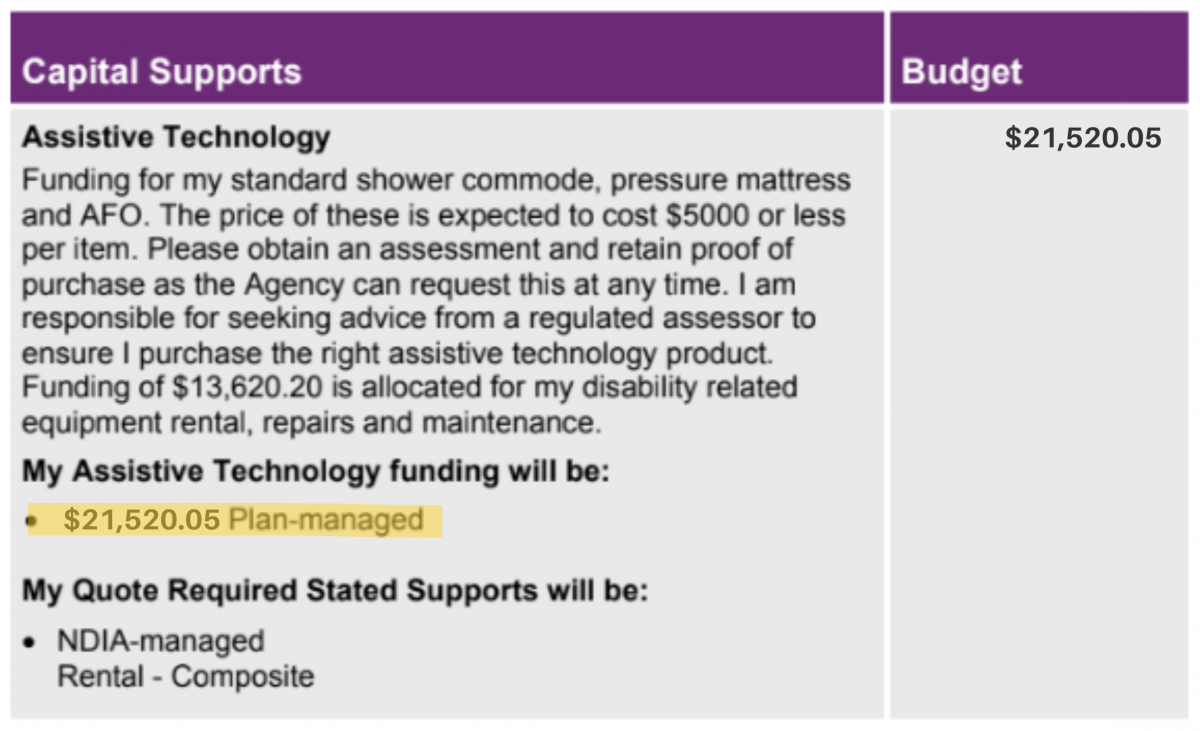
Your plan may be self, plan or NDIA managed. It is important to know that the management type can differ across your various budgets. Here is a guide on NDIS Self and Plan Management. 

If you are plan managed for any of your funding, this will be stated at the end of each budget in your NDIS plan, as highlighted below:


How to find the right Plan Manager?

Finding a Plan Manager who has experience with NDIS participants with physical disabilities ensures they will be confident in supporting you.

Here are some questions you may ask prospective plan managers:

  • What are common disabilities/conditions your participants have?
  • What budgets can I access assistive technology and consumables?
  • Please explain low, mid and high cost assistive technology?
  • How do I pay for short term accommodation?

If the Plan Manager can confidently answer the above questions, it is likely that they will be a good match for you.

You are welcome to contact Plan Hero for assistance in managing your NDIS plan.


How is Plan Management funded?

Funding for plan management is located in the Improved Life Choices section of the Capacity Building budget.


Get in Contact with Therapists

Therapists are also referred to as Allied Health Providers.

They are qualified health professionals who will seek to help you build your capacity and independence to reach your goals. It is important to find the right therapist for you.

Therapists you may benefit from seeing may include:

  • Occupational Therapy, for a functional capacity assessment and further assessment and intervention. Services may involve prescription of assistive technology/equipment.
  • Physiotherapy, to address the physical difficulties associated with your disability. Physios can also prescribe assistive technology/equipment.
  • Exercise Physiology, to address your health and well-being through exercise and movement, also potentially involving assistive technology/equipment prescription depending on your needs.

The MyCareSpace Connections Team can help you find the right therapist for you.

Get started

Consider whether the therapist provides services to a range of NDIS participants with varied conditions, or if their work is more refined to support individuals with your specific disability. You may find this information on their website or by speaking with the therapist directly before scheduling an assessment.

There are other therapists available that you may benefit from, depending on your needs related to your specific disability. This may include a Speech Pathologist, Orthotist, Dietician etc.


How is therapy funded?

Funding for therapists can be found in the Improved Daily Living section of your Capacity Building budget.


How to get in touch with a therapist?

You can contact a therapist directly for an assessment, or you can request your Support Coordinator to source therapist options for you.

If you would like further support, apply to become a MyCareSpace VIP Member for FREE where you will be linked in with local services to you.


How do I access Assistive Technology?

Understanding how assistive technology is funded is important in order to know how assistive technology can benefit you. Learn about Understanding Assistive Technology for an overview of the basics.

Knowledge of the Different Levels of NDIS Assistive Technology will help you approach purchasing assistive technology across the low, mid and high cost categories using your NDIS budget.

The level of cost will determine how you access the assistive technology you need. For low cost items below $1,500, this process can be completed with or without a therapist involved. Learn more about Purchasing Low Cost Assistive Technology and Consumables here.

Consult your therapist to explore mid and high cost assistive technology needs (over $1,500). You may also wish to familiarise yourself with assistive technology available by exploring the AT Australia Product Search Guide.


How do I get support for day to day living?

Think about the following:

  • Do you need someone to help you get out of bed in the morning? Assist with your morning routine? Showering and dressing?

  • Perhaps you might need assistance with cooking, cleaning or completing your laundry?

  • Or driving to your doctor appointments and completing shopping?

The NDIS can fund disability support workers to assist with all of the above (and more) depending on what you need. To identify your support needs, it is helpful to complete a Functional Capacity Assessment with an Occupational Therapist who will provide recommendations for support.

Alternatively, discuss your needs with your Support Coordinator, or you can access supports directly by yourself. 

How is it funded? Assistance with daily activities and with social and community participation is located in your Core Support budget.

The MyCareSpace Connections Team can help you find a support worker that has the right skills and experience with your disability, get in touch with our Connections team.

Get started


Accessibility needs - can I get around my home?

Your home may not meet your needs related to your disability. Consider if there are potential barriers in the following locations: 

  • Front access - Are there steps to the front door? Do I have a steep driveway? Where can I park my car? What is the condition of the footpath?

  • Internal access - Are there steps inside my home? how wide are my doorways? Can I manage hinge doors? What is the layout of my home - single or multi level? Is my bedroom far from the bathroom?

  • Bathroom - Is there a step into my shower? Is my shower head fixed or hand held? How high is my toilet? Does the space allow for use of assistive technology I may have or need? Is there also space for one or two support workers if needed?

You must also consider your kitchen, living/dining areas, laundry and any additional points of access into the home.

If your home doesn’t meet your needs related to your physical disability, the NDIS offers different options, including:

  • Minor Home Modifications, involving non-structural changes to increase the functionality of the space.

  • Complex Home Modifications, involving big changes to a room or various areas of your home. The Home Modifications Explained page by the NDIA provides further detail.

  • Specialist Disability Accommodation, referred to as SDA, offers various accessible housing designed for people with extreme functional impairment or very high support needs. The Specialist Disability Accommodation Explained page by the NDIA provides further detail.

You can refer to an Occupational Therapist who can assess your needs for minor or complex home modifications, or for SDA. Before proceeding with any assessment, enquire about the Occupational Therapist’s experience with providing these services. Find an Occupational Therapist with capacity to see you:

Get started


Ongoing support for my physical disability

When you gained access to the NDIS, you had to prove that your disability is permanent and life-long. Your NDIS supports must support you across the span of your life, throughout all of your life stages. Engaging with client-focussed, quality-driven and caring service providers will make all the difference in your experience with navigating the NDIS.


The MyCareSpace Team can help you find the supports you need

MyCareSpace offers a concierge service that connects you directly with local providers who have availability and can meet your needs.

Get started


MyCareSpace resources may be shared provided they are credited to MyCareSpace with backlinks to the original resource.

Resource Author: Bianca S. | NDIS Expert   Last Updated: 11 March 2026
NDIS

In this one hour webinar, CEO Nicole Gamerov will deep dive into autism assessments with expert guest speaker, Dr. Fiona Aldridge.

Fiona is a clinical psychologist with an interest in developmental disability and the assessment of neurodevelopmental conditions. She has particular experience in the assessment, diagnosis and management of autism and intellectual disabilities. Her research into autism assessment and support has been published in international journals and she has presented at international conferences.

In addition, Fiona is committed to supporting and educating new clinicians to ensure high-quality, evidence-based assessments are available to those who need them. Fiona is the Manager of Aspect’s Assessment service.

Fiona will help you understand some important elements of autism assessments, such as:

  • What is an autism assessment?
  • Who can do autism assessments?
  • What do you require for NDIS access?
  • What is the cost of an autism assessment?
  • Where can I find appointments for autism assessments?

Watch this free webinar

Watch webinar now

MyCareSpace resources may be shared provided they are credited to MyCareSpace with backlinks to the original resource.

Resource Author: Bianca S. | NDIS Expert   Last Updated: 11 March 2026
NDIS

The MyCareSpace Connections Team (compliments of the gorgeous Helen) spent some time collecting organisations across Australia that offer Autism Assessments. These are correct at the time of publishing. Feel free to give us feedback or tell us about other options by emailing our team.

ACT


NSW


NT


QLD


SA


TAS


VIC


WA


MyCareSpace resources may be shared provided they are credited to MyCareSpace with backlinks to the original resource.

Resource Author: Bianca S. | NDIS Expert   Last Updated: 11 March 2026
NDIS

In some remote and rural areas Aboriginal Community Controlled Health Organisations (ACCHO) provide disability support services for Aboriginal and Torres Strait Islander people and these organisations operate networks of more than 300 clinics across Australia.

You don’t have to be on an NDIS plan to go to an ACCHO for help and many of the affiliated clinics can help with all aspects of your life from housing to justice and advocacy.

To find out more, email: [email protected] 

NSW

  • Albury Wodonga Aboriginal Health Service - Albury-Wodonga
  • Armajun Health Service Aboriginal Corporation - Inverell
  • Awabakal LTD - Lake Macquarie, Port Stephens and Hunter Valley regions, Newcastle
  • Biripi Aboriginal Corporation Medical Centre - Taree
  • Bulgarr Ngaru Medical Aboriginal Corporation - Armidale Regional
  • Coonamble Aboriginal Health Service Limited - Coonamble
  • Durri Aboriginal Corporation Medical Service - Kempsey
  • Galambila Aboriginal Corporation - Coffs Harbour
  • Katungul Aboriginal Corporation Regional Health and Community Services - Eden to Batemans Bay
  • Pius X Aboriginal Corporation- Moree             
  • Tamworth Aboriginal Medical Service Inc - Tamworth
  • Tharawal Aboriginal Corporation - Airds
  • Walhallow Aboriginal Corporation - Tamworth Regional
  • Yerin Aboriginal Health Services Limited - Wyong

NT

  • Danila Dilba Biluru Butji Binnilutlum Health Service Aboriginal Corporation - Darwin

QLD

  • Aboriginal and Torres Strait Islander Community Health Service Mackay Ltd - Mackay   
  • Apunipima Cape York Health - Cape York
  • Bidgerdii Aboriginal and Torres Strait Islander Corp - Rockhampton 
  • Carbal Aboriginal and Islander Health Service Ltd -  Toowoomba
  • Cherbourg Regional Aboriginal & Islander Community Controlled Health Service (CRAICCHS) - Cherbourg and Kingaroy  
  • Galangoor Duwulami Aboriginal and Torres Strait Islander Corporation (Primary Health Care Service) - Hervey Bay
  • Gladstone Regional Aboriginal & Islander Community Controlled Health Service - Gladstone
  • Institute for Urban Indigenous Health Ltd - Windsor
  • Mulungu Aboriginal Corporation Primary Health Care Service - Mareeba 
  • Townsville Aboriginal and Torres Strait Islander (TAIHS) - Townsville         
  • Wuchopperen Health Service - Cairns

SA

  • Nunkuwarrin Yunti of South Australia Incorporated - Adelaide
  • Nunyara Aboriginal Health Service Inc - Whyalla
  • Pangula Mannamurna Aboriginal Corporation - Mount Gambier
  • Port Lincoln Aboriginal Health Service - Port Lincoln
  • Tullawon Health Service - Yalata
  • South Coast Women's Health and Welfare Aboriginal Corporation - Whyalla   
  • Yadu Health Aboriginal Corporation - Ceduna    

TAS

  • Tasmanian Aboriginal Centre - Hobart  

VIC

  • Ballarat and District Aboriginal Co-operative Limited - Ballarat   
  • Bendigo & District Aboriginal Co-operative - Bendigo     
  • Dhauward-Wurrung Portland and District Aboriginal Elderly Citizens Inc - Portland 
  • Gunditjmara Aboriginal Co-operative Limited - Warrnambool
  • Ramahyuck District Aboriginal Corporation - Sale
  • Rumbalara Aboriginal Co-operative Limited - Shepparton
  • Victorian Aboriginal Health Service - Yarra (Melbourne)
  • Wathaurong Aboriginal Co-operative - Geelong

WA

  • Derbarl Yerrigan Health Service Aboriginal Corporation - Medina
  • Moorditj Koort Aboriginal Health - Perth

MyCareSpace resources may be shared provided they are credited to MyCareSpace with backlinks to the original resource.

Resource Author: Bianca S. | NDIS Expert   Last Updated: 29 April 2026
NDIS

With the number of CALD participants increasing by 288% since 2018 to over 42,000 individuals, we reached out to Jeovic Community Care (QLD), specialists in providing CALD support, and self-identified 'Trust Brokers', to answer some big questions about who the CALD community are and how service providers can better deliver supports to this historically under-supported and under-resourced demographic.

Here is what they had to say...

What is CALD support?

Let's start by defining what we mean by a CALD participant:

In a 2019 outline, the NDIS defined Culturally and Linguistically Diverse (CALD) NDIS participants as "those who were either not born in Australia, New Zealand, the United Kingdom, Ireland, the United States of America, Canada, or South Africa, and/or where the primary language spoken at home is not English". 

Given this definition, CALD support is:

The support provided to a participant who is from a non-English speaking background in a way that ensures that freedom, choice, and control as well as their cultural background is respected in the provision of NDIS support to the participant.

How do I access/ask for CALD Support?

Any participant who is from a non-English speaking background who has a funding package with the NDIS can access or ask for CALD support.

There are a few ways to access CALD support as listed below:

  1. From a NDIS provider who provides CALD supports
     
  2. Using a Translating and Interpreting Service to request for support from an NDIS provider if you require information to be translated
     
  3. Request culturally competent staff to provide support - this means staff with targeted language skills and cultural knowledge of your heritage

How do I know when someone needs CALD support, and why is it important?

Any participant from a Culturally and Linguistically Diverse background will require CALD support.

This is because they have a right to access services that meet their needs just like every other participant, but to do this they will require a little more support as the NDIS is really set up to cater for English speaking participants from a culturally Anglosaxin background.

Providing CALD support also means CALD participants are supported for:

  1. better participation in training and employment,
  2. social inclusion, and
  3. access to goods, services, facilities, and advocacy to safeguard their rights and help them participate in their community!

Are disability services delivered in the same way for CALD participants?

The short answer is No.

CALD support is the support that embraces the cultural competence of the support workers and a service that is culturally appropriate for the individual.

This means demonstrating cultural competence, expressed by the provision and delivery of services that are equally accessible to all and actively non-discriminatory.

To do this requires:

  • An awareness of values, beliefs and prejudices which impact the way we view others
     
  • Sensitivity and awareness of the diverse cultural beliefs and practices of others
     
  • Knowledge and understanding about a person’s specific culture and experiences
     
  • Knowledge and skills of processes for working with persons with disabilities from different cultures, including cross-cultural communication

Overall, this means the support must be typically designed and delivered to meet the needs, aspirations, and individual choices of the participant according to their cultural and linguistic needs. 

Who can provide CALD support?

CALD support can be provided by any NDIS service provider who does the following:

  1. Provides culturally diverse staff who are competent to work across cultures
  2. Provides staff with targeted language skills and cultural knowledge
  3. Provides staff who are competent in culturally responsive practices to the service provision in the CALD community

The service provider must also be committed to developing standards and resources that include culturally responsive practices in their service provision.

Service providers should be able to provide interpreting services to all clients who require interpreting services, as well as train their staff on the use of interpreters.

How do you become a CALD provider?

Develop a 'trust brokering' strategy and consulting with a specific CALD community will go a long way in building trust with the community

  • Developing standards and resources that include culturally responsive practices in providing service.
  • Being able to understand the specific needs of the individual client using accredited interpreters where required to ensure the choice and control of the individual is understood and followed in developing a care plan for the client.
  • Being prepared to undertake targeted communication and engagement with the CALD community

Develop a cultural diversity strategy

  • This involves prioritising and planning for CALD disability service clients the same way as mainstream clients.
  • The outcome of this equitable framework would be the same level of access for CALD and mainstream clients.

Demonstrate cultural competency approaches and training

  • Understanding the diversity of values and beliefs across cultures will allow organisations and service providers to respond more appropriately to the needs of individuals with disability and their families.
  • Marketing to reach CALD clients should depict that the services provided is suitable to meet their needs and culturally appropriate in providing service to the CALD community.

Integrate appropriate language provisions

  • Language support services for CALD people with disability are needed to ensure the effective communication of important information and delivery of quality and suitable services.
  • Appropriate language can be provided through easily accessible, inexpensive, qualified translation services.
  • The use of TIS (Telephone Interpreting Services), which include access to a large catalogue of languages and dialects and is available 24 hours a day, 7 days per week will also be a great way to engage CALD clients.

Get comfortable with cultural brokering

  • Cultural brokering is defined by Jezewski and Sotnik as “bridging, linking or mediating between groups of different cultural backgrounds” to reduce possibilities of conflict, misinterpretation or enhance knowledge exchange, to bring about change.
  • Cultural brokerage helps to reduce inequality and improve access and outcomes for CALD people with disability.
  • Cultural brokerage should be driven by the community giving the community an opportunity to be experts in their own lives.

Co-design a CALD service policy with CALD people

  • This ensures that services provided to CALD clients are culturally appropriate and relevant.

What makes a good CALD provider?

A good CALD service provider is a provider that:

  1. respects the choice of the participant and
  2. demonstrates this by ensuring that in care planning for the participant, they can express their choice and control for the type of service they require.

This will ensure that the participant receives quality care.

A participant should expect to be supported in a way that validates who they are as individuals and should receive support that also validates their cultural heritage.


Jeovic Community Care

About Jeovic Community Services

Jeovic Community Services provides support services in Brisbane and the surrounding areas.

They specialise in providing CALD support, acting as 'trust brokers' in ensuring that CALD participants receive the tailored support they need. 

With an awareness of values, beliefs and cultural beliefs, the Jeovic team use their knowledge and skills to ensure that CALD participants feel understood and supported.

If you would like to learn more about their services, please reach out to Jeovic Community Services.

Are you are looking for CALD supports outside of QLD?

As a national platform, the MyCareSpace connections team can connect you with CALD supports in any state.

Please contact us today by phone 1300 2888 93 or make a support request online.


Sources

  1. Barriers and exclusions: The support needs of newly arrived refugees with a disability - Refugee Council of Australia
  2. Settlement-Services-International1.pdf (dss.gov.au)
  3. Culturally and Linguistically Diverse report | NDIS
  4. NDIS CALD Profile: Greater Brisbane (communities.qld.gov.au)
  5. AMPARO-report-for-CALD-NDIS-hr-003.pdf : The NDIS and Culturally and Linguistically Diverse Communities: Aiming high for equitable access in Queensland
  6. NDIS-CALD-Report-FINAL-2017.pdf (anglicaresa.com.au)

MyCareSpace resources may be shared provided they are credited to MyCareSpace with backlinks to the original resource.

Resource Author: Bianca S. | NDIS Expert   Last Updated: 11 March 2026
NDIS

Find NDIS ServicesMYCARESPACE CAN HELP YOU FIND MENTAL HEALTH SUPPORTS IN YOUR AREA

Our experienced Customer Connections team will connect you with support workers, allied health professionals and other providers that have experience with mental health and psychosocial disabilities. 

HELP ME FIND SUPPORTS
NDIS Mythbusters on mental health/psychosocial disability funding

The NDIS has provided clarification on these frequently asked questions about NDIS mental health funding:

1. I have used my 10 sessions of psychology under my Medicare funded mental health care plan, I can access the NDIS to top up my mental health care plan.
False. The NDIS does not fund therapy to address symptoms, we fund ongoing functional support for day-to-day living.

Treatment supports are not most appropriately funded by the NDIS.

NDIS does not require that you access a mental health care plan and is not able to top up funding if you have such a plan.

If the only support you require is treatment, it is likely you will not be eligible for the NDIS (because you do not require NDIS support with everyday activities).

2. My family member has recently begun to experience severe mental health issues. It is best for me to access the NDIS individualised support (an NDIS plan) early to prevent these issues from becoming lifelong.
False. As agreed between Commonwealth, State and Territory governments, early intervention services for people experiencing mental health issues are generally provided by mainstream services outside the NDIS.

3. If I am not eligible for individualised NDIS support (an NDIS plan) the NDIS will not assist me any further.
False. If you do not meet the access requirements for the NDIS, we will link you to an LAC who can help connect you to local community and mainstream supports. 
Contact the NDIS by phone: 1800 800 110 Email: [email protected] or NDIS Website

4. If a person experiences “good days” the NDIA determine they do not have substantially reduced capacity.
False. The NDIA looks at the person’s ability to function in the periods between acute episodes, not at any given point in time.

It is irrelevant whether a person applies to the NDIS when they are acutely unwell or feeling particularly well.

5. A person who has not worked for 20 years because of their mental health condition must have substantially reduced capacity.
False. The NDIA looks at day-to-day functioning and considers what people can do as well as what they cannot do within the six life skill areas.

Not being able to work because of a mental health condition does not, in isolation, demonstrate substantially reduced capacity in one of the life skill areas.

6. My ability to do day-to-day activities is substantially reduced in comparison to what it was before my mental health concerns began, so I should meet the NDIS access requirements.
False. Substantially reduced functional capacity does not involve a comparison with levels of functional capacity previously enjoyed.

It is a comparison with a person in the community who has not experienced similar impairment.

7. Only a psychiatrist can provide the best evidence of a person’s functional capacity.
False. Psychiatrists can provide evidence of functional capacity however, appropriately qualified mental health professionals such as mental health nurses can also provide evidence.

Depending on the nature of the doctor/patient relationship a psychiatrist may be well positioned to provide evidence of functional capacity.

The NDIA will consider the qualification of the person giving evidence and the relationship they have with you.

8. The NDIA will make clinical judgments about appropriate treatment/interventions for an individual

False. The treating clinician will decide on appropriate treatment and/or interventions for an individual.

The NDIA requires evidence that provides a history of treatment and the rationale relating to any decisions made by the clinician not to pursue a known treatment/intervention option.

9. The NDIA requires personal and intrusive information relating to trauma and abuse to demonstrate permanence of impairment.
False. The NDIA does not require specific information identifying a trigger for a mental health condition and is respectful of a person’s right to privacy.

There is no need to share private information relating to trauma and/or abuse with NDIA staff.

10. The NDIA will not accept a person has a likely permanent impairment unless they have had years of treatment/intervention.

False. The treating clinician confirms how much treatment/intervention is required for an individual before an impairment can be considered permanent.

The NDIA requests that clinicians provide clinical rationale to support that an impairment is likely to remain across a person’s lifetime (especially where there are any unusual circumstances).

11. If a person’s impairment caused by their mental health condition is accepted as likely to be permanent then they will meet the NDIS disability requirements for individualised support.
False. Likely permanence of impairment alone is not enough to meet the NDIS disability requirements.

Other factors are also considered which include that the impairment resulted in a substantial reduction in everyday functioning. For more details refer to Snapshot 4.

12. If a person has been diagnosed with Schizophrenia, which they have lived with for a number of years, they will automatically meet the NDIS access criteria?
False. No specific mental health diagnosis will automatically meet or not meet the NDIS access criteria.

Access decisions are made on individual circumstances and not specifically centred on the diagnosis, rather the impact that this mental health condition has on a person’s daily life.

13. If a person has co-existing drug/alcohol dependency they will not be eligible for the NDIS?
False. If you are seeking to access the NDIS with a psychosocial disability, the NDIA needs to know that the impairment is because of a mental health condition.

If that is the case, a person can meet the NDIS access requirements, regardless of any co-existing dependency issue(s).

A potential participant may be accessing, or planning to access treatment, for co-existing substance dependency at the time of access and throughout any ongoing relationship with the NDIS.

14. The NDIA does not recognise psychosis as a mental health condition.
False. Psychotic disorders include a range of diagnostic categories, some of which may be brief in nature. People who experience psychosis may be eligible for individualised NDIS support if they meet the access requirements.

15. I have an episodic condition therefore I cannot access the NDIS
False. Many NDIS participants experience episodic conditions resulting in disability. An episodic condition is not a barrier to accessing the NDIS.

16. I need to provide information about my ‘worst days’
False. The NDIA needs to know how the impairment/s from your mental health issues impact your day-to-day functioning.

If your mental health issues are episodic, the NDIA will need to know about how you function between episodes (not on particularly good or bad days).

17. To meet the NDIS access requirements I need to prove I’ve exhausted all treatment options
False. There is no requirement that all known treatments have to be completed.

The NDIA needs to know what treatments/interventions have been explored – ones that you have tried and ones that you and your clinician have decided not to try – and why the impairment will remain even when treatment continues.

18. The NDIS will replace Community Mental Health Services
False. The NDIS will not replace community-based support or medical/clinical care for people living with mental health conditions

The NDIS can provide support to increase independence, be part of your community, and participate in work.

Find NDIS ServicesMYCARESPACE CAN HELP YOU FIND MENTAL HEALTH SUPPORTS IN YOUR AREA

Our experienced Customer Connections team will connect you with support workers, allied health professionals and other providers that have experience with mental health and psychosocial disabilities. 

HELP ME FIND SUPPORTS

MyCareSpace resources may be shared provided they are credited to MyCareSpace with backlinks to the original resource.

Subscribe to NDIS Eligibility & Access

Our Preferred NDIS Plan Manager

Plan Hero Plan Management is our preferred NDIS Plan Manager because they are independent and specialist Plan Managers who have both lived experience and expert NDIS knowledge. Plan Management is all they do!

Plan Hero helps you keep your funding organised and on track within each funding period, so you don’t overspend or leave funds unused. They make sure providers are paid on time and help you stay on top of your budget. Their team is easy to reach, with clear, direct communication and no waiting on hold (ever).

Plan Hero gives you the support you need to use your NDIS funding with confidence.