Home / Using your NDIS Funds

Using your NDIS Funds

Resource Author: Bianca S. | NDIS Expert   Last Updated: 11 March 2026
NDIS

Major changes are now in effect which change how NDIS funds will be made available in NDIS plans. 

Categories of NDIS funding will be split into instalments over the life of the NDIS plan, with a specified amount made available in "Funding Periods".

Currently the funding period for all supports is 12 months. Now that the PACE system has been updated, the NDIS is expected to change this to shorter periods.

These changes, introduced under Section 33 of the NDIS Act, will affect HOW and WHEN Participants can access their NDIS plan funding budgets.

The NDIS CEO has advised us that this change will be rolled out gradually and Participants will not be impacted until they receive a new or reassessed plan following discussion with them to understand their circumstances.

What are these NDIS changes and who do they affect?

These changes will affect how and when Participants can access their plan budgets. 

Instead of receiving the full budget upfront (and it being available for 12 months), Participants will now have their funding released in smaller instalments over the duration of their plan, called Funding Periods.

These changes will be applied to new NDIS plans and to current Participants' NDIS plans when they are reassessed.

What are Funding Periods in the NDIS?

Funding Periods break the availability of your NDIS funds into instalments. A funding period is the time that part of a your funding is available for, and how long it needs to last.

Participants can spend up to the amount of funding available in that time.

NOTE: Currently, funding periods are 12 months and these changes will be rolled out gradually after discussion with Participants, reducing the funding periods for some parts of your plan.

How often you receive an instalment depends on the type of support. The 3 main Funding Periods will be:

  1. Quarterly (every 3 months): funding for most supports will be released quarterly.
  2. Monthly: Home and Living supports like Supported Independent Living (SIL) will be usually released monthly
  3. Up front: Funding for supports like Assistive Technology or Home Modifications will be released up front to pay for the item. They will typically have a funding period of 12 (months).

Funding periods won’t change theTOTAL AMOUNT of funding in your NDIS plan, they only change WHEN you can access their funds.

For example:
Your new 1 year NDIS plan includeds $48,000 for Assistance with Daily Life. You want to use this to pay for a support worker. 

You will have $12,000 available when your NDIS plan starts and then an additional $12,000 each quarter until the NDIS plan period ends. Any unspent funding will be carried forward and made available in addition to the next instalment. 

When does a Funding Period start?

The Funding Period starts when your NDIS plan starts. It is not linked to a calendar month.

For example:
If your NDIS plan starts on 27 March, this will be the start of your Funding Period. If you have quarterly funding, the next instalment you receive for a support will be 27 June.

What happens if you don't spend your funds in the funding period?

Unused NDIS funds rollover into the next period - they will keep adding up and will be available for the duration of your plan.

But any unused funding at the end of your plan will not be carried over into your next NDIS plan.

For example:
You have $24,000 of funding for Occupational Therapy and Speech Therapy ($12,000 for each) in your 1 year NDIS plan. The Funding Period is quarterly.

When your NDIS plan starts, you have a therapy total of $6,000 available each period (every 3 months). You are unable to find a speech therapist for the first 3 months, so the next Funding Period you have $9,000 available ($6,000 + unused funds of $3,000)

Where can I see the dates of my Funding Periods?

You will be able to see the Funding Periods in your NDIS portal as part of your NDIS PACE plan.

Your endorsed Plan Manager (if you have one) and your endorsed Support Coordinator (if you have one) will also be able to see all of these breakdowns in your NDIS plan.

Each support in your plan will now include the number of funding periods (e.g. 4 or 12) it has. It will specify the dates and amounts of the upcoming funding periods.

It's important that you share this with the Providers you engage as this information will need to be in their service agreements.

Other NDIS providers CANNOT see them.

Claiming for Supports with Funding Periods

When must I claim for my supports?

Claims should match the funding period - in other words, you claim for services delivered in the same period.

If a support spans two periods, it may require two separate claims or split invoices so that you can claim over the 2 periods.

The funded amount is made available from the start of each Funding Period so that you can pay your invoices during the funding period.

For example:
Your new NDIS plan starts on 27 March. You engage a support worker from 17 - 31 March.

You will need to claim 2 invoices: one for support delivered 17-27 March and one for support delivered 28-31 March.

What happens if I run out of funds?

Each funding period you will have the amount of funding allocated + any rollover funds (any left over funding from the previous funding period).

If you 'spend' more than this total amount, you will need to pay the overspent amount out of pocket

For example:
You have $12,000 of therapy funding in your plan.

This amount is released quarterly because you have a quarterly funding period, so you will have $3,000 available for therapy each quarter.

If your therapy costs $3,500 in a quarter, you will need to pay $500 out of pocket in that quarter.

YOU WILL NOT BE ABLE TO CLAIM IT FROM THE NEXT QUARTER (there was some wiggle room initially, but now this is very strict)

NOTE: If you spend more than this in even one funding period, your funding will not last for the duration of your NDIS plan. 

Ask for a reassessment if you need to change the frequency of funding periods or the amount of funding.

Can I 'borrow' from future Funding Periods?

No. You can only spend the amount you receive in a Funding Period + any rollover funds (funding not spent) from previous periods.

In Summary

  1. Only new NDIS plans will include funding in instalments.
  2. If you don't spend the whole instalment during its funding period, it is added (rolled over) to the next Funding Period.
  3. Unspent funds are not rolled over to your next plan.
  4. Ask for a reassessment if you need to change the frequency of funding periods or the amount of funding.
  5. You can see the Funding Periods in your portal and so can your Plan Manager and Support Coordinator. No other Providers can see them.
  6. These changes will be rolled out gradually after discussions with Participants

Sense Check

If you feel like this announcement came out of nowhere, quite frankly you are right. There has been very little information shared by the NDIA about it. The NDIA had to announce the changes because, according to Disability Intermediaries Australia they were working to update PACE all weekend (16-18 May 2025) so that it now shows funding periods. You may have noticed funding periods of 12 (months) which reflects the current setup of 1 year NDIS plans. 

There has been no planning for Providers who will need to update their service agreements and data collection fields. It doesn't make sense to implement quarterly funding periods immediately, but the NDIS does have the habit of doing unexpected things. 

We are watching and waiting.

Important things you need to do

  1. Update your Service Agreements
    Make sure that your service agreements/schedule of supports talk about funding periods. You will need to specify this moving forward.
    For example, don't commit to spending more during a funding period than you are receiving for the period.
     
  2. Do you have funding for Assessments?
    Make sure you have funding for this upfront.
     
  3. Stay Informed
    As we find out more, we will be updating this resource. We will let you know more as we find out more.
     
  4. Contact the NDIA
    If you need help, be sure to contact the NDIA.
    If you are having trouble matching your support needs to the Funding Period, contact the NDIA and ask for a plan reassessment.

New Words

  • Funding Amounts – This is the total dollar value of a Participants NDIS plan.
     
  • Funding Components – These are the categories that make the Participants plan, like Core Supports, Capacity Building, and Capital (assistive technology, home modifications, etc.).
     
  • Funding Periods – This is the new part. Funding periods control how much of a Participants plan budget you be accessed at a given time over the course of the plan. So if a participant is approved for a 2 year plan, they might only be able to use 3 months’ worth of that funding at a time. This restricts when a NDIS Participant can spend their NDIS Plan Funds.
     
  • Section 33 - Section 33 of the NDIS Act sets out the core requirements of a participant’s plan. Changes to the NDIS Act in 2024 introduced funding periods. The main concept of funding periods is a way for the NDIA to set how often participants can access part of their funding, across the length of their plan, in simple terms its to limit the ability for Participants and their service providers to draw down on big chunks of their funding in very quickly.

Sources:


MyCareSpace resources may be shared provided they are credited to MyCareSpace with backlinks to the original resource.

Resource Author: Bianca S. | NDIS Expert   Last Updated: 11 March 2026
NDIS

New Framework Planning is part of a major overhaul of how NDIS plans are created and reviewed. The Australian Government is introducing a new planning framework to make the process:

  • Fairer and more consistent across participants
  • Easier to understand
  • More focused on real support needs, not just diagnoses
  • More transparent about how funding amounts are decided

You can read the official information here: New framework for NDIS planning – Department of Health and Aged Care

Where This Change Comes From

The changes are a response to the Independent Review of the NDIS, which found that many participants, families and carers experienced:

  • Inconsistent decisions from one planner or plan to another
  • Confusion about how budgets were worked out
  • Planning that felt too focused on diagnosis instead of daily life and goals

Amendments to the NDIS Act passed in 2024 created the legal foundation for this new planning approach.

What New Framework Planning Will Look Like

The new framework restructures planning into clearer steps. Based on current information, it involves four key stages:

1. Preparing for a Support Needs Assessment

Before anything else, the NDIA will contact you to help you get ready. This may include:

  • Explaining what the new assessment will involve
  • Letting you know what information you might want to bring or think about
  • Helping you understand how the process fits with your current plan

2. Support Needs Assessment

Instead of heavily relying on diagnosis reports alone, there will be a structured assessment focused on:

  • Your daily life and routines
  • How your disability affects what you can and cannot do
  • Your goals, preferences and priorities
  • The supports you already have and where the gaps are

This assessment is designed to capture real support needs in a consistent way, rather than being driven mainly by medical reports.

3. Building the Plan

The information from your support needs assessment will be used to:

  • Determine your overall funding amount
  • Shape which types of supports are included in your plan
  • Provide a clear explanation of how your budget was calculated

The aim is that you can see the link between your assessed needs and the funding you receive, instead of the process feeling like a “black box.”

4. Using Your Plan

Once your new framework plan is approved, you will still be able to:

  • Have a plan implementation discussion to go through how it works
  • Choose and organise providers using your budget
  • Use NDIS support categories to purchase reasonable and necessary supports

The day-to-day use of the plan will feel familiar, but the way it was built should be more transparent.

When These Changes Are Happening

The start of New Framework Planning has been delayed. The current intention is to begin rolling it out from mid 2026, and it will be introduced gradually, not all at once.

Until you move to the new framework, your current planning process, plan reviews and rights remain the same.

Key Things to Know Right Now

  • The new framework is not yet in full operation.
  • Detailed rules and procedures are still being developed and consulted on with the disability community.
  • Participants will move to the new planning approach in stages over time, not on a single date.

What This Change Is Trying to Fix

People told the government that the current planning process can:

  • Feel inconsistent and unfair
  • Be confusing in how budgets are decided
  • Require repeated evidence and reports

New Framework Planning is meant to:

  • Focus more on practical, everyday support needs
  • Make funding decisions more consistent
  • Provide clearer explanations of how budgets are worked out
  • Reduce unnecessary paperwork where possible


MyCareSpace resources may be shared provided they are credited to MyCareSpace with backlinks to the original resource.

Resource Author: Bianca S. | NDIS Expert   Last Updated: 11 March 2026
NDIS

Is online therapy as good as face to face therapy? Here's what the research says.

Families ask us this every week. And it’s a completely reasonable question — if you’ve never tried online therapy before, it can be hard to imagine how it works, let alone whether it’s as effective as being in a room with a therapist.

The reassuring news is this: There is strong research showing that online therapy is just as effective as face-to-face therapy — and sometimes more effective.

The NDIS treats telehealth as a valid form of therapeutic support, as long as it is appropriate and good value for money. 

OT, speech and psychology all fall under NDIS therapeutic supports.

Below is a clear explanation of the research, what it means in real life, and why many families see great results.

Psychology: Anxiety, Depression, Emotional Regulation

What the research says

Large studies comparing online CBT (Cognitive Behaviour Therapy) with in-person CBT consistently show no difference in improvement. People get better — their anxiety reduces, their mood lifts — whether they are sitting in a therapy room or joining from home.

Some studies have found people are more likely to complete therapy online, probably because sessions feel less intimidating and are easier to attend.

Key findings come from:

What this means for you

If your child, teenager or you yourself find clinic rooms overwhelming, online psychology can be a calmer and more accessible way to get the same benefits.

Speech Pathology: Speech, Language and AAC

What the research says

Online speech therapy produces outcomes equal to in-person therapy for articulation, language development and stuttering.

Research on AAC (communication devices) shows children often make even better progress online because the speech pathologist can see exactly how the device is used in daily home routines.

Key findings come from:

What this means for you

Speech therapy is highly visual and interactive. Online platforms allow therapists to use digital activities, animations and games that help keep children engaged — often for longer than in the clinic.

For AAC users, online sessions make it easy for therapists and parents to collaborate around the device in real time.

Occupational Therapy (OT): Daily Living, Regulation, Fine Motor Skills

What the research says

Studies show that online OT produces comparable improvements in fine motor skills, handwriting, sensory regulation and everyday routines.

Parent coaching — a major part of paediatric OT — is often even more effective online because therapists can see the real home environment and guide strategies directly in context.

Key findings come from:

  • Camden & Silva (2021) — Telehealth OT is effective, especially for coaching parents.
  • Little et al. (2018) — Online OT improves regulation and participation for autistic children.
  • Suh et al. (2021) — Telehealth OT achieves outcomes equivalent to in-person OT for children with developmental delays.

What this means for you

OT is about building skills for real life — dressing, emotional regulation, morning routines, fine-motor tasks. Online OT works beautifully because it takes place where those routines actually happen.

So, Is Online Therapy “Just As Good”?

Based on dozens of high-quality studies across psychology, speech and OT:

  • Online therapy is as effective as face-to-face
  • Sometimes it is more effective (especially for anxiety, AAC and parent coaching)
  • The NDIS recognises telehealth as legitimate therapeutic support
  • Families often find online therapy easier, less stressful and more sustainable

It’s not a second-best option — it’s a different way of connecting that often fits real life better.

MyCareSpace resources may be shared provided they are credited to MyCareSpace with backlinks to the original resource.

Resource Author: Bianca S. | NDIS Expert   Last Updated: 11 March 2026
NDIS

At MyCareSpace, we talk to families, participants and Support Coordinators every single day who are desperate to start therapy but can’t get past the waitlists.

You’ve probably seen the same thing week after week — clinics booked out for months, or the only available appointment being an hour’s drive away. So we’re having more conversations than ever about online therapy and why it’s often the quickest, most practical and effective way to begin.

And here’s the truth many people don’t realise:

Online therapy isn’t a lesser version of therapy — when it’s delivered well, it’s real therapy, using the same evidence-based approaches, just delivered in a way that fits real life.

Let’s walk through exactly how online Occupational Therapy (OT), Speech Pathology, and Psychology work in the real world, and why so many families are seeing great outcomes.

Why online therapy works — and works well

Families tell us this all the time:

“We just needed to start — online therapy made that possible.”

There are four big reasons online therapy is becoming a game-changer:

1. You can start sooner

Online availability is usually broader — therapists aren’t limited by room bookings or travel time. This means:

  • shorter waitlists
  • more flexible session times
  • easier access in regional/remote areas

2. It fits real life

No travel, no siblings in the car, no parking stress. Sessions go ahead even if your child is having a wobbly morning or can’t manage an outing.

3. The evidence is strong

Online therapy (telehealth) is recognised by the NDIS as a valid mode of delivering therapeutic supports and providers can claim these sessions when they follow the telehealth rules in the NDIS Pricing Arrangements. :contentReference[oaicite:0]{index=0}

There is also extensive research showing outcomes are comparable to in-person therapy for OT, speech and psychology, especially when sessions are consistent and families are involved in practice between sessions.

4. Real environment = real progress

Therapists can see your home setup, routines and challenges — which often leads to more practical strategies that stick because they are designed for the environment you actually live in.

How Online Occupational Therapy Actually Looks in Real Life

Online OT works best when it’s connected to what’s happening in your actual home and daily routines — something clinic therapy can struggle to fully see.

A real example we see often: Morning routine battles

A parent jumps onto Zoom feeling defeated: “We can’t get teeth brushed without a meltdown.”

The OT might say: “Can you show me the bathroom? Just tilt the camera a little.”

They watch how the child moves in the space, how they reach, where things are placed. Then the OT helps the parent make real-time adjustments:

  • moving the toothbrush station lower so the child can access it more easily
  • adding a visual sequence on the wall to break the task into steps
  • trialling a timer to reduce the sense of “rush” and overwhelm

The parent tries it while the OT is still on the call, getting coached step by step and adjusting until it feels manageable.

Sensory regulation using what you already have

Your OT might ask you to grab everyday items:

  • pillows or a doona for deep-pressure input
  • a chair or couch for heavy work activities
  • toys, balls or household objects to use in movement breaks

You might hear things like: “Let’s try some body squeezes with the doona and then check in — does your body feel calmer, the same, or more buzzy?”

Parents often tell us they end up with a whole toolkit of sensory strategies they can use any time, not just during therapy.

Fine-motor practice that actually works

With simple household items — pegs, paper, Blu Tack, LEGO — OTs guide activities like:

  • strengthening pencil grip
  • improving hand control for cutting, writing or feeding
  • building bilateral coordination (using both hands together)

The OT watches posture, fatigue and regulation cues through the camera, just like they would in a clinic room, but in the real-life context where your child actually writes, eats and plays.

How Online Speech Pathology Works — More Interactive Than You Think

Speech therapy online isn’t a therapist talking at your child. It’s full of shared screens, mirrors, articulation tools and interactive activities designed to keep them engaged.

Clear articulation practice

A speech pathologist might say: “Can you move your camera a little closer? Great — now let’s look at your /s/ sound together.”

They model mouth movements slowly, use close-up camera angles and visual cues (like diagrams or animations) so your child can copy the sound accurately. Many children love the virtual reward systems and interactive games used online.

Building language through play

Speechies often screen-share:

  • storybooks
  • sequencing tasks
  • vocabulary games
  • digital whiteboards for drawing and labelling

They pause to model phrases, expand sentences (“Dog run” becomes “The big dog is running fast”), and check understanding — just as they would in a therapy room, but often with more visual support.

AAC support is often better online

For participants using communication devices (AAC), online therapy can be especially powerful.

The therapist might say: “Show me the home screen… great. Let’s model the word ‘go’ before we start the game.”

They watch how the device is set up at home, how the child or adult reaches it, and how the family uses it. Parents learn how to model words in everyday routines, which is where the biggest AAC progress usually happens.

Social communication support

For autistic participants, online sessions can feel safer and less intense. There’s less pressure around eye contact and unfamiliar environments.

Speech pathologists use shared games and activities to practise:

  • turn-taking and conversation skills
  • interpreting facial expressions and tone of voice
  • repairing breakdowns in communication
  • safe and appropriate digital communication (texts, chats, social platforms)

How Online Psychology Works — Safe, Comfortable and Surprisingly Personal

We see teenagers, adults and parents all tell us they feel more relaxed in online sessions, especially when they can join from their own room or a familiar space.

Rapport building happens naturally

Psychologists often begin with a simple grounding exercise: “Before we talk, just notice your feet on the floor. Take a slow breath. You’re safe here.”

Then they move into CBT, ACT, or emotional regulation strategies using:

  • shared worksheets and mood trackers
  • drawing or diagram tools on screen
  • goal-setting templates
  • thought records and coping plans

Real-life example: Managing anxiety

A teenager logs in from their bedroom desk. The psychologist helps them:

  • identify what anxiety feels like in their body
  • notice thinking patterns that fuel the anxiety
  • practise a grounding or breathing technique using items on their desk
  • create a “cope card” that stays pinned above the desk as a visual reminder

Because everything happens in their real environment, strategies are easier to remember and use outside therapy.

Parent involvement when helpful

For children and younger teens, parents might join the first 5–10 minutes of a session to:

  • share updates
  • set priorities for the session
  • learn how to support the strategies at home

This shared approach is one of the reasons online psychology works so well for many families.

Is online therapy covered by the NDIS?

Yes.

OT, speech and psychology are all recognised Therapeutic Supports within the NDIS and can be funded under capacity building budgets when they are reasonable and necessary. :contentReference[oaicite:1]{index=1}

Telehealth sessions can be claimed if:

  • therapy is appropriate for your needs
  • it’s agreed in your service agreement
  • the provider follows the NDIS claiming rules for telehealth and price limits

The NDIS Pricing Arrangements set out how telehealth can be claimed and make it clear that telehealth is a valid way to deliver therapy as long as it’s the same standard of care you’d receive in person. :contentReference[oaicite:2]{index=2}

Why families choose online therapy through MyCareSpace

MyCareSpace is built to make finding therapy easy, fast and personalised. We speak to parents and participants every day who feel stuck — and online therapy is often the key to getting things moving.

With us, you get:

  • Verified, trusted therapists who are experienced in online delivery
  • Matches based on your needs, not just a generic provider list
  • Faster start times — often within days, not months
  • Options Australia-wide, including regional and remote areas
  • Providers who know how to make online therapy engaging, warm and practical

Find Therapy

We’ve seen thousands of families successfully begin therapy online — sometimes transitioning to in-person later once momentum is built. Often, the hardest part is simply getting started.

Thinking about online therapy? Here’s what to do next

  1. Tell us what therapy you’re looking for
    OT, speech, psychology — and anything specific, like experience with autism, behaviour support, or early childhood.
     
  2. We secure a place with the best online therapists for you
    We look at your goals, location, preferences and availability to send you options that make sense.
     
  3. Book your first appointment
    Most families know within a session or two whether online therapy feels right for them.
     
  4. Start making progress sooner
    No long drives, no waiting rooms, no months on a list — just real therapy that fits your life.

Find Therapy

You can feel confident choosing online therapy

Online therapy isn’t a second-best option. For many families, it’s the most flexible, most accessible and most sustainable way to begin therapy.

And at MyCareSpace, we’re here to connect you with therapists who know how to make online sessions practical, warm, engaging and evidence-based.

If you’re ready to get started, we’re ready to help you find the right online OT, speech or psychology support for your situation.

Find Therapy


MyCareSpace resources may be shared provided they are credited to MyCareSpace with backlinks to the original resource.

Resource Author: Bianca S. | NDIS Expert   Last Updated: 11 March 2026
NDIS

In this comprehensive resource we answer all your questions about the NDIS Woker screening process. We will be answering:

What is the NDIS Worker Screening Check?

The NDIS Worker Screening Check assesses whether a person who works (or wants to work) with people with disability are safe to do so.

Each state has its own worker screening unit.

The screening aims to determine whether individuals will pose a risk to people with disability, and will clear or exclude certain people from working in various roles depending on the outcome.

Flowchart to show you how it works.

Here is how it works:

  1. Workers must first complete an online application to your state or territory NDIS Worker Screening Unit (WSU) and nominate an employer or self-managed participant.
  2. Payment is made to the WSU, and then WSU will confirm the identity of the worker and send the application to the NDIS Worker Screening Database (NWSD).
  3. This triggers an automatic email notification to the employer/provider and prompts them to log onto NWSD to verify the worker.
  4. The worker will then be identified on the database and they will become ‘linked’ to the provider.
  5. WSU then takes a risk assessment of the worker based on the information they have provided.
  6. WSU will then determine whether the worker can be cleared or excluded, and the result is sent through to the NWSD.
  7. Finally, another email is generated to the linked employer advising them of the result, and employment or continuation of employment can then commence.

Where to get an NDIS Worker Screening Check?

Remember that the NDIS worker screening check is a NATIONAL check so you only need to apply in one state.

Apply using the links below:

Who needs an NDIS Worker Screening Check?

It is mandatory for all workers of registered providers engaged in risk assessed roles to obtain a clearance from the screening process.

You need to have an NDIS worker screening check if you’re:  

  • an employee, volunteer, contractor or student who works for:
    • a registered provider in a risk-assessed role or key personnel role
    • a registered provider who has decided that all their workers need to have an NDIS worker screening check
    • an unregistered provider who has decided that their workers need to have an NDIS worker screening check

OR 

  • a self-employed worker or a sole trader who:
    • is a registered provider
    • supports a self-managed NDIS participant who has decided that all their engaged workers need to have an NDIS worker screening check. 

What is classed as a 'risk assessed' role?

Providers are responsible for determining whether a worker is in a risk assessed role or not.

According to the NDIS Commission, a risk assessed role is:

  • A key personnel role of a person or entity (for example, a CEO or Board Member)
  • A role for which the normal duties include the direct delivery of specified supports or specified services to a person with disability
  • A role for which the normal duties are likely to require more than incidental contact with people with disability, including:
    • physically touching a person with disability; or
    • building a rapport with a person with disability as an integral and ordinary part of the performance of normal duties; or
    • having contact with multiple people with disability as part of the direct delivery of a specialist disability support or service, or in a specialist disability accommodation setting.

IMPORTANT: This means that EVERY person who works for a registered provider and has ANY direct or indirect contact with people with disability MUST receive a clearance under the new check.

What about workers not engaged in risk assessed roles?

For workers not engaged in a risk assessed role, it is not mandatory to receive a check. For example the person doing the admin tasks in the back office of a disability organisation.

Note: Providers can still require workers to get a worker screening check even if they are not in a risk assessed role.

Do unregistered providers need a worker screening check?

As mentioned above, unregistered providers are able to decide whether they want their workers to undergo the screening process. Although the screening process is not mandatory for workers at unregistered providers, providers can still request risk assessed workers to demonstrate their clearance or an acceptable check, as well as requesting that the worker apply for one.

What about self-managed participants?

Self-managed participants are also able to decide whether they will require screening checks for their workers. It is, however, encouraged that self-managed participants do so, and worth noting that participants can change their minds and require screening checks of their workers at any time.

Are there any exceptions?

Exceptions include secondary students who are participating in formal work experience placements with registered NDIS providers.

These individuals do not require a screening clearance or acceptable check to engage in a risk assessed role. This is valid assuming the student is directly supervised by a worker who holds a current NDIS clearance.

How to check the expiry date of workers linked to an organisation?

If you are an employer for the purposes of NDIS worker screening, you can check the clearance status of any linked workers ,including the expiry, by searching for the worker in the NDIS Worker Screening Database (NWSD).

Access the NDIS Worker Screening Database (NWSD)

How to renew an NDIS worker screening check

Your NDIS worker screening check is valid for up to 5 years from date of issue, unless it’s cancelled or revoked.

You should renew your worker screening check up to 90 days before the expiry date of your current check.

To renew your worker screening check, submit a renewal application to the worker screening unit in the state or territory that you currently live. 

NOTE: You only need to renew your check in one state since its a national verificaiton.

Employers will get a notification when a worker linked to them has a worker screening check that’s expiring.

Can a worker work while waiting for their first NDIS Worker Screening Check or renewal?

Some states or territories do allow a worker to work for a registered provider while they’re waiting for the outcome of their application, with some conditions. This is called 'working on application'. 

For renewals, a worker with a valid worker screening check could continue working in risk-assessed roles while their renewal application is being processed so long as their registration state allows it. NOTE: you would need to be renewing in the same state as your initial registration.

Check if a state allows 'Working on applicaiton'

What is the cost of an NDIS Worker Screening Check?

Each state or territory sets their own fees for the Worker Screening Check. This fee will be paid by the worker or the employer, not by the NDIS Commission.

The cost ranges from $107-$156, depending. on the state.

Please see below for a chart outlining the fees - last updated 27/11/2025:

State

Fees
(paid)

Fees (volunteer)

QLD

$156.00

Free

NSW

$107.00

Free

VIC

$135.50

Free

TAS

$133.70

$22.92

ACT

$157.00

Free

SA

$140.00

Free

WA

$145.00

$11.00

FACT SHEETS

Worker Screening Facts Sheets


WORKER SCREENING QUICK REFERENCE GUIDES

For registered providers

         NDIS Worker Screening Check verification request

         Link a worker

         Find a worker and check their clearance status

         Unlink a worker

For unregistered providers

         Request access to the NDIS Worker Screening Database (NWSD)

         Manage NWSD access and email preferences

         NDIS Worker Screening verification request

         Find a worker and check their clearance status

         Link a worker

         Unlink a worker

For self-managed participants

         Request access to the NDIS Worker Screening Database (NWSD)

         Manage NWSD access and email preferences

         NDIS Worker Screening verification request

         Find a worker and check their clearance status

         Link a worker

         Unlink a worker

MyCareSpace resources may be shared provided they are credited to MyCareSpace with backlinks to the original resource.

Resource Author: Bianca S. | NDIS Expert   Last Updated: 11 March 2026
NDIS

The NDIS has released NDIS Pricing Arrangements And Price Limits version 1.1 on October 14th, 2025.

The latest guide (version 1.1) comes into effect from 24 November 2025 and this resource breaks down the key updates that are important for you to know.

Key Changes

Price limit reduction for Art and Music therapies:

If you access Art or Music Therapy, there’s been a price drop.
The hourly rate has changed from $193.99 down to $156.16.

What this means for you:

  • Plan Managed or Agency Managed: Your provider must adjust their rates to the new limit. Your NDIS Provider can’t charge above the NDIS price cap.
  • Self-Managed: You can still choose to pay more than the price guide rate, but your funding won’t stretch as far.

The NDIA reviews these prices regularly so its important to ensure you are aware of the latest price per the price guide.

No more COVID Add-ons

All COVID-related extras like PPE reimbursements, cleaning claims, or temporary supports are now completely removed from the price guide.
Everything goes back to standard NDIS pricing and claiming.

Changes to Low Cost Assistive Technology

The item “Low Cost AT – Capacity Building” has been removed from the Improved Daily Living budget.

You can still buy low cost assistive technology, which must be under $1,500. Things like small devices or daily living tools,  will now usually come from your Core Supports – Consumables budget.

Regional & Remote Area Updates

The Modified Monash Model (MMM) — the tool that defines remote and very remote areas, has been updated.
A few places are no longer considered remote:

  • Green Head and Leeman (WA)
  • Blythdale, Euthulla, Orange Hill, and Horrocks (QLD)

Tip: If you’re in one of these towns, your provider will now charge the standard rate (lower) instead of a remote one.

Greater Clarity in Updates

Some parts of the guide have been changed, in so far as:

  • Clearer information explaining that plan-managed participants hire their own providers (your Plan Manager just handles the payments).
  • Updated wording for Community and social activities to align with official NDIS lists.
  • Consistent references and links to “Supports that are NDIS supports"

When Do These Changes Start?

These abovementioned changes take effect from 24 November 2025.

Other pricing changes included in the new price guide took effect on 1 July 2025. These include Adjustments of line-item descriptions to align with the NDIS support list exclusions.

For example where supports are designed to help you take part in community, social, and recreational activitiesonly the disability-related costs can be claimed.

Below is a summary of the three affected support items and what’s not covered under each of them.

1. Community, Social and Recreational Activities (04_210_0125_6_1)

This support helps you engage in community, social, or recreational activities by funding the extra disability-related supports people need to take part independently.

2. Innovative Community Participation (09_008_0116_6_3)

This support is for participants with extraordinary or complex needs. It funds tailored, innovative activities that build skills and confidence to take part in the community.

3. Community Participation Activities (09_011_0125_6_3)

This support helps cover disability-related costs for community activities that build skills and independence, for example, camps, classes, or mentoring programs with a capacity-building focus.

NDIS Exclusions – What’s Not Covered 

The following costs cannot be claimed under the NDIS (effective 1 July 2025):

  • Fees or payments for outside school hours care, including before/after school, student-free days, vacation care, and holiday programs.
  • Costs associated with recreational sports and activities, such as membership fees, venue hire, uniforms, or footwear.
  • Standard recreational equipment or tools (non-modified), including toys, balls, or racquets.
  • General health, fitness, social, or recreational activity costs or services (e.g. standard gym memberships or classes).
  • Membership and entry fees to recreational clubs or use of standard gym equipment.


Quick Summary

Here’s the short version:

  • Art & Music Therapy rates are now $156.16/hour
  • COVID add-ons are gone
  • One Low-Cost AT item has been removed
  • Some towns are no longer remote
  • Line-item descriptions change for Community, Social, and Recreational Activities, Innovative Community Participation, Community Participation Activities

If your services are delivered on or after 24 November 2025, your provider should automatically update their pricing to reflect these changes.

Source: NDIS Pricing Arrangements and Price Limits 2025-26 v1.1 

MyCareSpace resources may be shared provided they are credited to MyCareSpace with backlinks to the original resource.

Resource Author: Bianca S. | NDIS Expert   Last Updated: 11 March 2026
NDIS

Art and Music Therapy Review Completed

After almost a year of campaigning against an hourly pay cut, music and art therapists have learned of the new maximum rate they can charge NDIS participants.

There was huge outcry last year when the government announced it would slash the rate of music and art therapy to just $68/hour (from the standard $193.99), and an independent Review of Art and Music Therapies was undertaken, led by leading health economist Dr Stephen Duckett AM. 

The 'Duckett Review' Recommendations

Art and music therapies will continue to be available to NDIS Participants where there is evidence it will provide beneficial outcomes.  

The 'Duckett Review' made 19 recommendations relating to art and music supports for NDIS participants, of which 15 are to be executed by the National Disability Insurance Agency.

The NDIA has agreed to support all the recommendations directed to it.  

The review’s key recommendations include:

  • Art and music therapies should be delivered by a qualified therapist who is registered with a recognised professional association.
     
  • A new national price limit of $156.16 per hour for Art and Music Therapy, in line with the maximum payment rate for counselling.
     
  • Making a clearer distinction between art and music as a therapeutic support, and art and music as a non-therapeutic support. E.g. Art therapy delivered by a registered Art Therapist vs a group activity which involves art as a social tool.
     
  • NDIS funding cannot directly be used to cover the cost of art and music activities. For example, music lessons or art lessons. Funding can however be used for a Support Worker to help a Partcipant attend these lessons.
     
  • The NDIS Evidence Advisory Committee* will assess the evidence base of music and art therapy interventions for specific groups of people in its 2025-26 work plan.
     
  • The NDIS Evidence Advisory Committee* will develop a process for making decisions where there is a poorly developed evidence base

New Rate of $156.16

​From November 24th 2025 Music and Art Therapists will be able to bill National Disability Insurance Scheme (NDIS) Participants at a rate of $156.16. This is the same rate as Counsellors.

To charge this amount, therapists need to be qualified by a recognised professional association.

Dr Duckett said "“Where an artist or musician does not have the relevant qualifications to register with one of the professional therapy associations, they should not be charging the therapy price limit.”"

Before November 24th, Participants can keep accessing the supports outlined in their plans. 

What do people have to say?

The Australian, New Zealand and Asian Creative Arts Therapies Association welcomed the review's recognition of art therapy as an "evidence-based therapeutic support", but expressed "deep concern" over the new payment cap.

CEO Kate Dempsey said it failed to "reflect the complexity, qualifications, and standards involved … particularly when psychology is funded at $232.99 and occupational therapy at $193.99".

"Art therapy is a distinct allied health profession requiring a master's qualification and rigorous clinical training," she said.

"While we respect all therapeutic disciplines, art therapy involves specialised techniques, materials, and clinical approaches that warrant appropriate recognition in pricing."


*Evidence Advisory Committee was set up to provide evidence-based decisions about whether supports are effective or not, and whether they should be available through the NDIS.

Sources:


MyCareSpace resources may be shared provided they are credited to MyCareSpace with backlinks to the original resource.

Resource Author: Bianca S. | NDIS Expert   Last Updated: 11 March 2026
NDIS

When Should I Share My NDIS Plan With My Plan Manager, Support Coordinator and NDIS Providers?

Navigating the NDIS can feel overwhelming at times, especially when it comes to knowing who should see your NDIS plan.

Sharing your plan with the right people ensures you’re getting the right supports, staying within your funding, and avoiding unexpected problems down the track.

Where can I access my NDIS plan?

You can access your NDIS plan through the myplace participant portal (on myGov). The NDIS will also email you a PDF copy of your plan when it’s approved, and you can request a paper copy to be mailed to you. These are the versions you’ll usually share with your Plan Manager, Support Coordinator or NDIS Providers.

Who has access to your NDIS plan?

Your NDIS plan belongs to you. Only the people you choose to share it with will be able to see the details. The NDIS does not automatically give your NDIS Providers or supports full access – it’s your decision who sees what.

Why should I share my plan with my Plan Manager?

We asked our friends at Plan Hero Plan Management to share their thoughts with us.

Plan Hero is responsible for paying Participant invoices and making sure supports are funded correctly. If they don’t know what supports are included in an NDIS plan, they could accidentally approve claims that aren’t allowed.

They also play an important role in budgeting. Plan Hero Plan Management helps Participants track their spending across their funding periods and helps them stay within budget so they don’t run out of funds early.

See: How to share your NDIS plan with Plan Hero and why it’s important

Here's a real life example from Plan Hero Plan Management

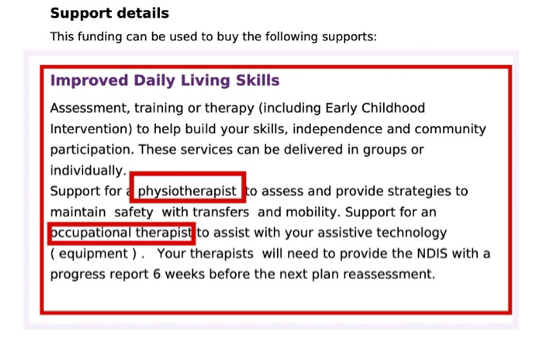
Let’s say you have Capacity Building funding for Occupational Therapy and Physiotherapy in your NEW NDIS plan. See sample below.

You spend your funding on Psychology because you had it in your last plan and haven't realised it hasn't been funded again.

If your Plan Manager doesn't have a copy of your NEW NDIS plan, they might pay it because you have Capacity Building funding or you had funding for it before.

You are not funded for Psychology you are not spending in "accordance with your NDIS plan". 

The NDIS can:

  • Change your plan to Agency Managed or
  • Ask you to pay it back

 Sharing your plan upfront avoids this stress.

IMPORTANT: When you get a new NDIS Plan, you must send a new copy to your Plan Manager, even if they have your old plan.

Stated Supports

See this sample of a real NDIS plan that has STATED therapy supports. This means you can ONLY spend your funding on these services.


Sample NDIS plan showing stated capacity building

Why should I share my plan with my Support Coordinator?

Your Support Coordinator helps you, understand what you can spend your funding on, connect with the right NDIS Providers and get the most out of your NDIS plan.

If they can see your funding periods and the specific supports listed, they can recommend services that are covered and help you make sure your spending is in line with your funding periods.

Like Plan Managers, Support Coordinators can help you plan your spending across the life of your plan. This means they can help you avoid engaging in services you can’t afford or committing to services that aren’t covered.

Why should I share my plan with your NDIS Providers?

Not every provider needs to see your whole plan. But sharing the relevant parts (like your stated goals or the funding category their service comes from) helps them understand:

  • what you are funded for
  • how much you can spend on their services.
  • the length of your funding periods
  • what outcomes they should be working towards with you

This also protects you from a common issue: starting services you can’t actually pay for.

If your NDIS Providers know your budget and the categories they fall under, they won’t deliver supports you don’t have funding for.

TIP: Only share your plan with NDIS Providers you have already decided to engage.

How do you share your NDIS plan?

  • Email a copy or screenshot of the relevant section.
  • Print and provide a paper copy
  • Upload to a secure portal if your Plan Manager or provider offers one
  • Share in myPlace portal (easiest) - See: How to share my plan in myPlace Portal

IMPORTANT: you’re in control. You can share only the sections that are relevant.

What are funding periods? 

Your entire NDIS plan usually runs for 12 months, but each type of funding may have its own shorter funding period. For example: monthly, quarterly or customised funding periods.  

Why sharing matters

By sharing your plan with your Plan Manager, Support Coordinator and NDIS Providers, you’re protecting yourself from overspending or paying for the wrong supports.

You’re also making it easier for the people around you to do their job well – to help you achieve your goals with confidence.

MyCareSpace resources may be shared provided they are credited to MyCareSpace with backlinks to the original resource.

Resource Author: Bianca S. | NDIS Expert   Last Updated: 11 March 2026
NDIS

Psychology vs Positive Behaviour Support (PBS)

If you’re navigating the NDIS, it can sometimes feel confusing to understand the difference between Psychology and Positive Behaviour Support (PBS).

Both are important therapeutic supports (therapies). They can sometimes overlap, but they serve different purposes.

At MyCareSpace, we know that understanding these services clearly helps you make the best choices for yourself or the person you care for.

Psychology: Understanding the Mind and Emotions

Psychology is a clinical health profession.

Psychologists are trained amongst other things to:

  • assess,
  • diagnose and
  • treat mental health conditions.
     

They can support people with a range of mental health concerns including:

  • Anxiety, depression and trauma
  • Emotional regulation (managing feelings like anger, sadness or stress)
  • Learning difficulties or developmental challenges
  • Coping strategies for daily life and relationships
     

Psychologists use evidence-based therapies like:

  • Cognitive Behaviour Therapy (CBT),
  • Acceptance and Commitment Therapy (ACT),
  • or Counselling.

The focus of Psychology can often be on improving mental health and emotional wellbeing.

Positive Behaviour Support (PBS): Reducing Behaviours of Concern

Positive Behaviour Support, on the other hand, is a specialised NDIS-funded service designed to understand and reduce behaviours of concern.

Behaviours of concern might include:

  • aggression,
  • self-harm,
  • running away (absconding),
  • or damaging property.

These behaviours are often a form of communication – a way for someone to express distress, frustration or unmet needs when words are not enough.

PBS practitioners develop a Behaviour Support Plan, which usually covers topics such as:

  • Assessing the reasons behind a behaviour
  • Identifying triggers in the person’s environment
  • Teaching new skills and safer ways to communicate needs
  • Supporting families, carers and support workers to respond consistently

PBS is strongly guided by the NDIS Commission and must follow strict guidelines, especially when restrictive practices (like physical restraint or medication to control behaviour) are being considered.

See our resource: What are Restrictive Practices in the NDIS

The focus of PBS is always on improving quality of life and supporting a persons' independence.

Do my NDIS Providers need to be NDIS registered to deliver PBS?

Behaviour Support Practitioners need to be registered as an individual with the NDIS Commission. They can be a sole provider or employed by an NDIS Provider.

A Practitioner may work for a Registered or Non-registered NDIS provider.

Only registered providers can implement restrictive practices. 

If there are no restrictive practices being implemented by the Provider, non-registered providers can be used (so long as their PBS Practitioner is registered).

Behaviour Support Practitioners must be:

  • supervised by another Behaviour Support Practitioner with a greater level of experience than them
  • provide evidence of their capabilities to the NDIS Commission via a Self Assessment.

NDIS Funding: When You May Have Psychology or PBS Included

The NDIS funds both Psychology and Positive Behaviour Support, but they appear in different parts of your plan and are claimed under different line items.

Psychology in the NDIS

You may have funding for Psychology if your NDIS plan goals include:

  • Improving your mental health
  • Building emotional regulation and coping strategies
  • Strengthening relationships or social participation
     

Psychology is usually funded under:

  • Improved Daily Living (Capacity Building) – Assessment, Recommendation, Therapy and/or Training (Item 15_043_0128_1_3)
  • Sometimes also claimed under Therapeutic Supports depending on the psychologist’s registration
     

Positive Behaviour Support in the NDIS

You may have funding for PBS if your NDIS plan mentions:

  • Behaviours of concern that affect safety or daily life
  • The need for a Behaviour Support Plan
  • Support for carers, families or workers to respond to behaviours consistently
     

PBS is usually funded under:

  • Behaviour Supports,  Specialist Behavioural Intervention Support (Item 11_022_0110_7_3) previously called “Improved Relationships” (Capacity Building)
  • Behaviour Support Plan development and ongoing monitoring fall under this category

Where They Overlap

It’s common for someone to have both a Psychologist and a PBS practitioner in their NDIS team.

For example:

  • A Psychologist might help a participant manage underlying anxiety.
  • A PBS practitioner might help the participant, their family, and support workers learn how to reduce behaviours triggered by that anxiety.

Together, they create a more holistic approach – addressing both the emotional wellbeing and the behavioural needs of the person.

Which Support Do You Need?

  • If your main goal is to: improve mental health, learn coping strategies, or work through trauma → Psychology is the right fit.
  • If your main goal is to: reduce behaviours of concern and develop a practical plan for carers and support workers → Positive Behaviour Support is needed.
  • Sometimes, you may benefit from both.
     

Both Psychology and PBS play crucial roles in the NDIS. Knowing the difference helps you request the right funding and find the right supports.

At MyCareSpace, we connect participants and carers with trusted Psychologists and PBS practitioners who understand the NDIS – making it easier for you to get the right help, sooner.

Find Positive Behaviour Support  Find Psychology

MyCareSpace resources may be shared provided they are credited to MyCareSpace with backlinks to the original resource.

Resource Author: Bianca S. | NDIS Expert   Last Updated: 11 March 2026
NDIS

Questions to Ask When Choosing a School for Your Autistic Child

Bring this list with you when you visit schools. Tick off the areas that feel right for your child, and make notes about how each school responds.

Download print version

1. Inclusion and Culture

  1. How does the school include children with disability in everyday classrooms and activities?
  2. What is the school’s attitude towards diversity and inclusion?
  3. Are there any examples of autistic students thriving here?

2. Support and Staffing

  1. Does the school have Learning & Support Teachers (LaST) or aides available?
  2. What specialist staff are on site (e.g. speech pathologists, OTs, psychologists)?
  3. What training do teachers and aides receive about autism and neurodiversity?

3. Individual Learning and Plans

  1. Will my child have an Individual Learning Plan (ILP)?
  2. How are learning goals set, and how often are they reviewed?
  3. How does the school track and share my child’s progress with me?

4. Environment and Sensory Needs

  1. Are there quiet spaces or calm rooms for when children feel overwhelmed?
  2. How does the school support sensory needs (lighting, noise, playground routines)?
  3. What adjustments can be made in classrooms (visual schedules, flexible seating, fidget tools)?

5. Communication with Families

  1. How will the school communicate with me (phone, email, meetings)?
  2. How quickly are concerns followed up?
  3. Is there a clear pathway for feedback or raising issues?

6. Peer and Social Support

  1. How does the school support my child to make friends and join activities?
  2. Are there social skills groups or peer mentoring programs?
  3. How do teachers manage bullying or exclusion?

7. Flexibility and Transition

  1. How does the school manage transition periods (new class, new teacher, moving between activities)?
  2. Is a staggered or gradual transition possible if my child needs it?
  3. How flexible are they with attendance or part-time starts?

8. Practical Details

  1. What’s the average class size?
  2. Are there autism or disability support units at the school?
  3. How does the school work with external providers (NDIS therapists, psychologists)?

Download print version

Read our related resource: ​How to Find a School That’s Right for My Autistic Child


MyCareSpace resources may be shared provided they are credited to MyCareSpace with backlinks to the original resource.

Subscribe to Using your NDIS Funds

Our Preferred NDIS Plan Manager

Plan Hero Plan Management is our preferred NDIS Plan Manager because they are independent and specialist Plan Managers who have both lived experience and expert NDIS knowledge. Plan Management is all they do!

Plan Hero helps you keep your funding organised and on track within each funding period, so you don’t overspend or leave funds unused. They make sure providers are paid on time and help you stay on top of your budget. Their team is easy to reach, with clear, direct communication and no waiting on hold (ever).

Plan Hero gives you the support you need to use your NDIS funding with confidence.