Home / Using your NDIS Funds

Using your NDIS Funds

Resource Author: Bianca S. | NDIS Expert   Last Updated: 11 March 2026
NDIS

Living with a disability, or caring for someone with a disability can be full of challenges in the NDIS.

It’s important to understand your rights, what self-advocacy means, and where to turn for support.

MyCareSpace is here to help you feel confident and informed every step of the way.

What Does Self-Advocacy Mean?

Self‑advocacy means speaking up for yourself in a way that’s clear, respectful, and informed.

It’s knowing what you need, expressing it, and taking part in decisions that affect your life.

The Independent Mental Health Advocacy model outlines a helpful six‑step process:

  1. Identify the issue
  2. Know your rights
  3. Identify your solutions
  4. Make a plan
  5. Enact the plan
  6. Review what happened

By learning this process, you can engage with the NDIS system more effectively, ensuring your voice is heard.

Your Rights under the NDIS

As an NDIS participant, you have the right to:

  • Access quality services
  • Make choices
  • Have control over your NDIS plan and service agreement
  • Choose the providers, supports and services that meet your needs

SSI’s Rights Path Project

Funded by the Dept of Social Services, SSI created a collection multilingual videos and guides (in Khmer, Punjabi, Urdu, Vietnamese, and English) to help you confidently share feedback and navigate your NDIS services.

SSI is a national not-for-profit organisation which has been providing dedicated human and social services across NSW, QLD and Victoria for the past 24 years.

Know Your Rights

In this informative video, you will learn the rights of NDIS participants in accessing supports and services.

Learn about your ability to:

  1. make choices regarding your NDIS plan,
  2. provide feedback, and
  3. resolve any issues with service providers.

The video highlights the importance of speaking up and how to access language support if needed.

Discover the confidential and safe process in place for feedback, ensuring your voice is heard in a fair and respectful manner.
 

Know your Rights - Print Version


How to Give Feedback

In this animated video, learn how NDIS participants can provide feedback on their supports or services.

You will learn the steps to:

  1. raise concerns with your service provider,
  2. seek advocacy support,
  3. make a formal complaint to the NDIS Commission.

This video will also help you:

  1. Understand your rights to quality care,
  2. the options available to resolve issues, and
  3. how to access language assistance when needed. 

How to give feedback - a step by step guide (print version)


Sources

MyCareSpace resources may be shared provided they are credited to MyCareSpace with backlinks to the original resource.
Resource Author: Bianca S. | NDIS Expert   Last Updated: 11 March 2026
NDIS

How to Find Physiotherapy Providers when I have funding in my NDIS plan

Physiotherapy is one of the most common supports NDIS participants look for—but it’s also one of the hardest services to find, because many physiotherapists don’t have capacity.

If you’re a participant or carer, knowing what physiotherapy is, how it can help, and where to look for the right funding in your NDIS plan can make the process far less stressful.

At MyCareSpace, we specialise in helping people find therapists who actually have availability and the right experience. Let’s break down what you need to know.

What is Physiotherapy?

Physiotherapy (often called “physio”) is a therapy focused on:

  • movement,
  • strength, and
  • function.

Physiotherapists use exercise programs, hands-on treatment, education, and equipment recommendations to help you:

  • move better,
  • reduce pain, and
  • build independence.

Unlike general exercise, physiotherapy is tailored to your disability and health needs. Every treatment plan is based on a professional assessment, and is designed to help you reach your NDIS goals.

What Skills Can Physiotherapists Work On?

Physiotherapists can support a wide range of skills, including:

  • Mobility and walking. For example improving gait, balance, or endurance.
  • Strength and coordination. For example  building muscle strength for daily activities like standing up from a chair, lifting, or playing sport.
  • Pain management. For example  using safe techniques to reduce chronic pain.
  • Respiratory and chest health. For example  helping people with conditions that affect breathing.
  • Postural support. For example  addressing spinal alignment or seating needs.
  • Exercise programs. For example creating safe and achievable exercise routines.

What Goals Can You Achieve With Physio?

Your goals will depend on your disability and your NDIS plan, but common outcomes include:

  • Increasing independence in moving around your home and community.
  • Reducing risk of falls and injuries.
  • Building strength and stamina to support participation in work, school, or sport.
  • Learning how to safely use mobility aids like walkers or wheelchairs.
  • Improving recovery after surgery or injury.
  • Enhancing confidence to engage in community or recreational activities.

Connect me with a Physiotherapist

Who Can Benefit from Physiotherapy?

Physiotherapy is useful across many disabilities and health conditions. Some examples include:

  • Neurological conditions. For example such as cerebral palsy, multiple sclerosis, Parkinson’s disease, or acquired brain injury.
  • Physical disabilities. For example like spinal cord injury or muscular dystrophy.
  • Developmental conditions. For example including autism or global developmental delay (often focusing on gross motor skills).
  • Age-related conditions. For example  such as arthritis, osteoporosis, or balance issues.
  • Chronic pain or fatigue conditions. For example  like fibromyalgia or post-polio syndrome.

Where Does Funding for Physio Come From in the NDIS?

Physiotherapy is funded under the Capacity Building category of your NDIS plan, usually under:

  • Improved Daily Living. This includes funding for therapy assessments, reports, and ongoing physiotherapy sessions.
  • Improved Health and Wellbeing. This includes funding that can sometimes be used for exercise-based physio programs.

If your physiotherapist recommends assistive technology (such as standing frames, specialised seating, or exercise equipment), this will usually require funding from the Capital Supports – Assistive Technology budget.

This funding usually also needs an OT or physio assessment and NDIS approval.

Important:

Not all NDIS plans automatically include physiotherapy.

If you believe physiotherapy will help you achieve your goals, make sure you raise this in your NDIS plan meeting or reassessment meeting and you will need to link it directly to your daily living or participation goals.

Reports or recommendations from therapists will be needed.

Connect me with a Physiotherapist

How to Find an NDIS Physiotherapist

Physiotherapists are in high demand, and many do not have immediate availability. You may also need a physio with specific experience—such as working with children, neurological conditions, or complex mobility issues.

This is where MyCareSpace makes the difference. We don’t just give you a long list of phone numbers to call. We actively connect you with physiotherapists who:

  1. Have current capacity to take on new clients.
  2. Understand your disability and goals.
  3. Can see you at home, in the community, or in a clinic.
  4. Are registered NDIS providers (if that’s a requirement for your plan).

Physiotherapy can be life-changing under the NDIS. It’s not just about exercise, it’s about building independence, reducing risks, and helping you achieve the goals that matter most to you.

Finding a physio with capacity, though, can feel overwhelming. That’s why MyCareSpace exists: to cut through the waitlists and connect you with the right physiotherapist who is available now.

Connect me with a Physiotherapist

MyCareSpace resources may be shared provided they are credited to MyCareSpace with backlinks to the original resource.
Resource Author: Bianca S. | NDIS Expert   Last Updated: 9 June 2026
NDIS

How to Find an Occupational Therapist in the NDIS

If you or someone you care for is living with disability, you may have heard about Occupational Therapy (OT) as part of NDIS supports.

But what exactly is Occupational Therapy, what does it help with, and how do you make sure you have the right funding in your NDIS plan?

At MyCareSpace, we connect NDIS Participants with the right supports every day. Here’s what you need to know about finding Occupational Therapy in the NDIS.

What is Occupational Therapy?

Occupational Therapy helps people build the skills they need for everyday life.

An “occupation” isn’t just about work, it means the activities that give our lives meaning and independence.

For one person, that may be showering or cooking. For another, it may be catching public transport, managing anxiety, or returning to a favourite hobby.

Occupational Therapist's assess your:

  1. abilities,
  2. environment,
  3. and goals,

And then provide:

  1. strategies,
  2. therapies,
  3. or equipment

to make daily activities easier and safer.

Find me a therapist today

What Skills Can Occupational Therapists Help You Develop?

Occupational Therapists work across a wide range of skill areas, including (with the fancy names):

  • Daily living skills. For example: dressing, eating, toileting, showering, or managing money.
     
  • Mobility and motor skills. For example: improving balance, coordination, and strength.
     
  • Cognitive and emotional skills. For example: planning, problem-solving, regulating emotions, or memory strategies.
     
  • Community participation. For example: using public transport, joining social activities, or volunteering.
     
  • Assistive technology and home modifications. For example: recommending equipment (like wheelchairs, shower chairs, or communication devices) or changes to your home to support independence.

What Goals Can You Achieve With Occupational Therapy?

With the right Occupational Therapy support, Participants often work toward goals such as:

  • Increasing independence at home and in the community.
     
  • Building confidence to try new activities or return to old ones.
     
  • Building independence which means reducing reliance on carers and developing self-management skills.
     
  • Supporting participation in school, work, or social groups.
     
  • Enhancing safety and reducing risk of falls or injuries.

Search for NDIS occupational therapists on MyCareSpace

IMPORTANT: Your Occupational Therapy goals must always link back to the goals in your NDIS plan.

This is how you ensure the support you pay for is considered reasonable and necessary by the NDIS.

What NDIS Funding can I use for Occupational Therapy Funding in my NDIS Plan?

Occupational Therapy is funded under CAPACITY BUILDING and can also be funded under the CAPITAL (assistive technology and housing)categories of an NDIS plan :

Capacity Building – Improved Daily Living

  • This is the most common category of funding that can be used to pay for Occupational Therapy in the NDIS.
  • It covers therapy sessions, assessments, and skill-building.

Capacity Building – Improved Health & Wellbeing or Social & Community Participation

  • This category is about helping participants build the knowledge, skills, and confidence to look after their health and live well.

1. Capacity Building – Improved Health & Wellbeing

Examples include:

  • Exercise Physiology or Personal Training. E.g. developing a tailored program to improve strength, balance, and fitness.

  • Dietitian support. E.g. learning how to meal plan, shop, and prepare healthy meals that suit personal needs.

  • Mental health support. E.g. sessions with a psychologist to build coping strategies, stress management skills, or emotional regulation.

  • Skill-building in daily routines. E.g. learning how to structure a morning routine that promotes better sleep and energy levels.

  • Programs for self-management. E.g. education on how to manage a chronic condition or disability to reduce reliance on crisis supports.

2. Capacity Building – Improved Social & Community Participation

This category helps participants develop the confidence, independence, and skills to join in community, social, and recreational activities.

Examples include:

  • Social skills groups. E.g. practising communication and building friendships in structured settings.
     
  • Support to access community activities. E.g. joining a local art class, gym, or music group with support to build independence over time.
     
  • Mentoring or coaching. E.g. building confidence, self-advocacy, and community engagement strategies.
     
  • Skill development courses. E.g. such as learning to use public transport, budgeting for social outings, or digital literacy for staying connected.
     
  • Volunteering or pre-employment programs. E.g. to build community contribution skills and confidence.

Capital Supports – Assistive Technology or Home Modifications

  • If your Occupational Therapy recommends equipment or changes to your home, the funding will usually come from Capital Supports.
  • This requires a report from the Occupational Therapist and approval from the NDIS.

Tip: Although almost all plans include funding for therapy, not all plans automatically include funding for Occupational Therapy.
Make sure you read the 'support details' part of your Improved Daily Living supports (see below).

Find me a therapist today
 

Examples of Occuptional Therapy Funding in your NDIS PACE plan

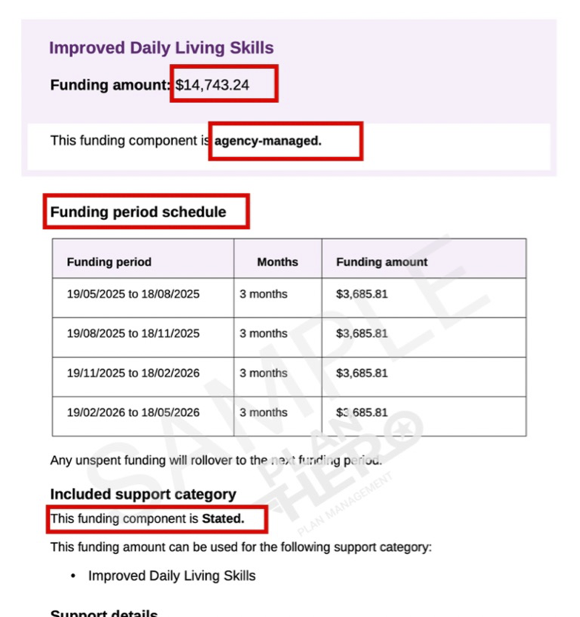
See an example of where you would find Occupational Therapy (OT) Funding in your NDIS plan under the Improved Daily Living Skills section of your plan.

Note in the example below:

  • Total funding Amount of $14,743.24
  • How this funding is managed (E.g. self, plan or agency) - in this example it is agency-managed
  • Your Funding Periods (how often and the amount of funding you receive during your plan period)

Example of Improved Daily Living therapy funding in your PACE plan

Stated therapy in your NDIS PACE plan

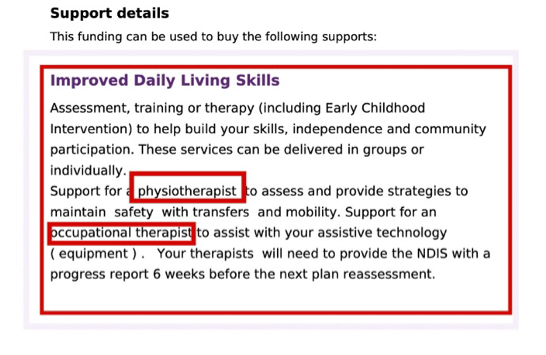
Support Details are provided in your NDIS plan that tell you what you can spend this type of funding on.

See below an example of stated therapy in an PACE plan. This means you can only spend your therapy funding on the stated therapies: physiotherapy and Occupational Therapy.


Example of stated therapy in a PACE plan

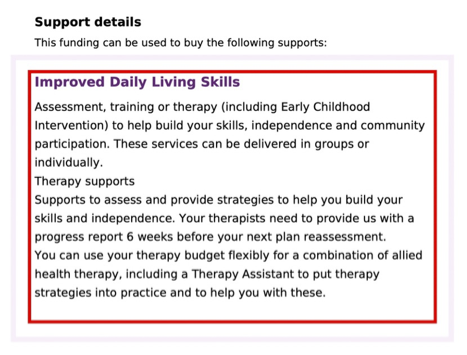
Therapy that is not stated in your NDIS PACE plan

See below an example of therapy funding that is not specified in an NDIS PACE plan. This means you can spend this funding on any type of therapy/

An example of therapy funding that is not specified

How to Find the Right Occupational Therapist for You

Finding an Occupational Therapist can be overwhelming, especially if you’re new to the NDIS.

Not all Occupational Therapist's specialise in the same areas—some may focus on children, while others specialise in neurological conditions, mental health, or home modifications.

There is also currently a shortage of Occupational Therapists in the NDIS, so you will need help in finding an Occupational Therapist who has capacity in your local area.

At MyCareSpace, we make it simple: we match you with Occupational Therapists who:

  1. have availability,
  2. hagve experience with your disability, and
  3. have an understanding of your funding category.

We also check practical things like whether they can see you at home, in the community, or via telehealth.

No one else in Australia can do this!.

Find me a therapist today
 

Occupational Therapy can open doors to greater independence and confidence. It’s about more than therapy—it’s about living the life you want, with the right supports in place.

If you’re not sure where to start, or if your plan covers Occupational Therapy, MyCareSpace can help you understand your funding, connect you with the an Occupational Therapy who has capacity for you today, and support you through the process.

Find me a therapist today

MyCareSpace resources may be shared provided they are credited to MyCareSpace with backlinks to the original resource.
Resource Author: Bianca S. | NDIS Expert   Last Updated: 11 March 2026
NDIS

It feels like Katy Perry dedicated this song to the NDIS!

NDIS Support Lists - What's in and what's out?

In October 2024, the NDIS made a big announcement about the supports it will and will not fund

Many people are still confused (or overwhelmed and worried) and scared, so we wanted to give you a quick summary of what it means for you.

Top 8 things you need to know when using the NDIS Support Lists

1. Purpose

The purpose of the NDIS Support Lists is to provide some clarification and to stop people from spending on items that SHOULD NOT be funded by the NDIS.

The list of allowable NDIS supports is not exhaustive, meaning it does not exclude items that are not specifically listed.

The purpose of the list is to clarify the TYPES OF SUPPORTS that fall under the OVERARCHING DESCRIPTION.

It is important for Participants to know that for something to be considered an NDIS support, it must:

  • fit WITHIN the overarching description provided in schedule 1 (however, it does not have to be specifically listed) and
  • must not be included in the non-allowable NDIS supports list.

2. Funding

The NDIS will typically fund a support if it meets ALL of the following criteria: 

  • it is for your impairments that meet the disability or early intervention requirements, or both 
  • it will help with your individual goals and aspirations 
  • it will help your social and/or economic participation 
  • it is value for money, which means that: 
  • the cost of the support is similar to or cheaper than alternative options that can provide you with the same outcome and/or 
  • purchasing the support is likely to reduce the costs of funding for other supports in the long term. 
  • it is effective and beneficial for you 
  • it helps to maintain your informal supports it is an NDIS support.

3. Support Lists

The NDIS released two NDIS Supports Lists showing what you can use your NDIS funding on:

What Supports are allowed NDIS supports?

NDIS supports refer to services, items, and equipment that can be funded by the NDIS.

These aim to help participants live independently, participate in community life, and improve their wellbeing.

They are grouped into 37 categories. 

The list of allowable NDIS supports does not exclude items that are not specifically listed.

The purpose of the list is to clarify the types of supports included in the general description.

What is NOT an NDIS support?

There are things the NDIS can’t fund or provide. They can’t fund services, items and equipment that are not NDIS supports. You also can’t spend your funding on things that aren’t NDIS supports. 

But...in some specific circumstances, the NDIS CAN fund supports that are not NDIS supports. They call these Replacement Supports. 

4. Replacement Supports

The NDIS released a Replacement Support List - this is a list of substitutions you can use if what you want to spent your funding on is NOT on the NDIS approved list.

5. Incorrect Spending

What happens if I spend my funds on items that are NOT NDIS Supports?

The new NDIS laws say that a participant or nominee can receive a debt if they spend NDIS funds:

  1. on a support that is not an “NDIS Support” for the person; or
  2. not spent “in accordance with” the person’s plan

The NDIS will not raise debts for disallowed supports under $1,500 within a 12-month transition period. 

This means that if a participant mistakenly uses NDIS funding for a support that is not allowed and the cost is under $1,500, the NDIA will not seek repayment. 

Participants will receive at least two warnings before any action is taken for these smaller purchases.

The new laws also allows the NDIA to:

  • change someone’s plan management style to Agency- or Plan-Managed (against their preference); and
  • reduce a person’s funding period. This is how often funding is released from a plan. For example, for a person who could previously access 12 months funding at once, the NDIA could change it to 6 months at a time.

The NDIA’s decision to vary a plan management style or funding period is reviewable.

6. Claims

Providers will need to make sure they are billing you for Approved NDIS Supports or you won't be able to pay their bills. More for Providers here.

7. Plan Managers

Plan Managers should help Participants by reviewing the type of services you are currently claiming and letting you know if any of the items are on the 'OUT" list.  If your Plan Manager is not helping you, talk to the team at Plan Hero Plan Management.

8. Transition Period

There is a transitional rule allowing participants to continue to access supports that are not NDIS supports for the duration of their existing plan if:

  • They were specifically identified as reasonable and necessary before 3 October 2024
  • The Administrative Appeals Tribunal has decided that the support should be funded as a reasonable and necessary support. 

NOTE: This rule does not apply to sexual services, alcohol or drugs. These supports are specified in the primary Act as non-NDIS supports.


More Information


MyCareSpace resources may be shared provided they are credited to MyCareSpace with backlinks to the original resource.
Resource Author: Bianca S. | NDIS Expert   Last Updated: 11 March 2026
NDIS

Section 34 of the NDIS Act establishes the criteria for what supports are considered "reasonable and necessary" for the NDIS to cover.

What does Reasonable and Necessary mean?

The NDIS funds a range of supports and services which may include education, employment, social participation, independence, living arrangements and health and wellbeing.

It funds supports that will help participants to:

  • pursue their goals, objectives and aspirations
  • increase their independence
  • increase community and workplace participation, and
  • develop their capacity to actively take part in the community.

Whether a support is deemed 'reasonable and necessary' for the NDIS to fund for a participant, takes into account any informal supports (family, community) as well as other formal supports (health, education).

Is it Reasonable and Necessary?

All NDIS supports need to meet all the reasonable and necessary criteria before they can be included in your NDIS.

If you can answer YES to these questions, the support is reasonable and necessary and likely to be funded if it helps meet your goals.

1. Will the support help you to reach the goals in your NDIS plan?
The support you buy must be linked to the support budgets and goals in your current NDIS plan and related to your disability. 

2. Is the support reasonably priced and good value?
The support should represent good value-for-money compared to other options. This means we need to consider the costs and benefits of the support, as well as the costs and benefits of alternative supports.Remember you can choose to pay less and get more support, or pay more for a higher quality support that meets your needs. 

3. Can you afford the support within your support budget?
Your NDIS funding needs to last for the length of your plan. Work out your budget early so you know what you can afford. This will help you to track your funding and make decisions about any changes to your supports during your plan. 

4. Will the support help you to connect with your community and improve the relationships you have with family and friends?
The support you buy should help you to participate in community activities with friends and other members of your community, by reducing the disability-related barriers that prevent you from participating in things such as social outings, recreation, work and study.

5. Is the support something that should be funded by the NDIS and not other government services?
In your NDIS plan the funded supports will not include support that is provided by other government services. For example, dental, health or hospital services, education, housing and public transport are all provided by other government services. 

6. Is the support safe? Is it likely to be beneficial?
The support you buy must be legal. It should not cause harm or put yourself or other people at risk.


What supports will NOT be funded by the NDIS?

The NDIS Act and the rules made under the NDIS Act also tell us which supports will not be funded by the NDIS. A support will not be funded if it:

  • is not related to the participant's disability
  • duplicates other supports already funded by a different mechanism through the NDIS
  • relates to day-to-day living costs that are not related to a participant's support needs, or
  • is likely to cause harm to the participant or pose a risk to others.

Will the NDIS fund it?

'Would we fund it' includes examples of commonly requested items that we find cause the most confusion.

For each item, the NDIS explains how they make reasonable and necessary decisions about them and provide an overview of whether or not we typically fund them. New items will be added to this resource as they are developed.

Read: Would we fund it?


Sources:

MyCareSpace resources may be shared provided they are credited to MyCareSpace with backlinks to the original resource.

Resource Author: Bianca S. | NDIS Expert   Last Updated: 11 March 2026
NDIS

Supports that are not NDIS funded

The NDIS 'Out' Supports List

The NDIS does not fund 15 categories of goods and services that fall outside its scope.

These include everyday living expenses, standard lifestyle costs, and supports that are the responsibility of government funding areas.

The NDIS document can be viewed, but we have created a summary for you below:

Will the NDIS pay for that?

Summary of categories the NDIS won't fund

  • Day-to-Day Living Costs: Rent, mortgage, bills, furniture, whitegoods, and utilities.

  • Finance & Legal: Donations, fines, insurances, superannuation, debts, legal costs, business expenses.

  • Food & Groceries: General groceries, takeaway, and food delivery (except pre-approved meal components).

  • Lifestyle & Entertainment: Smoking, gambling, phones, computers, gym memberships, events, recreational goods.

  • Clothing & Beauty: Non-adaptive clothing, jewellery, cosmetic services, tattoos, hair and nail services.

  • Travel & Vehicles: Holidays, fuel, registration, general vehicle purchase or maintenance, non-compliant devices.

  • Pets: Any pet-related costs unless the animal is a funded assistance animal.

  • Reproductive Health: Fertility treatments, surrogacy.

  • Alternative Therapies: Crystal healing, tarot, reiki, aromatherapy, yoga therapy, etc.

  • Wellness & Coaching: Life coaches, hypnotherapy, sports supplements, non-clinical massage.

  • Energy & Healing Practices: Shamanic healing, frequency therapy, scalar lounges, etc.

  • Health Services: Medical treatments, pharmaceuticals, emergency services, diagnostics, hospital care.

  • Mental Health: Hospital-based clinical services, addiction treatments, prescription drugs.

  • Child Protection & Family: Parenting programs, babysitting, marriage counselling, OOHC services.

  • Education & Employment: Tuition fees, uniforms, education-related supports, employer obligations.

  • Housing & Infrastructure: Standard housing, social housing upgrades, homelessness services, mobile homes.

  • Public Transport: Fares, concessions, transport infrastructure, airline lounge access.

  • Justice System: Supervision in custody, psychological reports, secure accommodation for offenders.

  • Aged Care: Daily care, health services, aged care accommodation and services per Aged Care Act.

  • Unlawful or Non-Compliant Items: Illegal goods, non-certified modifications, weapons, seclusion rooms.

  • Income Replacement: Rent subsidies, income support or top-ups.

  • Sexual services, alcohol, drugs, or services that breach state or federal laws.

Looking for Supports the NDIS will pay for?

See our resource: What I can spend my NDIS funding on?

Sources


MyCareSpace resources may be shared provided they are credited to MyCareSpace with backlinks to the original resource.

Resource Author: Bianca S. | NDIS Expert   Last Updated: 11 March 2026
NDIS

What Supports are allowed NDIS supports?

NDIS supports refer to services, items, and equipment that can be funded by the NDIS.

These aim to help participants live independently, participate in community life, and improve their wellbeing.

They are grouped into 37 categories

The list of allowable NDIS supports does not exclude items that are not specifically listed.

The purpose of the list is to clarify the types of supports included in the general description.

It is important for Participants to know that for something to be considered an NDIS support, it must:

  1. fit WITHIN the general description provided (but, it does not have to be specifically listed) and
  2. must not be included in the non-allowable NDIS supports list.

You can read the official NDIS Supports List here, but we have created a summary of the items below: 

Summary of the type of NDIS Supports you can spend your funding on

Accommodation & Tenancy Support

Help with rental applications, tenancy obligations, and short-term accommodation when long-term housing isn’t ready.

Assistance Animals

Covers matching, training, care, and vet needs of eligible assistance animals.

Life Transitions & Coordination

Help with transitions (e.g., leaving school, hospital, or custody) and support coordination.

Employment & Education Access

Support to prepare for, find, and maintain employment or further education.

Daily Life in Shared Living

Supervision and help with daily tasks in shared or aged care settings.

Transport

Travel assistance for community participation, education, or training in independent transport use.

Recreational Equipment

Modified sports and recreation gear, including training and maintenance.

Household Task Aids

Devices to assist with cleaning, cooking, gardening, etc.

Personal Care & Safety Products

Includes hygiene, adaptive clothing, incontinence aids, safety furniture, and visual/tactile alert systems.

Communication Equipment

Devices and tools to help send, receive, or process information.

Community Nursing Care

Clinical support for high needs (e.g., catheter care, injections, training support workers).

Customised Prosthetics & Orthotics

Custom devices and training for physical functionality.

Daily Personal Activities

Help with eating, hygiene, mobility, and personal care.

Skill Development

Training in cooking, budgeting, social skills, and using public transport.

Disability-Related Health Supports

Support for managing conditions like diabetes, epilepsy, and wound care.

Early Childhood Intervention

Therapy and key worker supports for children 0–9 years.

Exercise & Wellbeing

Physical training to improve mobility, balance, and fitness.

Group & Centre-Based Activities

Support for participating in group social and recreational activities.

Hearing Equipment

Hearing aids and equipment not covered by Hearing Services Program.

High Intensity Personal Care

Complex daily personal support by qualified workers.

Home Modifications

Changes to home layout or equipment to improve accessibility and safety.

Household Tasks

Help with meal prep, cleaning, laundry, or maintenance.

Innovative Community Participation

Custom supports for people with unique social inclusion needs.

Interpreting & Translation

Language services for communication in social and community settings.

Plan Management

Support to manage funding and NDIS plans via registered providers.

Community Participation

Support to engage in community, civic, and cultural life.

Personal Mobility Equipment

Walking aids, wheelchairs, hoists, and related services.

Positive Behaviour Support

Plans and training to manage behaviours of concern.

Specialist Disability Accommodation (SDA)

Housing solutions for participants with high needs or impairments.

Driver Training

Lessons with adapted vehicles and equipment.

Specialised Hearing Services

Audiology services for complex hearing needs.

Supported Employment

Help to prepare for and keep a job.

Support Coordination

Help connecting with community and funded supports.

Therapeutic Supports

Therapy to improve communication, mobility, psychosocial functioning, etc.

Vehicle Modifications

Changes to vehicles for safe use (e.g., hoists, restraints), excluding vehicle purchase.

Vision Equipment

Navigation, braille, magnifiers, and note-taking tools.

What if the support I need is not on the list?

A support is allowed if it's GENERAL DESCRIPTION appears in the list. It does not have to be specifically listed. 

NOTE: It cannot be included in the non-allowable NDIS supports list.

Replacement Support List 

The NDIS released a Replacement Support List - this is a list of substitutions you can use if what you want to spent your funding on is NOT on the NDIS approved list.

Here is a detailed resource about the Replacement List and How to Apply (there are lots of rules)

Sources

MyCareSpace resources may be shared provided they are credited to MyCareSpace with backlinks to the original resource.

Resource Author: Bianca S. | NDIS Expert   Last Updated: 11 March 2026
NDIS

Can I buy it with my NDIS funds? 

NOTE: this resource has been updated to include the NDIS support lists introduced in October 2024.

If you can answer YES to these questions and it meets the requirements of the NDIS Supports List, it is likely you can spend your funding on it

1. Will the support help you to reach the goals in your NDIS plan?

The support you buy must be linked to the support budgets and goals in your current NDIS plan and related to your disability. 

2. Is the support reasonably priced and good value?

The support should give you good value-for-money compared to other options. Remember you can choose to pay less and get more support, or pay more for a higher quality support that meets your needs. 

3. Can you afford the support within your support budget?

Your NDIS funding needs to last for the length of your plan. Work out your budget early so you know what you can afford. This will help you to track your funding and make decisions about any changes to your supports during your plan. 

4. Will the support help you to connect with your community and improve the relationships you have with family and friends?

The support you buy should help you to participate in activities with friends and other members of your community, or help you fnd or keep a job.

5. Is the support something that should be funded by the NDIS and not other government services?

In your NDIS plan the funded supports will not include support that is provided by other government services. For example, dental, health or hospital services, education, housing and public transport are all provided by other government services. 

6. Is the support safe? 

The support you buy must be legal. It should not cause harm or put yourself or other people at risk.


What supports will not be funded by the NDIS?

The NDIS Act and the rules made under the NDIS Act also tell us which supports will not be funded by the NDIS. A support will not be funded if it:

  • is not related to the participant's disability
  • duplicates other supports already funded by a different mechanism through the NDIS
  • relates to day-to-day living costs that are not related to a participant's support needs, or
  • is likely to cause harm to the participant or pose a risk to others.

The is an NDIS Suppot List of things you cannot spend your funding on.

Sources:


MyCareSpace resources may be shared provided they are credited to MyCareSpace with backlinks to the original resource.

Resource Author: Bianca S. | NDIS Expert   Last Updated: 11 March 2026
NDIS

Can I buy second hand disability equipment with my NDIS funds?

Buying second-hand assistive technology can help spread your NDIS funds that little bit further or perhaps you are even looking to sell assistive technology that you no longer need.

Below find a collection of options where you are able to buy or sell disability equipment.

There are a number of Facebook groups that help people sell, swap and buy second-hand disability equipment:

The following Assistive Technology websites also offer the ability to buy or sell second-hand equipment:

General Trading Websites:

If you are self-managed or plan managed, you can use your NDIS funds to buy second-hand equipment so long as: 

  1. You can answer YES to the "Can I buy it with my NDIS funding?" - see our resource titled "What can I buy with my NDIS funding?"
  2. You have a receipt and the details of the transaction. If the transaction is made in person, type up the receipt with the sellers details, date, item description and cost and have the seller sign it. If the transaction was made online, keep a copy of the emaill or even a screen shot of the transaction.

Tips for buying Second Hand Assistive Technology Disability Equipment

Buying second-hand disability assistive technology (AT) can save money, but it's crucial to ensure safety, suitability, and functionality. Here’s a comprehensive guide to help you buy wisely:

1. Know What You Need

Before buying, make sure you know:

  • Specific features required (e.g., seat width for a wheelchair, lift capacity for a hoist).
  • Whether the item needs to be prescribed by an OT or allied health professional (especially for NDIS funding), like a wheelchair.
  • Whether the person using it has changing needs (e.g., progressive conditions).
  • Tip: If unsure, consult an occupational therapist (OT) to assess suitability.

2. Inspect for Condition and Safety

Ask or check for:

  • Signs of wear or damage: rust, frayed cables, cracked parts.
  • Functionality: all buttons, motors, or mechanisms should work properly.
  • Cleanliness: especially for hygiene-related items (toilet/shower chairs).
  • Battery health (for powered devices): check runtime or if it holds charge.
  • Weight limit & dimensions: must match user needsp If possible, test it in person or ask for a video demo before buying online.

3. Ask About Service History

  • Has it been regularly maintained or repaired?
  • Any manuals or accessories included?
  • If powered: has the battery/motor ever been replaced?
  • How old is the item?
  • Tip: Avoid equipment that's older than 5–7 years, unless it’s well-maintained and simple (like walkers or rails).

4. Check for Compatibility

  • Make sure it fits your environment:
  • Will it fit through doorways or around tight corners?
  • Is it compatible with other equipment (e.g., a lift chair with a specific hoist)?
  • Can it be transported/stored easily?

5. Check Warranty, Insurance & Return Policy

Most second-hand items are sold “as-is”, but some suppliers offer limited warranties.

If you're buying from a business (not an individual), ask about:

  • Return/refund policy
  • Short-term warranty
  • Insurance for delivery

6. Compare Prices

Look at similar listings on platforms like eBility, Gumtree, or AT Australia.

Prices can vary a lot, so ensure you're paying a fair amount relative to condition and age.

7. Check NDIS Rules (if relevant)

If you're self- or plan-managing through the NDIS:

You can buy second-hand AT if it’s considered low-cost (under $1,500) or mid-cost (under $15,000).

You’ll need:

  • A receipt or invoice (must include item details, seller info, date, and amount).
  • Confirmation the item is safe and appropriate (usually via an OT or therapist note).
  • Keep all documentation for audits or plan reviews.

8. Involve a Health Professional

Always a good idea if:

  • The item is for a complex physical condition.
  • You’re buying something electronic or medical (e.g. CPAP machines, power chairs, hoists).
  • You’re unsure about fit, comfort, or ongoing suitability.

9. Sanitise and Maintain After Purchase

  • Clean thoroughly before first use.
  • Check bolts, screws, and brakes regularly.
  • Replace worn-out accessories (e.g., cushions, pads, straps).

10. Make sure you have the documentation you need

Self managed and Plan managed participants need to make sure they get a receipt with:

  • seller details
  • item description
  • price
  • proof of payment - copy of the item in your bank statement to show you have paid for it - a plan manager cannot reimburse you without this

Here is a buying checklist for you

  1. Check functionality and safety
  2. Confirm size and weight capacity
  3. Ask about usage history and age
  4. Get proper documentation
  5. Make sure you have receipt of your payment
  6. Involve a therapist for complex needs like wheelchairs
  7. Compare similar items to assess value
  8. Clean and inspect thoroughly before use
  9. Proof of payment: make sure you have a receipt that shows the details of the sale or the payment made from your bank. If purchased from a business, an invoice is required too.


Sources:

MyCareSpace resources may be shared provided they are credited to MyCareSpace with backlinks to the original resource.

Resource Author: Bianca S. | NDIS Expert   Last Updated: 11 March 2026
NDIS

How does the 2025 NDIS Pricing Review affect Therapy Providers

This resource covers;

What is the Annual NDIS Pricing Review

The Annual Pricing Review is when the NDIA looks at how much NDIS services should cost. They check things like:

  • Changes in wages
  • Increases in prices (inflation)
  • What it costs providers to do their jobs

Then, they decide if the maximum prices for NDIS services (like therapy or support work) should go up, down, or stay the same.

This helps make sure:

  • People with NDIS plans get good value
  • Providers are paid fairly
  • The system keeps working well

Now, the NDIA wants to stop doing this big review every year and instead review different services one at a time over a few years. This will make the process more focused and planned.

  • NDIA will introduce a 3-year pricing work plan with targeted reviews (not annual full reviews).
  • Pricing updates will be released earlier in the financial year to support provider planning.

What therapy changes did the NDIS announce about Therapy - effective from 1 July?

Therapy Review

  • A full review of therapy pricing will be undertaken to assess existing price limits and help guide the move from one-size-fits-all pricing towards the differentiated pricing approach outlined in the Independent Pricing Committee’s report.

  • It will consider factors such as practitioner qualifications, workforce availability, service settings, regulatory obligations, and the nature of participant outcomes achieved.

  • It will be informed by sector consultations and analysis of provider and market data.

  • The review will ensure pricing continues to support participant outcomes, provider sustainability, and service quality.

Therapy Prices

  • Price limits will be considered as 10-minute blocks to allow more flexibility. This is intended to encourage greater flexibility in billing and service delivery.
  • It aims to clarify that 1 hour is not a ‘default’ or ‘expected’ service length, and that the length of service can vary depending on the agreement between the participant and provider, based on individual needs and circumstances.

Therapy Travel

  • Labour travel claims for therapy will be capped at 50% of the thearpy rate charged by the provider.

  • Non-Labour Costs (with a Participant's agreement via a service agreement) may also be charged at a cost per kilometre* for a vehicle owned by a Provider and
    other forms of transport or associated costs up to the full amount, such as road tolls, parking,
    public transport fares.

Example of how to calculate Therapy costs

Let’s say a you are a therapist and your participant has agreed to pay travel costs in addition to therapy costs:

  • Deliver a 30-minute therapy session
  • You travel 35min to get to the Participant
  • Your charge rate for therapy is $190/hr
  • Your travel rate is 50% of your therapy rate which is $95/hr
  • A per km fee of 0.99/km can be charged for other travel related wear and tear. This can be charged in addition to the labour travel fee.

Here's how you calculate the total invoice amount:

  • Your therapy rate (labour cost) = 0.5 x $190/hr = therapy cost of $95 (no GST charged)
  • Travel time of 30 minutes = 0.5 x travel rate of $95 = travel cost of $47.50 (maximum of 30min can be charged for travel)
  • Total amount charged: $142.50 (no GST)
  • Note: a non labour travel fee could be included if agreed

Note: Even if you spend 35 minutes traveling, No more than 30 minutes can be claimed. You can only claim $23.75 for travel in this case.

Additional Notes:

  1. Existing travel time caps remain:
    • 30 minutes max in metro areas
    • 60 minutes max in remote areas
       
  2. Return travel can only be charged if returning to your usual place of business.

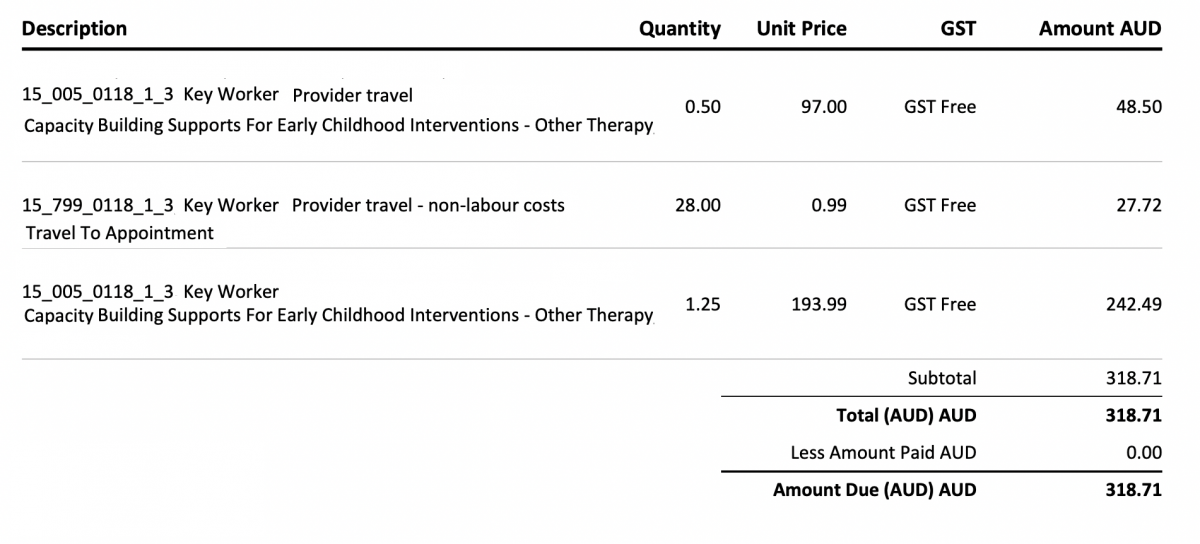
What should a Therapy invoice look like?

Each line item should include:

  • Description: This should include a description and th NDIS support line item code

  • Quantity of units

  • Cost per unit

  • Amount (quantity x cost per unit)

Here is a sample of a correct therapy invoice:


2025 Changes to Therapy prices

The NDIS has told us that their review used over 10 million+ therapy data transactions, benchmarked against Medicare, PHI, and other schemes—revealing some NDIS prices exceeded market rates by up to 68%.

These changes focus on keeping travel costs proportionate to the length of the actual service provided.

Physiotherapists

  • The NDIA plan to remove the state and territory differentiated pricing arrangement for supports delivered by a Physiotherapists. 
  • A national price of $183.99/hr will replace state-based pricing.
  • This will result in a reduction in price limit of $10/hr for Physiotherapists in NSW, VIC, QLD and ACT.
  • This will result in a reduction in price limit of $40.06/hr for Physiotherapists in WA, SA, NT and TAS.

Psychologists

  • The NDIA plan to remove the state and territory differentiated pricing arrangement for supports delivered by Psychologists.  
  • A national price of $232.99/hr will apply.
  • This will result in a reduction in price limit of $11.23 for Psychologists in WA, SA, NT, and TAS.

Dietitians & Podiatrists

  • National prices will decrease by $5 to $188.99/hr.


Which Therapy Providers can charge for travel?

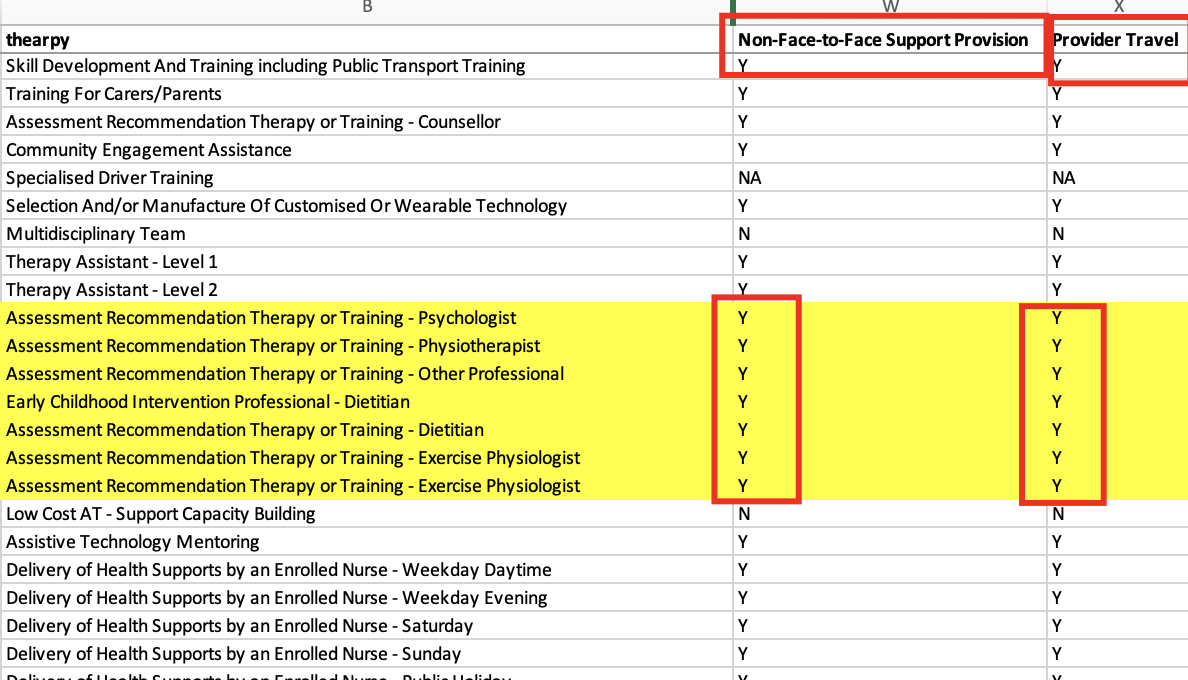
Capacity Building Providers (fancy name for therapists in NDIS speak) if there is a  'Y' in the 'Provider Travel' column in the NDIS Support Catalogue for the service line item. 

Support Catalogue Provider Travel column


What Travel Costs can Therapists Charge For?

Therapists offering services in the NDIS can charge for the following travel costs:

1. Labour Costs (your time) 

This is the time you spend:

  1. travelling to your client and 
  2. returning to your usual place of business afterwards 
  3. time spent doing administrative tasks like report writing and research
    (NOTE: this can only be charged if the support catalogue has a 'Y' in the 'Non-Face-to-Face Support Provision' column)


2. Non-Labour Costs

With a Participant's agreement (via a service agreement) a therapist may also charge a client for a portion of your non-labour travel costs. 

This travel cost could include:

  • a cost per kilometre* for a vehicle owned by a Provider and
  • other forms of transport or associated costs up to the full amount, such as road tolls, parking,
  • public transport fares.

The NDIS has set a maximum rate of $0.99 per km. You will need to negotiate an amount with your client.

*Check the NDIS Pricing Arrangements and Price Limits document for the latest rates.

Find your MMM region by entering your address here


MyCareSpace resources may be shared provided they are credited to MyCareSpace with backlinks to the original resource.

Subscribe to Using your NDIS Funds

Our Preferred NDIS Plan Manager

Plan Hero Plan Management is our preferred NDIS Plan Manager because they are independent and specialist Plan Managers who have both lived experience and expert NDIS knowledge. Plan Management is all they do!

Plan Hero helps you keep your funding organised and on track within each funding period, so you don’t overspend or leave funds unused. They make sure providers are paid on time and help you stay on top of your budget. Their team is easy to reach, with clear, direct communication and no waiting on hold (ever).

Plan Hero gives you the support you need to use your NDIS funding with confidence.