Home / Using your NDIS Funds

Using your NDIS Funds

Resource Author: Bianca S. | NDIS Expert   Last Updated: 11 March 2026
NDIS

Do you feel like you are spending almost as much on your therapist's travel as on the therapy itself?

This resource sets out just how much a therapist can charge you and tips to reduce travel costs.


Which NDIS capacity building providers can charge travel?

Capacity building services include services like Occupational Therapy, Speech Therapy, Physiotherapy, Physiology, Psychology and more.

Capacity building Providers (mostly allied health professionals) are able to claim for provider travel if there is a  'Y' in the 'Provider Travel' column in the NDIS Support Catalogue for the service line item. 

In truth, there is a Y for almost all items!

Support Catalogue Provider Travel column

These NDIS providers can charge you for:

1. Labour Costs (their time)

This is the time they spend:

  1. travelling to your appointment and 
  2. returning to their usual place of business afterwards (Note: that they cannot charge return travel if you are their last appointment and they are travelling home afterwards)


2. Non-Labour Costs

With your agreement (via a service agreement) a therapist may also charge you for a portion of their non-labour travel costs. 

Some charge back more than others so make sure you check your invoices!

This may include parking, running costs of the vehicle, tolls etc.

This travel cost could include:

  • a cost per kilometre* for a vehicle owned by a Provider and
  • other forms of transport or associated costs up to the full amount, such as road tolls, parking,
  • public transport fares.

The NDIS has set a rmaximum rate of $0.99. You can negotiate this with your therapy provider.

*Check the NDIS Pricing Arrangements and Price Limits document for the latest rates.
 

How much labour travel time can NDIS capacity building Providers/Therapists claim?

The maximum amount of time therapists can claim is:

  1. 30 minutes in MMM1-3 areas (most participants fall into this MMM area as it includes major cities, inner regional and some outer regional) 
  2. 60 minutes in MMM4-5 areas (regional and remote areas)

For therapy supports providers, including early childhood therapy, the price limit for provider travel time is 50% of the regular price limit for these items. For example, if a speech pathologist travelled for 1 hour in an MMM5 area to deliver support to a participant, the maximum claimable for this travel time component would be $97.00 (which represents 50% of the direct hourly price limit of $193.99). This does not impact the amount that can be claimed for non-labour costs.

Find your MMM region by entering your address here


IMPORTANT UPDATE to Therapy Travel from July 1 2025

Therapy Prices

  • Price limits will be set in 10-minute blocks to allow more flexibility. This is intended to encourage greater flexibility in billing and service delivery.
  • It aims to clarify that 1 hour is not a ‘default’ or ‘expected’ service length, and that the length of service can vary depending on the agreement between the participant and provider, based on individual needs and circumstances.

How it will work?

  • NDIA will publish therapy rates per 10 minutes.

  • Providers will multiply that rate by how many 10-minute blocks were delivered.

  • The total claimed must still follow existing rules (e.g. maximum hours per plan, no rounding up, etc.).​

Therapy Travel

  • Travel claims for therapy will be capped at 50% of the therapy rate

Why is this happening?

  • To prevent overclaiming for travel when the therapy session is short.
  • To keep the NDIS more sustainable: aligning travel charges with service value.
  • More flexibility: Not every therapy session needs to be exactly 60 minutes. Some may be 30 mins, 40 mins, or 70 mins.
  • Fairer billing: Providers will claim only for the actual time spent, not rounding up to the hour.
  • Easier for participants: Less risk of being overcharged or losing funding due to fixed-length pricing.

Case Example of Therapy Travel:

Example of how to calculate Therapy costs

Let’s say your therapist:

  • Delivers a 30-minute therapy session
  • They travel 35min to get to you (you agree to pay for travel)
  • Their charge rate for therapy is $190/hr
  • Their travel rate must 50% of your therapy rate which is $95/hr
  • They may charge you for other travel costs (if you agree) at a rate of $0.99/km travelled.

Here's how much their total invoice amount should:

  • Therapy rate (labour cost) = 0.5 x $190/hr → $95 (no GST charged)
  • Travel time of 30 minutes = 0.5 x travel rate of $95 → $47.50 (maximum of 30min can be charged for travel)
  • Total amount charged: $142.50 (no GST)

Note: Even if you spend 35 minutes traveling, No more than 30 minutes can be claimed. You can only claim $23.75 for travel in this case.

Additional Notes:

This rule is in addition to existing travel time caps:

  • 30 minutes max in metro areas
  • 60 minutes max in remote areas

It focuses on keeping travel costs proportionate to the length of the actual service provided.

Tips to reduce travel cost

  1. Check your service agreement for specified labour and non-labour travel costs. Negotiate with your provider to limit these costs. Make sure you don't get a shock when you get the first bill!
  2. Check your invoices to make sure they are correct. Remember that 1 hour sessions are not the default.
  3. Make sure your Plan Manager knows if you have agreed to pay travel costs.
  4. Find a provider closeby if possible. Ask the connections team at MyCareSpace to find you a therapist closest to your location so you are able to get more therapy and spend less on their travel!
  5. Collaborate with people in your area to share the travel costs of a single therapist.
  6. Consider Teletherapy if there are no therapists near you - give it ago, it's not just a video call. Therapists use specific methods to engage with patients online.


MyCareSpace resources may be shared provided they are credited to MyCareSpace with backlinks to the original resource.

Resource Author: Bianca S. | NDIS Expert   Last Updated: 11 March 2026
NDIS

NDIS Supports

Participants are only able to use their NDIS funds for items listed as NDIS supports on the approved NDIS Supports List as well as being Reasonable and Necessary

There is also a list of things NDIS funding cannot be used for.

In some circumstances Participants may be able to request a substitution from the replacement support list.

Below we have listed examples of what a Participant may spend their NDIS funding on.

What are the support budgets in my NDIS plan?

There are 4 types of support budgets that are funded by your NDIS plan. They are named:

  1. Core 

  2. Capacity Building 

  3. Capital 

  4. Recurring

We are now going to look at each part of your your budget.

What can I spend my CORE funding on?

Purpose of Core Funding

Core Supports help you with:

  • everyday activities,
  • your current disability-related needs and
  • to work towards your goals.
     

Your Core Supports budget is the most flexible because you can use your funding across any of the following 4 support categories (in most cases).

Examples of what you can spend your Core Funding on

There are 5 categories of funding in the Core budget of your ndis plan.

Here are examples of what each categories of funding can be used for:

1. Assistance with Daily Life

For example, assistance with everyday needs, household cleaning and/or yard maintenance. 

This could also fund a Support Worker helping you with food preparation.

Supported Independent Living (SIL) is also funded under this category and must be a stated support.

Find Support Worker Rates here.


2. Consumables

Everyday items you may need. For example, continence products or low-cost assistive technology and equipment to improve your independence and/or mobility.

Here are some examples of consumables:

  • Daily living solutions/daily adaptive equipment: e.g. medication management devices, non-slip bathmats, signature guide, long-handled or adapted grip equipment, cutlery,
  • Mobility: e.g. replacement mobility cane; replacement covers (like for like); walking stick
  • Hearing & communication devices: Auslan or Signed English Training
  • Interpretation & translation services
  • External continence: One off /short term supply of washable briefs, pads, bedding prot
  • Supplies: Catheters, bags, pullups, pads, wipes
  • Continence alarms
  • Home enteral nutrition (HEN) products and repairs
  • Bowel management
  • Specialised waste disposal equipment
  • Low-cost Assistive technology: low risk items under $1500

Find prices for Consumables here.


3. Assistance with Social & Community Participation

For example, a support worker to help you to participate in social and community activities. (Note this does not include the cost of the activity)

Here are some examples of when you may need a support worker to assist you:

  • Attend a social group or school holiday event
  • Visit your local library
  • Take part in a personal development course
  • Go to a movie or concert
  • Go to community events or a sporting club
  • Take part in an art class

Find Support Worker rates here.


4. Home and Living

For example, this includes:

  • Short term accomodation (STA) - respite away from your carers (max 14 days)
  • Medium term accomodation (MTA) - up to 28 days while looking for housing
  • Supported Independent Living (SIL) - funded personal support to help you live independently in your home or shared accomodation
  • Individualised Living Options (ILO) - package of supports that can help you live how you want in the home environment you have chosen


5. Transport

This is support that helps you travel to work or other places that will help you achieve the goals in your plan.

It may include specialised transport to school, educational facility, employment, community and transport payment, taxi, worker vehicles.

How you can spend your transport funding and how it is paid to you (whether upfront or in regular payments) will be different for each person. Your LAC will explain how you can use this budget.


What can I spend my Capacity Building funding on?

Purpose of Capacity Building funding

Capacity Building Supports help you:

  • build your independence and skills
  • reach your long-term goal

Your Capacity Building budget is different to your Core budget because it is NOT flexible - they cannot be moved from one support category to another.

This funding can only be used to purchase approved Capacity Building supports (see support catalogue).

Examples of Capacity Building Funding

1. Support Coordination and Psychosocial Recovery Coaches

This is a fixed amount for a Support Coordinator or Recovery Coach.


2. Improved Living Arrangements

Support to help you find and maintain an appropriate place to live.


3. Increased Social & Community Participation

Development and training (individually or in a group) to increase your skills so you can participate in community, social and recreational activities. It also includes community participation activities.


4. Finding & Keeping a Job

This may include:

  • Employment related assessment and counselling
  • Assistance in specialised supported employment
  • Individual employment support (time limited)
  • Employment preparation and support in a group
  • Supported employment start up (ADE)
  • Support in employment (ADE)
  • School leaver employment supports (SLES)


5. Behaviour Supports

Funding for a registered Behaviour Support Practitioner to deliver:

  • A Behaviour Management Plan Incl. Training In Behaviour Management Strategies
  • Specialist Behavioural Intervention Support 
     

6. Relationships

This support will help you develop positive behaviours and interact with others with the help of:

  • Specialised behaviour intervention support
  • Behaviour management plan
  • Training in behaviour management strategies
  • Individual social skills development


7. Health & Wellbeing

Including exercise or diet advice to manage the impact of your disability. Examples include:

  • Dietician consultation and diet plan management
  • Dietician group session
  • Exercise physiology
  • Exercise physiology in a group of 3
  • Personal training

The NDIS does not fund gym memberships.


8. Lifelong Learning

Examples include training, advice and help for you to move from school to further education, such as university or TAFE.


9. Choice & Control

Plan Management to help you manage your plan, funding and paying for services. Funding for Plan Management is provided in addition to all other funding. You cannot use this funding for anything else.


10. Improved Daily Living Skills

Assessment, training or therapy to help increase your skills, independence and community participation. These services can be delivered in groups or individually.
Find Prices for Therapy here.


What can I spend my Capital funding on?

Purpose of Capital Funding

Capital Supports include:

  • higher-cost pieces of assistive technology,
  • equipment and
  • home or vehicle modifications.

It can fund one-off purchases you may need.

It can only be used for their specific purpose which are usually stated in your plan and cannot be used to pay for anything else.

Examples of what you can spend your Capital Funding on

The Capital Supports budget has 3 support categories:

Assistive Technology (AT)

This includes equipment items for mobility, personal care, communication and recreational inclusion such as wheelchairs or vehicle modifications.

Examples may include:

  • wheelchairs
  • pressure mattresses
  • standing frames
  • bathing and toileting equipment
  • personal readers & vision equipment
  • vehicle modifications
  • Orthotics
  • Prostheses
  • Assistive equipment for recreation
  • Assistive equipment for household tasks
  • Communication and information equipment
  • Lifts
  • Hoists and slings
  • Trailer to carry wheelchair
  • Transfer equipment
  • Sit-to-stand chairs
  • Adapted furniture
  • Hearing aids, maintenance, replacement
  • Cochlear ear implant
  • Vision equipment
  • Tactile devices
  • Voice generator
  • Face to face communication assistive products
  • Apps
  • Text to speech devices
  • Head pointer
  • Eye gaze system
  • Braille equipment
  • Environmental control systems
  • Sports wheelchairs
  • Specialised bowling equipment
  • Assistance animals

There are 4 types of Assistive Technology

Level 1 (Low Cost)
Cost less than $1500, are low risk and participants will mostly identify and buy from a retail store or online. Funding for Low Cost AT in your NDIS Plan is included under Core Budget. 

For example: Non-slip bath mats, Large print label, Doorbells 

Level 2 (Standard) 
Typically 'off the shelf' AT that participants can buy from AT providers and test/trial before making a final choice. Only minor adjustments needed 

For example: Bath mats, Hand rails, Ramps 

Level 3 (Specialised) 
Often requires specific modification to suit the needs of the participant. May require an assessment and quote 

For example: Electronic magnification for reading, Pressure mattresses 

Level 4 (Complex) 
Typically high cost and custom made or 'off the shelf' but configured uniquely for the individual. Requires an assessment and written quote 

For example: Power wheelchairs, Cochlear implant, speech processors 


Assistive Technology (AT), Maintenance, Repair and Rental

This is funding to pay for the repair or rental of Assistive Technology and is separate from the cost of buying Assistive Technology.


Home Modifications

This includes:

  • Assistive products for personal care and safety - e.g.installation of a hand rail in a bathroom or a ramp in a doorway.
  • Elevator
  • Ramps
  • Slip resistant tile coating
  • Certification of approval of home modifications
  • Project manager or building certifier
  • Consultation about home modifications with builder


Specialised Disability Accommodation (SDA)

SDA funding covers the cost of the physical environment, design, and technology required to accommodate their specific needs.

It may include the cost of building or modifying a home to include features such as accessible bathrooms, ramps, wider doorways. 

The goal is to provide safe and accessible housing that promotes independence, social participation, and improved quality of life. 

This does not cover the cost of accommodation, rent or utilities or everyday living costs (food, internet, rates). 


What can I spend my Recurring funding on

Purpose of Recurring Funding

Recurring supports is funding the NDIS pays into your bank account.

The NDIS ususally pays you this funding every 2 weeks.

You do not need to claim these supports.

Examples of what you can spend your Recurring Funding on

Funding for transport is a recurring support and paid every 2 weeks.


NDIS Price Guide and Support Catalogue

Use the MyCareSpace Price Finder to search for any NDIS item price.

Price List search banner

MyCareSpace resources may be shared provided they are credited to MyCareSpace with backlinks to the original resource.
Resource Author: Bianca S. | NDIS Expert   Last Updated: 11 March 2026
NDIS

What supports will the NDIS pay for?

The NDIS will typically fund a requested support if it meets ALL of the following criteria: 

  • it is for your impairments that meet the disability or early intervention requirements, or both 
  • it will help with your individual goals and aspirations 
  • it will help your social and/or economic participation
  • it is value for money, which means that: 
  • the cost of the support is similar to or cheaper than alternative options that can provide you with the same outcome (NDIS Supports for Participants Rule 3.1(a)); and/or
  • purchasing the support is likely to reduce the costs of funding for other supports in the long term (NDIS Supports for Participants Rule 3.1(c)). 
  • it is effective and beneficial for you 
  • it helps to maintain your informal supports 
  • it is an *NDIS support (see below)

For more information see What is Reasonable and Necessary ?

What is an "NDIS Support"

This refers to what can and cannot be funded by the scheme.

The list of approved supports is extremely detailed and largely includes items or services directly linked to managing a disability

What is on the NDIS Supports List?

There are 37 categories of goods and services that are ‘NDIS supports’.

NDIS supports are the services, items and equipment that can be funded by the NDIS.

The NDIS has created an 'IN' List of supports. You can access them here:

The NDIS IN List - Supports that will be funded

What is NOT on the NDIS Supports List?

There are 15 categories of goods and services that are not ‘NDIS supports’.

These are services, items, and equipment that can’t be funded by the NDIS.

Note: The NDIS cannot fund sexual services and sex work, alcohol or drugs. 

If a Participant spends their funding on an item that is not on the NDIS Supports List, they could incure a debt if the amount is over $1500. '

The NDIS is currently issuing warnings when this occurs initially.

The NDIS OUT List - Supports that won't be funded

NOTE: If a Participant is identified as spending on items that are NOT on the NDIS Supports list, the NDIS can IMMEDIATELY and without warning change your NDIS plan management to Agency Managed. We have seen this happen multiple times.

What happens if an NDIS participant needs something that is not on the list? 

If a participant needs something to manage their disability that isn't on the list, they can make a request to the NDIA in writing. 

In some specific circumstances, the NDIS can fund supports that are not NDIS supports

The NDIA calls these Replacement Supports

What are Replacement Supports?

A Replacement Support:

  • Is a service, item or equipment you would like to use instead of the NDIS support or supports in your plan.
  • Is a support that the NDIS has agreed to fund (in writing).
  • Replaces an existing NDIS support or supports in your plan - it is not an extra support
  • Represents value for money and there is good evidence to support it.

This example was provided by the NDIS Minister The Hon.Bill Shorten: 

"You might need a pair of specially designed shoes because of your disability. That could cost literally hundreds and hundreds of dollars," he told reporters on Tuesday.

"If you can prove that getting [that] particular shoe off the shelf actually is better than the specially designed one, even though that shoe is not on the list, the agency will take that into account."

See this comprehensive resource on what is on the Replacement List and how to apply.


Some key things to note:

  1. Support coordination only able to be spent if it stated in the plan. So participants will no longer be able to use support coordination from their core unless it’s stated in their plan.
     
  2. What we knew as the substitution rule is now replacement support determinations. This is where something is on the out list, but you would like to request that you get an exception.
    It can be requested for standard commercially available household items. And for smartwatches, tablets, smartphones or apps used for accessibility or communication purposes.
     
  3. Specialised driver training appears to now be available to people with a range of disabilities, but it must be stated in their Plan and it must be delivered by a specialized driving instructor.
     
  4. Assistance animals and innovative community participation will also only be allowed to be paid for with NDIS funds by participants who have it stated in their plan.
     
  5. One notable item not on the out list is that hairdressing for hair washing is no longer on the OUT list. However, you’re still not allowed to claim a pedicure or manicure or fake nails, etc.
     
  6. Electricity generators remain on the out list.
     
  7. There appears to be a capacity for NDIS to fund repairs for disability-related damage to property.
     
  8. Legal costs are now on the out list, which will be a big blow to self managers who may need a lawyer to check employment contracts, etc.
     
  9. ILO arrangements appear to be untenable with rent on the out list. This will create significant extra expenses as Housemates will need to be paid for providing supports in home, and will need to be paid for appropriate overnight shifts. This will also likely shift the power dynamic and balance in housemate-shared homes and is especially disappointing. 
    It’s unknown what happens to all the existing agreements where rent for non-disabled supportive housemates covering "free" overnight passive supports is part of signed contracts.
     
  10. Meal delivery platforms are out except where the Food and ingredient components can be separately identified from the meal preparation and delivery costs.
     
  11. Gym membership seems to be a little softened with the changing of the wording to saying that you can’t have costs associated with recreational sports and activities, including membership costs, so that might potentially allow for some leeway where a gym membership is not for recreational purposes.
     
  12. Dating and relationship services remain on the out list. There is no definition of what a relationship service is.
    This could be a big problem for people with intellectual or other cognitive disabilities who do need extra supports around safety and relationships, for example.
     
  13. Conference fees are now on the out list so I guess all of the disability specific conferences that are educational may need to change their names to training events or some such.
     
  14. Life coaches and career coaches and gaming therapists and cultural coaches are all on the out list still. So I suspect, if those services are to be claimable, they will need to be listed as community access/support work and charged accordingly.
     
  15. After school care, au pairs, vacation care school holiday programmes, etc. are all on the out list.
     
  16. Postal services are on the out list, so I don’t know how people are supposed to be able to claim for delivery of their assistive technologies. 

Things that won't be covered are services which are:

  1. "not evidence-based" like 'cuddle therapy'
  2. not directly linked to someone's disability, such as childcare fees, crystal and wilderness therapy
  3. day-to-day living costs such as rent, groceries and bills.


Sources:


MyCareSpace resources may be shared provided they are credited to MyCareSpace with backlinks to the original resource.

Resource Author: Bianca S. | NDIS Expert   Last Updated: 23 April 2026
NDIS

The Annual Pricing Review is when the NDIA looks at how much NDIS services should cost. They check things like:

  • Changes in wages
  • Increases in prices (inflation)
  • What it costs providers to do their jobs

Then, they decide if the maximum prices for NDIS services (like therapy or support work) should go up, down, or stay the same.

This helps make sure:

  • People with NDIS plans get good value
  • Providers are paid fairly
  • The system keeps working well

Now, the NDIA wants to stop doing this big review every year and instead review different services one at a time over a few years. This will make the process more focused and planned.

  • NDIA will introduce a 3-year pricing work plan with targeted reviews (not annual full reviews).
  • Pricing updates will be released earlier in the financial year to support provider planning.

What changes did the NDIS announce from 1 July?

Nursing:

  • Nursing price limits will increase in line with Wage Price Index (80%) and CPI (20%).

Disability Support Workers:

  • Prices will be increased based on minimum wage and superannuation increases.

Therapy Supports:

Therapy Review

  • A full review of therapy pricing will be undertaken to assess existing price limits and help guide the move from one-size-fits-all pricing towards the differentiated pricing approach outlined in the Independent Pricing Committee’s report.
  • It will consider factors such as practitioner qualifications, workforce availability, service settings, regulatory obligations, and the nature of participant outcomes achieved.
  • It will be informed by sector consultations and analysis of provider and market data.
  • The review will ensure pricing continues to support participant outcomes, provider sustainability, and service quality.

Therapy Prices

  • Price limits will be set in 10-minute blocks to allow more flexibility. This is intended to encourage greater flexibility in billing and service delivery.
  • It aims to clarify that 1 hour is not a ‘default’ or ‘expected’ service length, and that the length of service can vary depending on the agreement between the participant and provider, based on individual needs and circumstances.

How it will work:

  • NDIA will publish therapy rates per 10 minutes.
  • Providers will multiply that rate by how many 10-minute blocks were delivered.
  • The total claimed must still follow existing rules (e.g. maximum hours per plan, no rounding up, etc.).​

Therapy Travel

  • Travel claims for therapy will be capped at 50% of the 10-minute rate on a pro rata basis to encourage more efficient scheduling by providers and provide clear cost expectations for participants to help them get better value from their funding. 
  • This is known as a labour time cap — it limits how much of a therapist’s time for travel can be billed under NDIS.

What does “10-minute rate on a pro rata basis” mean?

  • If the therapy rate is, say, $190/hour, that breaks down to $31.67 per 10 minutes.
  • The max travel claim per 10-minute block of therapy is 50% of that, or $15.84 per 10 minutes of therapy delivered.
  • This keeps travel costs in proportion to the therapy time actually provided.

Why is this happening?

  • To prevent overclaiming for travel when the therapy session is short.
  • To keep the NDIS more sustainable: aligning travel charges with service value.
  • More flexibility: Not every therapy session needs to be exactly 60 minutes. Some may be 30 mins, 40 mins, or 70 mins.
  • Fairer billing: Providers will claim only for the actual time spent, not rounding up to the hour.
  • Easier for participants: Less risk of being overcharged or losing funding due to fixed-length pricing.

Case Example of Therapy Travel:

Let’s say a therapist:

  • Delivers a 30-minute therapy session
  • Therapy rate = $190/hr → $31.67 per 10 mins
  • Maximum travel claim allowed:
  • 30 minutes = 3 × $31.67 = $95.01 for therapy

Travel claim must be no more than 50% of that → $47.51

Even if the therapist spends 40 minutes traveling, they can only claim $47.51 for travel in this case.

Additional Notes:

This rule is in addition to existing travel time caps:

  • 30 minutes max in metro areas
  • 60 minutes max in remote areas

It focuses on keeping travel costs proportionate to the length of the actual service provided.

Physiotherapists:

  • The NDIA plan to remove the state and territory differentiated pricing arrangement for supports delivered by a Physiotherapists. 
  • A national price of $183.99/hr will replace state-based pricing.
  • This will result in a reduction in price limit of $10/hr for Physiotherapists in NSW, VIC, QLD and ACT.
  • This will result in a reduction in price limit of $40.06/hr for Physiotherapists in WA, SA, NT and TAS.

Psychologists:

  • The NDIA plan to remove the state and territory differentiated pricing arrangement for supports delivered by Psychologists.  
  • A national price of $232.99/hr will apply.
  • This will result in a reduction in price limit of $11.23 for Psychologists in WA, SA, NT, and TAS.

Dietitians & Podiatrists:

  • National prices will decrease by $5 to $188.99/hr.

Support Coordinators:

  • Level 1 and Psychosocial Recovery Coach prices will be indexed with DSW rates.
     
  • Level 2 and 3 price limits will remain unchanged.

Plan Managers:

  • Monthly fee stays at $104.45.
     
  • The setup fee and remote loadings will be removed.

Why have therapy prices not been increased?

The review used over 10 million+ therapy data transactions, benchmarked against Medicare, PHI, and other schemes—revealing some NDIS prices exceeded market rates by up to 68%

What does this mean for Participants?

There is no change to Participant NDIS plans as a result of price decreases - when you get a new plan, it will be created at the new rates.

As much as the NDIS says these changes shouldnt affect supply of services, this may not be the case in some areas.

MyCareSpace resources may be shared provided they are credited to MyCareSpace with backlinks to the original resource.
Resource Author: Bianca S. | NDIS Expert   Last Updated: 11 March 2026
NDIS

For NDIS participants, online therapy (also called telehealth therapy) is a flexible and accessible option that’s offering new levels of convenience.

Whether you need speech therapy, occupational therapy, psychology, physiotherapy, or dietetics, expert healthcare is available with just a few clicks.

*Multiple studies have found telehealth to be as effective as in-person services for improving speech and language skills, while also demonstrating strong outcomes in treating childhood ADHD, anxiety, and depression. 


What Is Online Therapy and How Does It Work?

Online therapy is exactly what it sounds like—therapy delivered through video

calls, phone sessions, or digital platforms instead of face-to-face appointments. It

allows NDIS participants to work with qualified therapists from anywhere—all you

need is an internet connection and a device with a camera.


Here’s how it works:

Video Sessions – Most online therapy happens via Zoom, Microsoft Teams, or

another secure video platform.

Phone-Based Support – For those who prefer it, some therapy can be done

over the telephone.

Interactive Activities – Therapists often use screen sharing, apps, and online

tools to make sessions engaging.

Home-Based Exercises – Many therapists provide reading, videos, worksheets,

and tasks to help you stay active between sessions.


It’s important to understand that what you work toward in online therapy is no different from in-person therapy.

The goals, techniques, and therapeutic relationship remain the same—the only thing that changes is the delivery model,

making therapy more flexible and accessible.

Best of all, online therapy is just as effective as in-person therapy for many people,

especially when therapists tailor their strategies to suit the needs of the individual

they’re working with.


Four Misconceptions about Telehealth

Despite its growing popularity, online therapy is still surrounded by misconceptions

that make some people hesitant to try it. Let’s clear up some of the most common

myths:

Myth #1: Online therapy isn’t as effective as in-person therapy

Reality: Clinical research shows that online therapy can be just as effective as

face-to-face sessions. Many people even prefer it because they feel more

comfortable and secure in their home environment.


Myth #2: It’s just a video chat—it’s not “real” therapy

Reality: Online therapy follows the same structured approach as in-person

therapy. Sessions include assessments, goal setting, exercises, and progress

tracking. Therapists also use interactive tools like screen sharing, digital

whiteboards, and guided activities to make sessions more interactive.


Myth #3: You need advanced technology or IT skills

Reality: If you can make a video call, you can do online therapy. Most

providers use simple, user-friendly platforms like Zoom or Microsoft Teams, and

therapists guide you through any setup needed. Many even offer tech support if

you run into technical issues.


Myth #4: Online therapy is only for people with mild needs

Reality: Online therapy is effective for a wide variety of needs, ranging from

mild to complex. Whether you need support with communication, mobility,

mental health, or daily living skills, your therapy plan can be personalised to suit

your individual goals.


NDIS & Online Therapy: What’s Covered?

If you’re wondering whether the NDIS covers online therapy, the short answer is

yes, in many cases it does. However, the details will depend on your individual

plan.


NDIS typically funds online therapy under these categories:

Capacity Building Supports – Covers therapy that helps develop new skills,

improve independence, and build communication abilities.

Improved Daily Living – Includes services like speech therapy, psychology,

and occupational therapy to support everyday life.

Core Supports – In some cases, online therapy may be covered if it directly

helps you achieve your NDIS goals.

If you’re unsure if your plan covers online therapy, your support coordinator,

plan manager, or the MyCareSpace team can help you check.


Finding the Best Online Therapy Provider & Making the Most of Your Sessions

Choosing the right online therapy provider is key to getting the most out of your

sessions. Here’s how to find the best fit and ensure you’re making progress:


1. Look for Providers with Online Therapy Experience

Not all therapists specialise in telehealth. Look for those who have experience

delivering therapy online and know how to adapt sessions for a digital format.

✔ Are they NDIS-registered (or do they accept self-managed/plan-

managed funding)?

✔ Do they have experience with telehealth therapy?

✔ Do they offer a free consultation or trial session?


2. Make Sure They Understand Your Needs

Every therapy journey is different. Find a provider who takes the time to

understand your goals, whether that’s improving communication, mobility,

mental health, or daily living skills. If possible, ask for case studies or examples of

how they’ve helped others with similar needs.


3. Create a Comfortable & Distraction-Free Environment

To get the most out of online therapy:

✔ Choose a quiet, comfortable space with minimal distractions.

✔ Use headphones if needed for better audio clarity.

✔ Have any therapy worksheets, journals, and questions ready before your

session starts.


4. Be Open About What’s Working (and What’s Not)

Therapy is a collaborative process—so don’t be afraid to share what’s helping

and what isn’t. If something doesn’t feel effective, a good therapist will be willing

to adjust the approach.


5. Stay Engaged Between Sessions

Progress doesn’t just happen during appointments—it happens between them

too. Many therapists provide exercises, worksheets, and video guides to help you

keep practicing skills. Staying consistent will accelerate your progress.


6. Keep Track of Your Progress

Use a notebook or digital journal to track your therapy journey. Write down:

✔ Improvements and achievements

✔ Challenges or difficulties

✔ Questions to discuss in your next session

By choosing the right provider and staying actively involved in your therapy, you

can maximise the benefits of your sessions—without ever even leaving home.


*Source: Using Telehealth to Provide Interventions for Children with ASD

Connect me with an online therapist

MyCareSpace resources may be shared provided they are credited to MyCareSpace with backlinks to the original resource.

Resource Author: Bianca S. | NDIS Expert   Last Updated: 11 March 2026
NDIS

What devices are a restrictive practice in transportation of NDIS participants

A guide for providers, parents and carers

In some circumstances restrictive practices used in a vehicle may fall under mechanical restraint, or environmental restraint depending on the manner and context the device is applied. If the devices outlined on page 9 are used in any other circumstances to manage behaviours of concern then this would constitute a regulated restrictive practice.

For example:

  • Using a seatbelt guard while the vehicle is not in transit to keep a person with disability in their seat because they are agitated is a mechanical restraint.
  • Using a harness on a person to manage a behaviour of concern in a vehicle who does not require it for postural/ therapeutic support is a mechanical restraint.

More examples of when devices are, and are not, a regulated restrictive practice are provided below.


What devices are considered restrictive practice in transportation  

Harness

  • The use a harness to stop a person from hitting others in a vehicle who does not require it for postural/ therapeutic support is a mechanical restraint.
  • The use of a harness that is part of an appropriate child restraint or seat (depending on the child’s size and age) that is in line with state or territory road safety rules is not a mechanical restraint, for example, a 3 point booster seat.
  • A harness prescribed by an occupational therapist for postural support for a person with a disability when travelling in a vehicle.


Lap belt

  • The use of a lap belt when not in transit to stop a person from getting out of their wheelchair and wandering in a vehicle is a mechanical restraint.
  • The use of a lap belt on a wheelchair for postural/therapeutic support is not a mechanical restraint.


Child lock

  • Using a child lock when not in transit to prevent a person from exiting the vehicle when agitated is an environmental restraint.
  • The use of the child lock on a vehicle in transit is not a mechanical restraint.


Dividing screen

  • A dividing screen between the driver and the back seat is not a mechanical restraint.


Seat belt guard

  • Using a seat belt guard when not in transit to prevent a person from getting out of their seat in a vehicle when agitated is a mechanical restraint.
  • Using a seat belt guard in a vehicle to ensure the seat belt remains fastened in transit is not a mechanical restraint.


MyCareSpace resources may be shared provided they are credited to MyCareSpace with backlinks to the original resource.
Resource Author: Bianca S. | NDIS Expert   Last Updated: 11 March 2026
NDIS

What is a Stated Support in my NDIS Plan?

A 'Stated Support' in your NDIS plan means that funding has been allocated for a type of specific support or service, and you can't use this funding for something else/another service.

You cannot swap 'stated supports' for any other types of support, but stated supports do have flexibility within the same support category.  

Examples of Stated Supports in your NDIS plan

Individual Items/Services

The following individual items/services in an NDIS plan can be a Stated Support. For example:

  • Preparation and delivery of meals
  • Orthotics
  • A wheelchair

Support Categories

Sometimes a whole NDIS category of support can be stated support:

  • Capacity Building Supports 

  • Support Coordination

  • Plan Management

  • Behaviour Support Plan

  • Improved Daily Living Skills - e.g. occupational therapy, speech therapy, early intervention etc


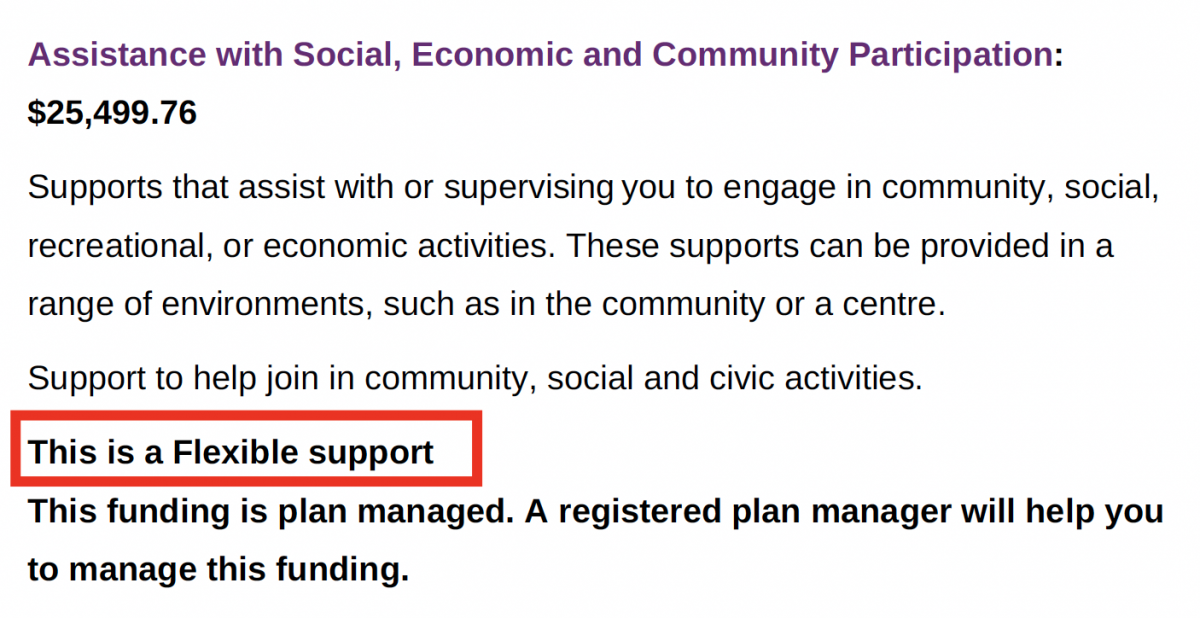
What is a Flexible Support in my NDIS plan?

A flexible support is where funding can be used across different support categories.

For example the funding you receive in your CORE support categories can be used across any of the CORE categories.

NOTE: Only when they are part of the same fund management type. So a plan managed support cannot be used for an agency managed support and vice versa.

Examples of Flexible supports

Your plan will include information that describes what the support category budget is for.

This is to help you understand the purpose and intention of what has been funded in your plan.

You still have the flexibility to use your funds for any support as long as it's within that same support category.

How do I know if a support is a Flexible or Stated support in my NDIS plan?

Easy, because it will say so. You may even find that some parts or a specific type of funding are stated supports and agency managed, while other parts may not be.

Snippet from an NDIS plan that shows Stated Support details


In your plan the NDIS describes NDIS support categories as flexible or stated, based on NDIS laws.

You must spend your funding in line with your plan. 


Changing a Stated Support

Support needs can change over time. If you have a stated support in your NDIS Plan that no longer meets your needs, there are a couple of options.

If the requested change is small, such as the need to purchase a different model of an item that costs the same, you can ask the NDIS for a ‘light touch’ review. Light touch reviews cannot be used to request more funding.

If the requested change is more significant such as requiring additional money in one of your NDIS budgets, you’ll need to request a Plan reassessment (previously called Plan Review). To find out more here are our relevant resources about Plan Reassessments.


MyCareSpace resources may be shared provided they are credited to MyCareSpace with backlinks to the original resource.
Resource Author: Bianca S. | NDIS Expert   Last Updated: 11 March 2026
NDIS

Intellectual Disability and Supported Independent Living (SIL) 

Supported Independent Living (SIL) is the support or supervision of daily tasks by paid support workers to help you to live as independently as possible.

This support can be received individually in your own home, or to a group of people who live together.

SIL is typically funded if your diagnosis of intellectual disability has a moderate to severe impact on your functional capacity.

SIL may be suitable for you if you require both:

  • active disability support for more than 8 hours per day to complete daily activities in the home
  • some level of support for the other hours

SIL is typically funded for those who require support for 24 hours per day, 7 days per week, including overnight support.

Overnight support may be active, where more than two hours of direct assistance is provided. Inactive or sleepover support involves less than two hours of assistance provided to you.

Intellectual Disability and Functional Capacity

The term “functional capacity” is thrown around a lot in the NDIS space. What does it mean?

Functional capacity is a snapshot of how independent you are, or how much support you require, to complete a particular task or activity that is meaningful in your life. How much difficulty you may have to complete a task, and how much time and effort is required, is also taken into consideration.

Your functional capacity to perform certain tasks may vary across different aspects of your daily routine. 

Your functional capacity may also be impacted by access (or lack of access) to assistive technology, or whether you live in an accessible environment or not.

How can SIL help me?

The support you receive through SIL relates directly to your support needs in the home.

SIL support must cater to your individual needs for the various activities that make up your day at home. You may require a higher intensity of support in the morning compared to the afternoon and overnight, for example.

SIL may include the following supports for people with an intellectual disability:

  • Assistance with personal care, like showering, dressing and toileting
  • Assistance with household tasks such as cleaning, preparing meals, washing clothes and cleaning
  • Active overnight and/or sleepover support
  • Assistance with complex medical needs
  • Positive behaviour support management
  • Assisting with administering medication and management of health needs related to your disability, such as bowel care, catheter, epilepsy, asthma and tube feeding

Intellectual Disability and High Physical Support Needs in SIL

As intellectual disability can result in a significant functional impairment, high support needs may be present. This may be the case if your intellectual disability is classified as severe or profound.

This means that increased time and support is required to assist with performing activities of daily living.

High support needs usually means you require a 1:1 or 2:1 ratio of support for personal care tasks and other activities.

Ratio of Support

A ratio of support describes how many disability support workers will provide your support, and how many participants you’ll share this support with.

1:1 support means that you are receiving direct support from one support worker to assist you to engage in an activity, i.e. grooming tasks.

2:1 support means that you are receiving direct support from two support workers to assist with an activity. The additional support worker is usually necessary to assist with operating assistive technology. This may be due to manual handling requirements to keep you and your staff safe.

Manual Handling

Manual handling is the term used to describe the physical assistance provided for transferring and repositioning. 

Every participant in SIL who receives manual handling assistance should have a Manual Handling Plan. This is to minimise the risk of injury involved when receiving care.

Safe manual handling may be necessary for someone with an intellectual disability who is unable to move independently to transfer between surfaces, i.e. bed to chair, or to reposition i.e. when laying in bed.

Intellectual Disability and Assistive Technology in SIL

High physical support needs typically involve the use of assistive technology (AT).

You may be able to operate some assistive technology devices yourself. 

Alternatively, you may require support from your SIL staff to operate assistive technology and assist with manual handling.

Examples of Assistive Technology for Intellectual Disability

Common assistive equipment used by people with an a severe or profound intellectual disability who have high support needs includes:

  • Wheelchair
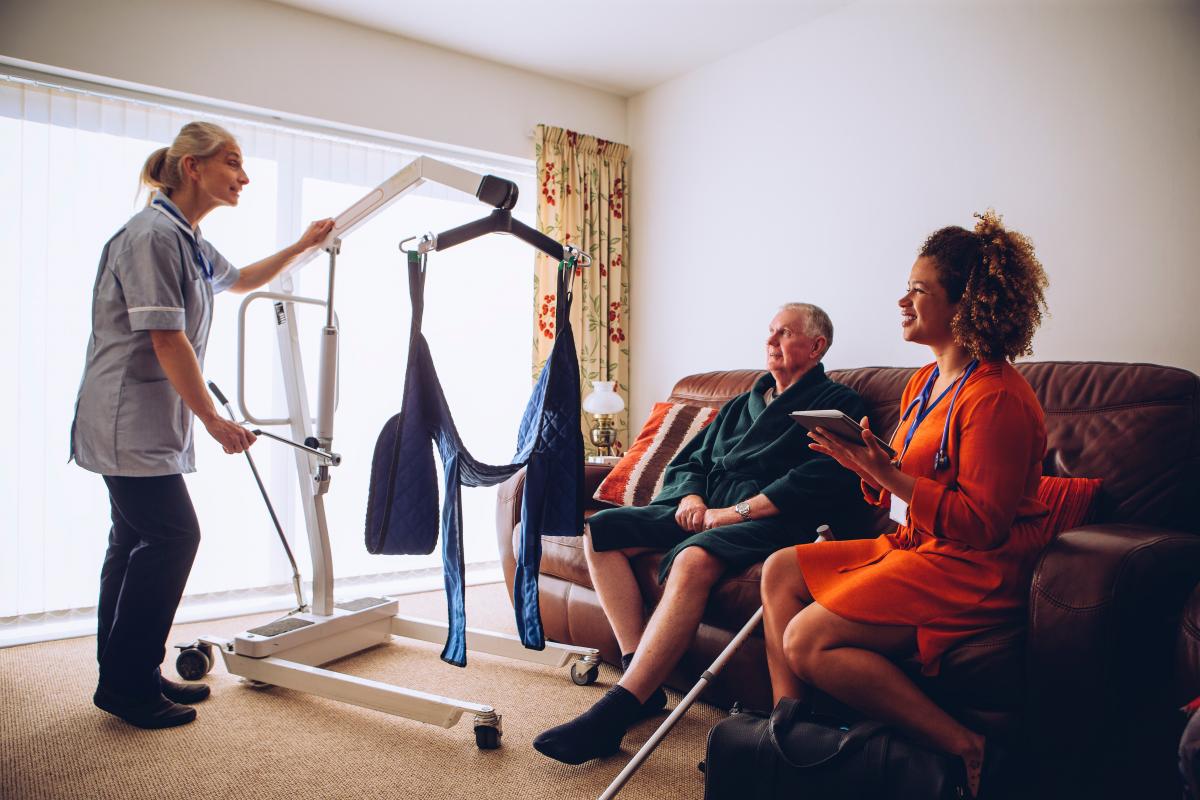
  • Mobile Hoist or ceiling hoist
  • Sling
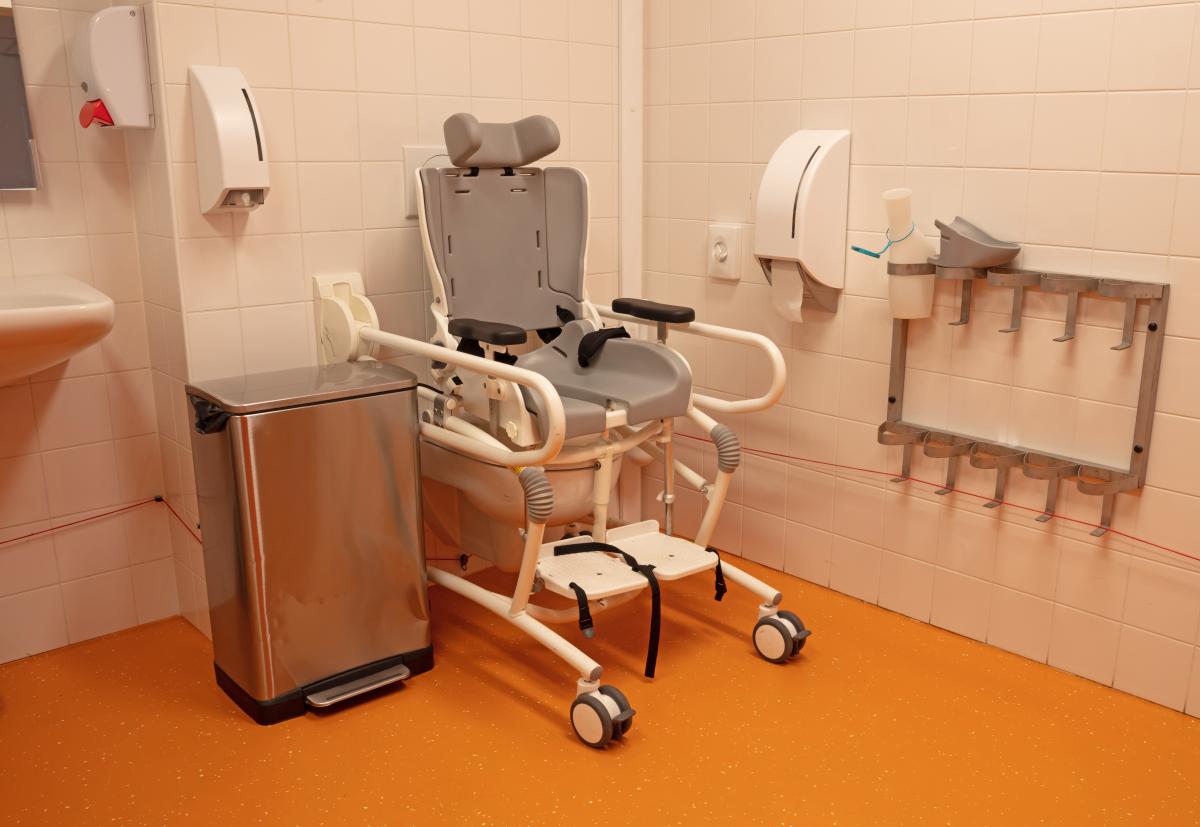
  • Mobile shower commode
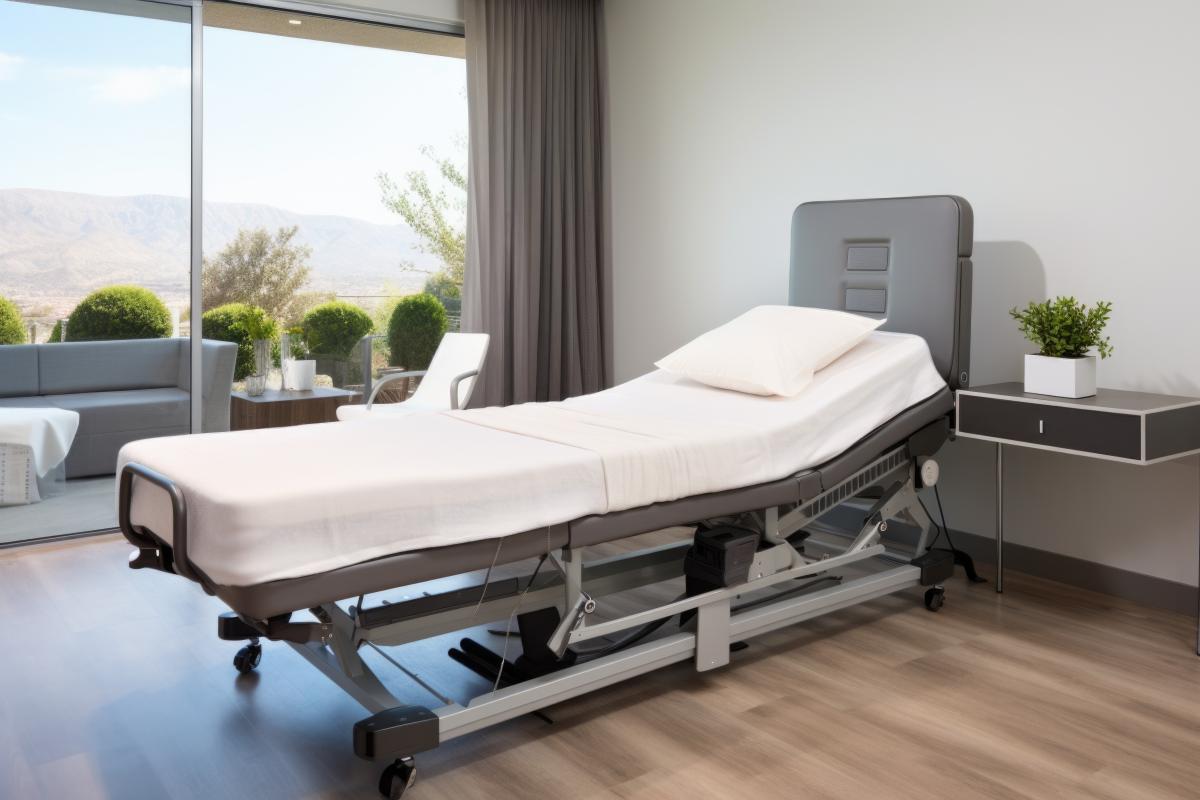
  • Hi-lo adjustable bed
  • Alternating air mattress
  • Recliner Chair (with customisable features and high-pressure relief)

Mobile hoist with sling attached operated by a support worker  Two men seated in living room enjoying a conversation

Height adjustable bed with foam mattress  Mobile shower commode positioned over toilet in accessible bathroom

How do I find an NDIS SIL Provider?

When SIL is approved in your NDIS Plan, you are not automatically allocated to a provider. You have choice and control over the provider you engage with for SIL.

Need help finding a SIL provider?

Get in touch with the MyCareSpace Connections Team for assistance to find a SIL services in your area and nagivate the NDIS.

Get Started

MyCareSpace resources may be shared provided they are credited to MyCareSpace with backlinks to the original resource.

Resource Author: Bianca S. | NDIS Expert   Last Updated: 11 March 2026
NDIS

What is Supported Independent Living (SIL)?

Supported Independent Living (SIL) is the support or supervision of daily tasks by paid support workers to help you to live as independently as possible.

SIL must cater to your individual needs for the various activities that make up your day at home.

SIL may include the following supports for people with cerebral palsy:

  • Assistance with personal care, like showering, dressing and toileting
  • Assistance with household tasks such as cleaning, preparing meals, washing clothes and cleaning
  • Active overnight and/or sleepover support

SIL does not typically include support outside of the home.


The Logistics of SIL

Whether you are applying for funding for SIL, or are already accessing SIL services, it is important to understand how SIL is funded in your NDIS plan and what is included and excluded when it comes to SIL supports. 

There is often confusion about how SIL can be funded in your home or a home you share with others. Continue reading to learn more about SIL.


Where is SIL funded in my NDIS plan?

Across NDIS Plans, there is a new category called the Home and Living Supports (Category 16) which appears within the Core Support Budget. This budget is allocated for support for living options in line with your disability needs.

This funding can only be used flexibly within this category, and not across the remaining Core Support budget categories.

Within the Home and Living Supports budget, funding may be available in your NDIS plan for the following:

  • Short-term accommodation (STA)
  • Medium-term accommodation (MTA)
  • Supported Independent Living (SIL)
  • Independent Living Options (ILO)

SIL is considered a long term living option, with the primary purpose of supporting you in your home to live alone or with others. SIL funding includes at-home support or supervision to build skills in self-care, independence and maintaining a safe home for people with higher support needs.


Does SIL include accommodation?

SIL involves the funding for support provided to you in the home environment.

It does NOT include the home environment where you live.

This means, SIL does not cover the cost of rent, board or lodging costs.

If you require disability-specific accommodation, you may be eligible for Specialist Disability Accommodation (SDA). See further details here: What is SDA and SIL?

The NDIS do not generally provide funding for housing, except for SDA. If you do not meet the criteria for SDA eligibility, you will be required to cover the cost of your accommodation. If you need affordable housing or are at risk of homelessness, there are state or territory government programs that can help you. Learn more about Housing and Community Infrastructure outlined by from the NDIS


Does SIL include groceries and other day-to-day expenses?

SIL does not include day-to-day living costs that are not related to your disability support needs.

The cost of groceries are not included in SIL. This is a cost you are required to cover. If you live with others, you may arrange between yourselves to contribute towards shared groceries. In some SIL arrangements, the staff may assist by facilitating online orders and monitoring household supplies.

The cost of utilities such as gas, electricity, water, telephone, and internet bills are also not included in SIL. This is a personal expense for you to cover.

Expenses related to holidays, including travel costs, are also not funded by SIL.


What happens to SIL if I am in hospital?

SIL is not responsible for providing you with personal support while you are admitted to hospital.

The health system is responsible for you meeting your support needs while you are under hospital care.

You will need to discuss ongoing payments for SIL with your SIL provider directly if you are not home to receive it. It is important to review your service agreement to understand the provider’s policies about the payment for services when the participant is not present. Make sure you are comfortable with these terms before signing the agreement with your chosen provider.


Is staff training required for Cerebral Palsy in the NDIS?

Undertaking training specific to cerebral palsy is not a requirement for service providers of SIL in the NDIS.

Some providers may be more familiar with supporting individuals with cerebral palsy than others.

Before engaging with a service provider, it is important for you to understand the staff’s experience working with people with cerebral palsy if you are after quality care that aligns with your needs. Consider asking the following:

  • Do you support any existing participants who have cerebral palsy? If yes, please describe the model of care, i.e. what does support in the home look like? How are supports shared? How are supports individualised?
  • What assistive technology are your staff experienced with operating?
  • Do your staff have any manual handling training? When was training last completed?
  • Are they familiar with supporting any other medical conditions, such as epilepsy?

Receiving support from a provider who has the skills and capabilities is an important factor in maintaining your safety and ensuring your support needs will be met.


Does SIL = shared supports?

SIL can be provided across a variety of settings. SIL can be individual or shared.

Individual Support (Living Alone)

SIL can be provided individually to you in your own home. This means the roster of care is built around you alone, and may include a combination of 1:1 (one support worker to one participant), or 2:1 (two support workers to one participant). The ratio of care across different routines and activities depends on your functional capacity and relevant support needs.

Shared Support (Living Alone)

SIL can be provided to you in a shared capacity while you live in your own home. This model of care is described as Concierge Support. Concierge Support involves on-site support shared between several participants, however the support provided is not considered live-in support. Instead, an office is set up nearby the residences and is typically staffed 24/7. Drop in support is available to residents on a needs basis and/or for scheduled check ins. Residents can contact the SIL Concierge Staff member at any time if they need one-off support during their day or evening i.e. support that is not part of their scheduled routine.

Shared Support (Living With Others)

SIL can also be provided in a shared living setting, where services are shared across two or more participants. It is not considered necessary for all participants to have cerebral palsy. However, all participants in the home must have the same or similar support needs to ensure the support can be shared appropriately.


Will I receive SIL if I don’t need support all of the time?

If you do not need some level of support all of the time when you are at home, it is unlikely that you will be considered eligible for SIL finding.

There are other options available to you for your support needs to be met. This may be through Assistance with Daily Life in your Core Support Budget, where drop in support is available as you require it.


How do I choose a SIL provider?

When SIL is approved in your plan, you will be provided with a sum of funding for SIL in your Core Support budget.

You are not automatically allocated to a provider, and have choice and control over which provider you engage with for SIL.

The SIL provider you select will assist in preparing a roster of care, utilising the funding allocated in your plan to cater to your needs across your week.


Need help finding a SIL provider? Get in touch with our Connections Team for assistance to nagivate the NDIS and find a SIL provider in your area.

Find A SIL Provider

MyCareSpace resources may be shared provided they are credited to MyCareSpace with backlinks to the original resource.

Resource Author: Bianca S. | NDIS Expert   Last Updated: 11 March 2026
NDIS

What is Assistive Technology in the NDIS?

Assistive technology may be a device or item of equipment to help you perform a task in your daily life. It is often abbreviated to 'AT', or sometimes called 'equipment'

How does Assistive Technology help you as part of your NDIS funding?

Assistive technology aims to:

  • Increase independence - This helps you to do more for yourself, therefore reducing the need for person-to-person support.

  • Increase participation - You do more of what you want to do by making tasks easier for you to engage in.

  • Promote safety - By reducing risks and hazards that may be present.

Assistive technology can be used for activities you currently do, or activities you want to do. Assistive technology helps you to pursue your goals and aspirations.

Does AT have to be purchased from a disability-specific shop?

Assistive technology may be considered a disability-specific aid (supplied by a disability company) or a mainstream support (available at a regular store).

Disability-Specific Aids

Assistive technology may be specifically designed to address challenges you face because of your disability. Examples include:

  • Powered Wheelchair
  • Alternating air mattress
  • Shower chair
  • Modified chopping board

These types of supports are often named specifically in your NDIS plan.

Mainstream Support

Assistive technology that can be bought from a regular store is called Low Cost or Low Risk assistive technology as it costs less that $1500. It can be used to help you with specific need related to YOUR disability: Examples include:

  • Planners/schedules
  • Large print labels
  • Electric timer toothbrush
  • Apple watch for falls detection/contacting emergency services

When you are looking to buy assistive technology from a regular store, you must be able to justify how it relates to challenges linked to your disability

You may need to seek guidance from the National Disability Insurance Agency (NDIA) and Allied Health Professionals, also known as therapists, to ensure the item is most appropriately funded by the NDIS. 

The NDIA does not fund household furniture or other general items. However, they might fund the extra cost of adapting general items for your disability if needed.

Example: You might use your NDIS funding to purchase a kettle tipper, however, you must supply the kettle, as this is an everyday item. The NDIA may fund vehicle modifications to your car for wheelchair accessibility, but will not fund the purchase of the car.

Here are some great examples of Low-cost disability-specific and mainstream support items, provided by The Growing Space.

Remember, whether a disability-specific aid or a mainstream support, assistive technology must align with needs relating to your disability and meet the NDIS Reasonable and Necessary Criteria.

This is a criteria in the NDIS Act (2013) that all funded supports must meet.

Where do I find Assistive Technology in my NDIS Plan

There are three main categories of funding in your NDIS plan:

  • Core Supports
  • Capacity Building Supports
  • Capital Supports

You may see one of these categories in your plan, two or all three. Assistive Technology is a budget located in the Capital Supports category.

NOTE: If you do not see the Capital Supports budget in your plan, you do not currently have funding for Assistive Technology.

screenshot of an NDIS plan showing the Capital Supports section

Is there anywhere else in my plan I can purchase Assistive Technology?

Low-cost assistive technology can be funded by your Consumables budget, which can be found in the Core Supports Category.

How to get Assistive Technology funding in my NDIS Plan

There are several ways you can get Assistive Technology funded in your plan, such as:

  1. When you receive your first plan, a budget may be allocated for you to explore what Assistive Technology supports you may need.
     
  2. At your NDIS Plan Review meeting, you can identify future goals and how assistive technology may seek to achieve these goals. Potential outcomes include:
    • You may be allocated Assistive Technology funding in your new plan, 
    • You may be allocated funding for a therapist to complete an assessment for your assistive technology needs. Funding for the assessment will appear in the Capacity Building category.
    • The NDIA suggests another funding source is more appropriate for funding the item.
       
  3. A therapist (such as an Occupational Therapist) completes an assessment for your assistive technology needs. This typically involves trialing a variety of items to ensure the following:
    • The AT meets your needs related to your disability,
    • The AT helps you perform the necessary activity,
    • The AT is suitable for the intended environment.

The therapist is responsible for ensuring the assistive technology aligns with your needs from a clinical perspective, while also ensuring the NDIS Reasonable and Necessary Criteria are met.

What is the approval process for Assistive Technology?

The approval requirements depend on the cost of the item. Here is a quick summary:

  • Low cost (Less than $1500): No NDIA approval required.
  • Mid cost (Between $1500 - $15,000): If funding for AT already allocated in plan and item is stated specifically, no approval required. If not specifically stated, submit a request to the NDIA to gain approval.
  • High Cost (Over $15,000): NDIA approval required.

Therapist involvement is recommended across all levels of assistive technology to ensure items are appropriate. The need for therapist input increases for mid and high cost items.

Where to Find AT Suppliers

The MyCareSpace Connections Team can help you access assistive technology by linking you in with a therapist who prescribes assistive technology.

Find Me a Therapist

MyCareSpace also have an Assistive Technology Providers Directory which includes a broad range of AT suppliers.

Search for AT Suppliers

Additional Information

Find more information on assistive technology here:

Reasonable and Necessary Supports

NDIS Operational Guidelines - Assistive Technology

Providing Assistive Technology


MyCareSpace resources may be shared provided they are credited to MyCareSpace with backlinks to the original resource.

Subscribe to Using your NDIS Funds

Our Preferred NDIS Plan Manager

Plan Hero Plan Management is our preferred NDIS Plan Manager because they are independent and specialist Plan Managers who have both lived experience and expert NDIS knowledge. Plan Management is all they do!

Plan Hero helps you keep your funding organised and on track within each funding period, so you don’t overspend or leave funds unused. They make sure providers are paid on time and help you stay on top of your budget. Their team is easy to reach, with clear, direct communication and no waiting on hold (ever).

Plan Hero gives you the support you need to use your NDIS funding with confidence.