Home / Using your NDIS Funds

Using your NDIS Funds

Resource Author: Bianca S. | NDIS Expert   Last Updated: 11 March 2026
NDIS

This resource is for participants that self manage their NDIS plan and covers hiring self-employed or independent support workers who have an Australian Business Number (ABN).

Self Managed participants can hire their own support workers with an ABN!

As a self-managed participant you can use ANY provider whether they are NDIS registered or not.

When you self manage your NDIS Plan, you can hire a support worker to help you achieve the goals set out in your plan.

You can:

  1. Engage the services of a care company who provides you with a support worker of your choice OR
  2. Find and then hire an independent support worker as a contractor if they have an Australian Business Number (ABN

Why or when would you consider hiring a support worker yourself?

Hiring your own support worker might involve a little work, but it gives you flexibility with their hours and the chance to negotiate their rates and hours. 

Being self managed means you may be able to negotiate a lower hourly rate (lower than the NDIS support catalogue) since the support worker receives the full amount when you pay them directly (a care company will take a cut) - this will help stretch your funding.

This will be especially useful when you are hiring a support worker over the weekend (or public holiday) as the support catalogue rates are very much higher over these periods.

It's more FLEXIBLE
You can hire someone you already know (not family members) or someone who lives nearby. The hours you need could vary and many agencies will have support worker minimum service times. When you hire someone directly it may be easier to fill the hours you need more easily.

Here are some examples of where MyCareSpace members have hired their own support workers who have their own ABN:

  • Sue is able to hire her next-door neighbour, who is a good friend, to look after her son for just a couple of hours every afternoon between him finishing school and her getting home from work.
    They don't need any disability certification if this is not important to you.  Her son knows her neighbour well, and because they are next door, there is no travel issue for the short period she needs them. They are also flexible and she can call them up to stay on if she's running late.
     
  • Tony hires the coaching assistant from their inclusive football club to take his son to footie matches on the weekends.
     
  • Amy needs help in the morning to get showered and dressed. She pays her friend, who lives just down the road, to pop over for an hour in the early mornings to help her.

How to get started when hiring your own Support Worker with an ABN

Before you can hire someome, identify what your needs are. You will need to do this regardless of whether you already have someone in mind or will need to find someone.

To start, you will need to think about (and document) the following:

1. The areas of your life where you want the help of a support worker.

Make a list of where you need help with:

  • Personal care
  • Health needs (going to medical appointments etc)
  • Accessing the community - getting out an about, going shopping etc
  • Daily living requirements like help with cooking, cleaning etc
  • Everyday tasks like sending emails.

It may be helpful to write a daily plan of what you do (or want to do) every day and work off that.

It will take some time to get this together and you are probably going to have a few versions before you have it ready.

See this Sample Duty Statement from MyPlace (WA) which is part of their resource on engaging support workers (referenced below in its entirety). It will help you identify the duties you may need a support worker to perform.

2. What is your support budget?

This will influence how many hours of support you can pay for. Your NDIS funding for support workers falls under CORE - Assistance with Daily Life in your NDIS plan.

Look at your total funding for support workers for the year and divide it by 52. Now you have a weekly budget. 

According to the NDIS Support Catalogue, the weekly hourly rate is around the $50-ish, the Saturday hourly rate around $72-ish and the Sunday hourly rate around $95.

If you can negotiate better rates than that, you are going to be able to stretch your funds.

3. What kind of support worker would you like?

It's helpful listing the type of qualities you would like in a support worker. For example punctuality, flexibility, discretion, physical strength, patience etc. Perhaps you might prefer a support worker that shares your interest or has skills you'd like to learn.

4. Get help

MyPlace WA has created a comprehensive resource on the process of finding and hiring a support worker and also documenting what you need from them beforehand. It covers:

  • Planning your support needs, documenting your needs and your budget
  • Duty statements (what must they do), employment adverts and application forms 
  • What kind of support worker you want, employee interviews and picking the right workers
  • Work safety, worker management and termination

MyPlace WA - A Guide to Engaging Your Own Support Workers

5. Finding Support Workers

You might already have someone in mind and that's the reason you are travelling down this path. Alternatively, you can put ads out on NDIS Facebook groups or other online platforms or even just use word of mouth.

Here is a Sample Application Form from MyPlace (WA) which is part of their resource on engaging support workers (referenced below in its entirety).

How to make sure your support worker is a contractor and not an employee

For every worker that you engage personally, you need to look at the specific working arrangement to determine whether that person is an employee or a contractor.

Why does this matter?
Because your legal, financial and tax obligations are different if your worker is an employee or a contractor.

A contractor (independent support worker) can typically:

  • decide how the work will be done
  • agree to the hours that make up the job
  • are usually engaged for a specific task or time
  • usually have their own insurance
  • use their own tools and equipment
  • pay their own tax and GST
  • have an ABN and submits invoices
  • don’t receive paid leave

Source: Dept of Fair Trading

There won’t be one thing on its own that decides whether a support worker is an employee or an independent contractor. You need to consider all of these factors making sure your support worker is an independent contractor. 

The ATO website has a great tool that asks you a series of questions to determine whether you are engaging a worker as an employee or contractor for tax and superannuation purposes.

Visit ATO Website Check Tool

What do I need so that I can hire my own support worker?

1. They need an ABN and Insurance

An independent contractor is a person who has an Australian Business Number (ABN) and is generally responsible for managing their own insurance, tax and superannuation.

If you are self-managing and want to hire a support worker directly as a contractor, you need to make sure they have:

  • an ABN
  • appropriate insurance - MyCareSpace has been working with insurers to provide insurances to disability support workers. Get an instant online insurance quote here
    If a support worker is driving your car, you will need to make sure you have them listed as a nominated driver on your comprehensive motor vehicle insurance policy.

2. They need to invoice you

​Support workers who are contractors can charge per hour at a rate agreed upon by you. They will need to invoice you for their support hours.

An invoice should include:

  • Name
     
  • ABN
     
  • Description of service:
    Tip from the team at Plan Partners: A plan manager will need to link the service description to the participant’s funding category and price limits, therefore use the similar language to the NDIA will be ideal for example – Assistance with Daily Living Weekday or In Home Support Weekdays. We suggest this is best practice as it would help the participant understand how their funds being used against available funding and this will assist the participant at plan review as well.
     
  • Number of hours at an agreed rate
     
  • Total cost

3. What about a Police Check and Working with Children Check

As a matter of course you should get both of these before hiring a support worker (especially for a child) - even if you think you know them well.

Contacts for obtaining National Police Clearance

State or territory

Agency and website address

ACT

Australian Federal Police

NSW

NSW Police

QLD

QLD Police

SA

SA Police

VIC

VIC Police

WA

WA Police

NT

NT Police

TAS

TAS Police


Contacts for obtaining Working with Children Screening

State or territory

Agency and website address

ACT

Working with vulnerable people registration

NSW

NSW Office of the Children’s Guardian: http://www.kidsguardian.nsw.gov.au/Working-with-children/working-with-children-check

QLD

QLD Government Blue Card: http://www.bluecard.qld.gov.au/about.html

SA

Department of Human Services Screening

VIC

Department of Justice: http://www.workingwithchildren.vic.gov.au/

WA

Working with Children Check

NT

Working with children clearance

TAS

Department of Justice: http://www.justice.tas.gov.au/working_with_children


How can my support worker apply for an ABN?

The ATO website has a quick and easy application process.

TIP: have your tax file number handy for quicker application as the ATO can identify you from that easily.

Apply for an ABN


MyCareSpace resources may be shared provided they are credited to MyCareSpace with backlinks to the original resource.
Resource Author: Bianca S. | NDIS Expert   Last Updated: 9 June 2026
NDIS

What is a Therapy Assistant in the NDIS?

A therapy assistant can support participants in their therapy, after undergoing some training or supervision from a therapist.

They assist in helping the participant and their family implement their therapy plan, leaving the therapist to focus on the more complex parts of service delivery.

They must be implementing supports/strategies/techniques that are helping you/your child reach their plan goals.

They can also be used to assist the Therapists in their administrative tasks.

Types of Therapy Assistants

Level 1 Therapy Assistants

Level 1 Therapy Assistants can only deliver support under the direct supervision of a therapist.

Level 2 Therapy Assistants

Level 2 Therapy Assistants can deliver supports under indirect supervision but may require specific training in the needs of the participant from the therapist before they take responsibility for the delivery of the therapy.

In these cases, it is appropriate for the provider to bill for the time spent by both the therapist and the therapy assistant.

This arrangement can represent value for money for the participant compared to the alternative of all supports being delivered by the supervising therapists.

Check Therapy Assistant Prices

Note to Providers: Where a support is delivered by a therapy assistant, they are operating under the delegation and supervision of an allied health professional.

The therapy assistant must be covered by the professional indemnity insurance of the supervising allied health professional (or the allied health professional’s or therapy assistant's employing provider).

Benefits of using a Therapy Assistant

The cost of a therapy assistant is ½ or even ⅓ that of a therapist, so this helps the participant stretch their therapy funding.

This also helps when there is not enough capacity (or funds) for a participant to see a therapist weekly. Instead, you could see your Therapist on alternating weeks with a Therapy Assistant.

Therapists will use a Therapy Assistant to help with research, product sourcing, reporting and note writing. This means that you are only paying a Therapist for therapy delivered, not for admin tasks.
 

Find NDIS occupational therapy providers

How do I pay a Therapy Assistant?

Therapy Assistants come under the Capacity Building part of your plan (the same part as your Therapy funding).

The Therapy Company can supply them or you can source one yourself. 

Your Service Agreement should specify exactly how and when the Therapy Assistant will be working. 

How to find a Therapy Assistant

Ask the MyCareSpace Team to help you!

Our Connections Team will do the search for you and send you the details of Therapy Assistants in your local area.


MyCareSpace resources may be shared provided they are credited to MyCareSpace with backlinks to the original resource.

Resource Author: Bianca S. | NDIS Expert   Last Updated: 11 March 2026
NDIS

How much is Teletherapy?

Teletherapy or telehealth means the therapy is not delivered face-to-face, but rather over the phone or video.

It can be used to deliver therapeutic supports where appropriate and with the agreement of the participant.

Providers can only claim Telehealth Services where ALL of the following conditions are met:

  • The delivery of the support by telehealth is appropriate
  • The proposed charges for the activities comply with the NDIS Pricing Arrangements and Price Limits and with the Service Agreement with the participant
  • The activities are part of delivering a specific therapy to that participant (not things like enrolment, administration or staff rostering)
  • The provider explains the activities to the participant, including why they represent the best use of the participant’s funds (that is, the provider explains the value of these activities to the participant)
  • The provider has the agreement of the participant in advance (that is, the service agreement between the participant and provider specifies that Telehealth services can be claimed).

Providers have a duty of care to their participants to ensure they are providing the same standard of care through video technology as in a clinical setting.

Teletherapy costs the same as a direct face-to-face service.

Claims for Telehealth Services should be made using the same relevant support line item in the NDIS Price Guide. When making a claim on the portal, you would select the "Telehealth Services" option.

How much is teletherapy when it's delivered to a participant in a remote or very remote area?

In general, the cost of teletherapy = the price of therapy delivered at the location of the provider. So, even if a participant is in a remote area, the rate charged depends on where the provider is located.

For example: if the speech therapist is located in metro Sydney area, and the participant in a very remote area in Western Australia, the rate charged would be the regular metro Sydney rate.

BUT, participants in Remote or Very Remote areas can agree to pay the remote or very remote prices, if they are satisfied that the support provides value for money.


MyCareSpace resources may be shared provided they are credited to MyCareSpace with backlinks to the original resource.

Resource Author: Bianca S. | NDIS Expert   Last Updated: 11 March 2026
NDIS

What is the Key worker funding in NDIS Early Intervention and who should I choose to be my Key worker?

Since we are often asked about this at MyCareSpace, we wanted to find out more about what the NDIS Key worker Model is and how to choose a Key worker that is the right fit for your child.  

Ask MyCareSpace to help you find an NDIS Key worker

What is the Key worker role in the NDIS?

Funding for a key worker is part of the NDIS early childhood / early intervention approach, it is based on research evidence and is the best way to support children with disability or developmental delay under the age of 9 years.

The Key worker model focuses on supporting both the child and the family in their everyday natural environments.

The Keyworker model includes the nomination of a Key worker whose role it is to break down each goal into its components and identify when additional expertise is required to help address a specific challenge.

What qualifications are needed to be a Key worker in the NDIS?

A keyworker can be an allied health professional (therapist) who has specialist skills in working with children in an early intervention capacity. You could choose a:

  • Physiotherapist

  • Occupational Therapist

  • Early Childhood Teacher

  • Social Worker

  • Speech Pathologist

  • Psychologist

The keyworker will conduct an assessment with the child and the parent/carer to identify areas for improvement with clear goals.  Then they will manage an early intervention family therapy support plan and strategies to achieve this. 

The key worker’s role is to support and educate the family so that they can provide every opportunity for the child to practice their skills and participate in the therapy plan and work toward achieving the goals.  

What is the role of a Key worker in the NDIS?

A keyworker will generally be part of an early intervention team of supports. Their role will be to co-ordinate the communication and information sharing between the health professionals working with the child and the family. They will also co-ordinate the reporting requirements for plan reviews.

How do I know if I have Key worker funding in my child’s NDIS plan?

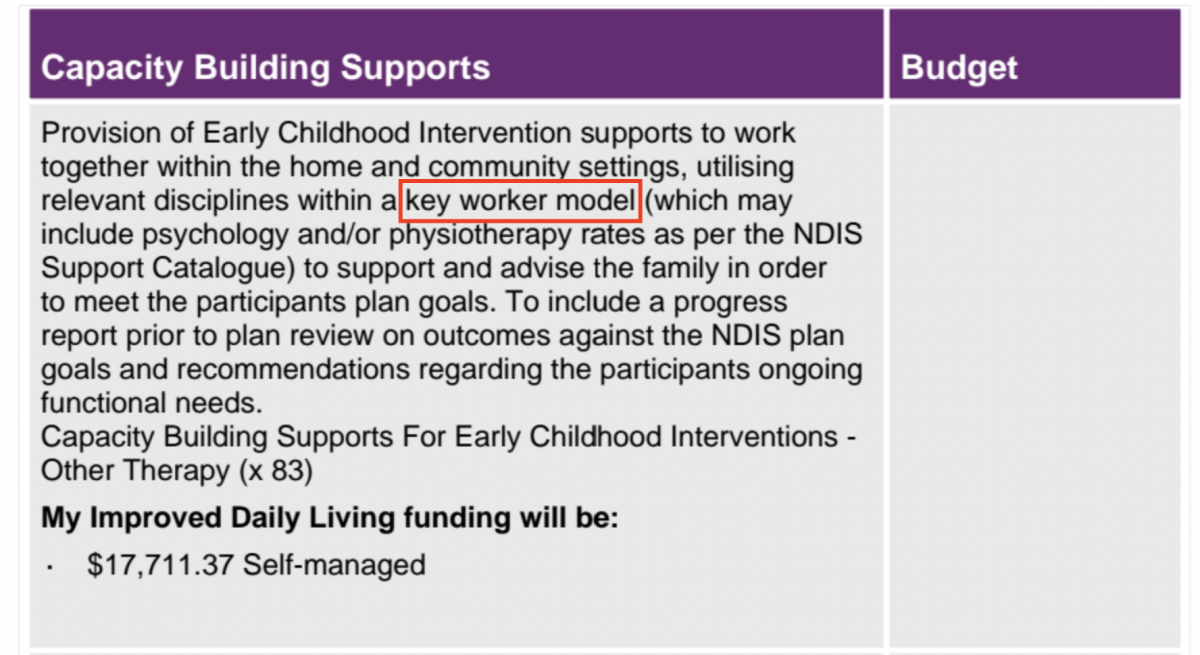
There will be a stated item of support in the Capacity Building Supports part of your NDIS plan, labelled Early Intervention (children <9yrs) and indicates the funding is for a ‘Key worker Model’. The amount included in the plan, as illustrated below, will be an aggregate amount which includes the funding for the key worker and all related therapies.

  1. You may have this Capacity Building support specified in your place. See this extract from an NDIS plan: 

    keyworker extract from ndis plan
     

2. Or your child have General Therapy Funding which you can use on a KEYWORKER.


Where do I find Key worker prices in the NDIS price guide?

The cost of a key worker will be the cost of the individual (therapist, social worker etc) you choose to take on this role.

Therapy rates for a Key Worker can be found in the NDIS Price Guide. Search for NDIS Keyworker prices here.


What characteristics make a good Key worker?

Being a Keyworker is all about working with the families, paediatricians and other Early Childhood Intervention professionals to develop a child and family friendly therapy support plan around the developmental goals of the child.

To be a good Key worker you must:

  • Have great rapport and skills in working with children
  • Work really well with families, playgroup facilitators and development educators from childcare or kindergarten (they might be with you for 4 years!)
  • Be a great trainer (upskilling and educating is a big part of the Key worker's role)
  • Have experience working in a multidisciplinary team (collaborating with colleagues from different fields like Speech Pathologists, Paediatricians and Psychologists)
  • Have worked in a multidisciplinary team environment (can draw on skills and knowledge from different areas to inform their practice)
  • Have experience with the Key worker Model


How do I choose the right NDIS Key worker for my child?

Typically your therapy provider will match you to a Key Worker Therapist who is best suited to your child's needs.

The Key worker’s professional background should align with the priority areas of the child.

Sometimes the NDIS Planner will nominate an ECI Professional in the plan, for example a Physiotherapist or a Psychologist, but not always.

Below is a quick guide to help you identify who might be best suited to the role of Key worker:

  • A Physiotherapist would make an awesome Key worker if the goals concern gross motor skills, or gross motor delay, positioning for optimal function, standing and balance, assistive technology like walkers, wheelchairs and lower limb splints (such as not sitting properly, not running, hand-eye coordination, toe walking etc…) 
     
  • An Occupational Therapist would be your go to as the Key worker, if most of the goals are around improving fine motor skills (holding a pencil, brushing teeth tying shoelaces), dressing and hygiene, play skills, assistive technology, sensory processing/behaviours, planning/organisation skills.
     
  • A Speech Pathologist would be a good choice, if the goals are related to anything language/communication (social stories, speech articulation, need for a communication device), play skills, eating (things like swallowing or food aversions), sensory processing/behaviours.
     

The child’s goals might cover all of these areas to some extent. It is the job of the Key worker to break down each goal into its components and identify when additional expertise is required to help address a specific challenge.

For example, a Physiotherapist might be working on goals around helping your child sit comfortably and improve their posture for handwriting and class participation, but then identify some challenges around pencil grip, which is fine motor skill related. The Physio Key worker would then bring in an OT to help with fine motor skills so that together, they can achieve the goal of improved handwriting and participation in class.


Where do I find a Key worker?

Because the Key worker Model is all about teamwork, it is generally easier to deliver this model of support through a large therapy provider with an Early Intervention Team where all the ECI professionals your child needs can be found in the once place. Other benefits of going to a large provider include:

  • Leveraging existing relationships and strong communication between team members who already work in the same company.
  • It is highly likely that the Key worker would have already worked in a multidisciplinary team before, and have the access to a team of health professionals that can support the child/family (family-centred practice)

Ask MyCareSpace to help you find an NDIS Key worker

MyCareSpace resources may be shared provided they are credited to MyCareSpace with backlinks to the original resource.

Resource Author: Bianca S. | NDIS Expert   Last Updated: 11 March 2026
NDIS

According to the latest NDIS Quarterly report, close to 99% of NDIS Participants receive funding in their NDIS plan for therapies.

This funding is for therapies like occupational therapy, speech therapy, psychology, physiotherapy and also more unusual ones like art therapy, music therapy and rehabilitation counselling.

Where to find the NDIS therapy funding in your NDIS Plan

Funding for therapy is found in the Improving Daily Living Skills category, which falls under the CAPACITY BUILDING section of your NDIS plan. 

NOTE: this is different from the CORE funding part of your NDIS Plan which includes funding for support workers. (See our resource called Understanding your NDIS Plan for help understanding the different sections of your plan)

When engaging NDIS Registered Therapy Providers for Occupational Therapy, Speech Therapy, Psychology, Physiotherapy and more, you will need to know how much their hourly fee is under the NDIS so that you can work out how many hours of therapy are included in your NDIS plan.


Does my therapist have to be NDIS Registered?

Your therapist does not have to be NDIS registered if your NDIS plan is self-managed or plan managed.
They simply need an ABN to invoice you, making sure they use the right line items from the NDIS Support Catalogue if they want to be paid quickly.

Using our NDIS Price Guide search tool, you can see all the therapy line items easily! 

Therapy items in the Support Catalogue

This also means you can keep your existing therapists after joining the NDIS and use your NDIS funding to pay them.


How do I know how many hours of therapy I have in my plan?

If it's not specified, you can do this by dividing the total amount of funding in your plan by the hourly rate of the therapy/therapies you want to use. This may be the NDIS rate or lower.

NOTE: You can use this bucket of funding for ANY therapy, even if it has something specified in your plan.

NOTE: The team at MyCareSpace can help you work this out.


How much is my NDIS therapy going to cost?

It depends on whether you are using registered or unregistered NDIS providers

You can use both unregistered and registered NDIS providers, but it's likely you'll find that NDIS registered providers charge higher rates than unregistered NDIS providers.

If you are using a therapist who is not NDIS registered, your therapy is likely to cost less per hour. For example, a physio may charge you $130/hour but a physio who is a registered NDIS provider will use the NDIS rate of around $194/hour.

Prices do differ across different types of therapy, with Psychology being the most expensive and counselling being the least expensive. 

NOTE: your therapy funding includes "assessment, planning, and delivery of therapy", which means that this funding can be used for assessments (like functional capacity, wheelchair or housing assessments) and for ongoing therapy.

Remote Pricing

Higher rates are paid for therapy delivered in rural and remote areas. These prices can be seen in the NDIS Price List and will depend on their MMM rating.

For Areas MMM4-5, the Remote rate applies. For Areas MMM6-7, the Very Remote rate applies. See an extract:

Assessment Recommendation Therapy or Training - Psychologist
Improved Daily Living Skills

15_054_0128_1_3
$214.41   H (NSW)
$328.76 (Remote)
$352.25 (Very Remote)

See how to work out if you are in a Rural or Remote region


NDIS Therapy Prices

The NDIS Support Catalogue (NDIS Price List) contains the current prices for all therapies. MyCareSpace has an easy-to-use NDIS Price List tool where you can search for all NDIS prices.

NDIS Therapy Rates

NOTE: the latest price list saw specific line items added for more alternative therapies like Music Therapy and Art Therapy.

NOTE: there are also matching line items for popular therapies in the SOCIAL and COMMUNITY PARTICIPATION funding


How much is Online Therapy?

Teletherapy or online therapy means the therapy is not delivered face-to-face, but rather over the phone or video.

It can be used to deliver therapy like Occupational Therapy, Speech Therapy, Psychology and even Physiotherapy where appropriate and with the agreement of the participant.

Providers can only claim Telehealth Services where ALL of the following conditions are met:

  • The delivery of the support by telehealth is appropriate
  • The proposed charges for the activities comply with the NDIS Pricing Arrangements and Price Limits and with the Service Agreement with the participant
  • The activities are part of delivering a specific therapy to that participant (not things like enrolment, administration or staff rostering)
  • The provider explains the activities to the participant, including why they represent the best use of the participant’s funds (that is, the provider explains the value of these activities to the participant)
  • The provider has the agreement of the participant in advance (that is, the service agreement between the participant and provider specifies that Telehealth services can be claimed).

Providers have a duty of care to their participants to ensure they are providing the same standard of care through video technology as in a clinical setting.

Teletherapy costs the same as a direct face-to-face service.

Claims for Online Services should be made using the same relevant support line item in the NDIS Price Guide. When making a claim on the portal, you would select the "Telehealth Services" option.

How much is online therapy when it's delivered to a participant in a remote or very remote area?

In general, the cost of teletherapy = the price of therapy delivered at the location of the provider. So, even if a participant is in a remote area, the rate charged depends on where the provider is located.

For example: if the speech therapist is located in the metro Sydney area, and the participant is in a very remote area in Western Australia, the rate charged would be the regular metro Sydney rate.

BUT, participants in Remote or Very Remote areas can agree to pay the remote or very remote prices, if they are satisfied that the support provides value for money.


How much can a therapist charge for travel

Your therapists can charge you for travel. They can claim for:

  • the time spent travelling to each of you: 30 minutes in MMM1-3 areas and 60 minutes in MMM4-5 areas.
  • the time spent travelling from you (if you are the last participant), back to their usual place of work.
    Note: this travel is only claimable when the provider must pay their worker for the return travel time.
    Note: the maximum amount of return travel is 30 minutes in MMM1-3 areas and 60 minutes in MMM4-5 areas.

See how to work out MMM region

Shared Travel Time

Where a worker is travelling to provide services to more than one participant in a ‘region’, then it is reasonable for a provider to apportion all of the travel time (including the return journey where applicable) between the participants.

This apportionment should be agreed upon with each participant in advance as part of the service agreement.

How will your therapist charge for travel?

Claims for travel must be made separately from the claim for therapy on your invoice. The hourly rate for travel is the same as the therapy rate, unless otherwise agreed beforehand with the participant.

There is a matching “Provider Travel” line item for each therapy. The therapy is allocated to the therapy line items. The travel is allocated to the matching travel line item.

How much can my Therapist charge for travel


Top 3 Tips when choosing a Therapist

  1. Choose a therapist that has availability now (or very soon) - confirm a start date. If you agree to waitlist, make sure you have a start date.
     
  2. Choose a therapist that can help you reach your goals - this may not be the therapist you think you need!
    Did you know that both an OT AND a Physio can deliver therapy to help you reach the same goals?
     
  3. Watch out for travel costs. Did you know that you have to agree to any travel costs up front!

MyCareSpace resources may be shared provided they are credited to MyCareSpace with backlinks to the original resource.

Resource Author: Bianca S. | NDIS Expert   Last Updated: 11 March 2026
NDIS

In a nutshell, arts therapy uses the sensory elements made available through art making, movement and other creative processes as a means to facilitate communication and expression.

In other words, art therapy helps NDIS participants connect with and express thoughts and feelings that are difficult to communicate through talking, using different forms like:

  • Images
  • Colour
  • Movement
  • Sound
  • Shape

Does Art Therapy always involve visual arts like painting or drawing?

No, it doesn’t. The beauty of art therapy is that it can utilise all forms of artistic expression. If you enjoy drawing or painting, you can certainly do this in your session. 

At Crayons and Stuff, however, we offer the opportunity to work across a range of forms, including:

  • The visual arts (e.g. painting, collage, pencils, pastels, Textas)
  • Poetry
  • Narrative
  • Clay
  • Sandplay
  • Installations
  • Photography
  • Digital drawing
  • Editing and animation
  • Objects
  • Textiles
  • Movement
  • Music
  • Dance and drama

Do I have to be good at art to be able to benefit from it?

Not at all. The purpose of arts therapy is to help you find a way to express yourself and communicate your experiences.

So, whilst there may be mediums that are better suited to expressing yourself than others, no art making skill or experience is required :)

As mentioned previously, arts therapy doesn’t even need to involve visual arts like drawing or painting – taking a walk through a park and identifying leaves or natural objects that connect you to that place or represent other thoughts and emotions could be a form of arts therapy.

How does Arts Therapy help an individual?

Sometimes it’s hard to make sense of our experiences, particularly if they have been difficult or emotionally challenging. By opening up discussions about someone’s artwork and the art making process, we can help participants gain insight and create meaning from their experiences.

However, you do not need to talk to get benefits from arts therapy and many people engage in arts therapy to support much broader goals or creative activities.

What qualifications does an art therapist need?

Art therapists are mental health professionals who are trained to use creative methods in their work... Under the NDIS, art therapy is classed as an Allied Health Provider.

This is very different to an art teacher. While many people choose to use the title of art/arts therapist, there are significant risks in seeing a practitioner who does not have adequate training or oversight and supervision of their work.

Arts therapists working as or for NDIS registered providers should meet the qualification standards required for professional membership of the Australian, New Zealand, and Asian Creative Arts Therapy Association (ANZACATA). This usually requires a Master’s degree or equivalent.

Some qualified art therapists choose to register instead with the Counselling Associations, such as the Psychotherapy and Counselling Association of Australia (PACFA) or the Australian Counselling Association.

Through any of these memberships, you have assurance about (and oversight of) the quality of our practice and our work is represented by the Allied Health Professional Association.

How much does an arts therapist cost? Can I use my NDIS funding for an Art Therapist?

A qualified art therapist is entitled to charge in accordance with the NDIS Price Guide, which allows up to $193.99 per hour (metro) and can be charged under the Other Therapy groups of funding. The line items are listed below:

  • 15_610_0128_1_3 – Assessment, Recommendation, Therapy and/or Training – Art Therapist
  • 15_056_0128_1_3 / 01_741_0128_1_3 - Assessment, Recommendation, Therapy and/or Training (including Assistive Technology) - Other Professional
  • 15_005_0118_1_3 - Capacity Building Supports for Early Childhood Interventions - Other Therapy

Note: If the participant is attending a group session, prices may be lower depending on the number of people in the session.

What NDIS budget do I use for art therapy?

Art therapy is usually funded from the Improved Daily Living budget. However, some participants are eligible for Disability Related Health Supports which can be taken from the Core budget.

What NDIS goals can an art therapist help me reach?

Arts therapy can support a very wide range of goals, such as:

  • health and wellbeing
  • self-care and self-management
  • daily living skills
  • community participation
  • social skills
  • confidence building
  • improved relationships

It can also support more specific goals, such as employment, education, or improved living arrangements.

It does this by assisting the participant to explore barriers to achieving their goals and/or generate new strategies for working towards them.

Art therapists in early childhood will often focus on using a range of creative methods to support communication, social interaction, learning and/or emotional regulation.

The Crayons and Stuff practice model is flexible, person centred and emergent, which requires being responsive to the participant’s needs in each session.

This provides a safe space in which they can explore and express the issues of most significance to them and can be done while achieving therapeutic outcomes and tangible steps towards their goals.

How do I know If I might benefit from an art therapist?

As a general rule of thumb, if a qualified health practitioner like a GP has indicated you may benefit from seeing a Mental Health Practitioner like a Psychologist or a Counsellor then you may benefit from seeing an Arts Therapist.

Some other ways to tell if Art Therapy may be beneficial:

  • You have mental health challenges including depression, anxiety, or a history of self-harm
  • You have a psychosocial disability
  • You struggle to express yourself and your emotions to others
  • You have difficulty understanding and/or processing your own emotions and experiences
  • You find it difficult to manage your emotions and/or behaviours
  • You are non-verbal, selectively mute or sometimes don’t like talking
  • You are not benefiting from traditional talk therapy
  • You already enjoy art or
  • You have not made art for some time and would like support to access your natural creativity

Are there certain disability types that benefit from art therapy more than others?

At Crayons and Stuff many of our NDIS participants have autism, developmental delays or psychosocial disabilities but nearly anyone can benefit from art therapy. It is personal preference, rather than a disability type that determines who can benefit.

Is there an age limit?

No. Art Therapy can benefit people of all ages.

Is arts therapy an evidence-based practice?

Art therapy meets the criteria for evidence-based practice, including through published and refereed literature and consensus of expert opinion.

For example, in 2019 the World Health Organisation (WHO) confirmed the effectiveness of the arts and arts therapies for helping people experiencing mental illness at all stages of the life course and reported studies suggesting good cost–effectiveness. Both the WHO report and an Australian review of the efficacy of the Arts Therapies in 2013 found the effectiveness of creative arts therapies for a wide range of other conditions.

The WHO Report finds specifically that the beneficial impacts of arts therapy could be furthered through better acknowledging and acting on the growing evidence base (WHO Health Evidence Network Synthesis Report 2019).

A core strength of Arts Therapy is that it responds to the needs of each person rather than a diagnostic or one-size-fits-all approach.

At Crayons and Stuff, we place a high value on experiential evidence, where the participant (and, where appropriate, the carer) are supported sensitively to reflect on their own experience of the process and any changes they have observed.

This is consistent with the NDIS legislation, which recognises the lived experience of a participant and their carer as evidence of the effectiveness of a particular support, including for others in like circumstances.

We are confident that by now the NDIS will have an incredible archive of testimonies to the benefits of art therapy in the voices of NDIS participants and their carers.


Find Art Therapists

MyCareSpace resources may be shared provided they are credited to MyCareSpace with backlinks to the original resource.

Resource Author: Bianca S. | NDIS Expert   Last Updated: 11 March 2026
NDIS

Find an Exercise Physiologist


Is an Exercise Physiologist the same as a Personal Trainer?

Definitely not. Exercise Physiology provides 'specialised clinical exercise interventions' for a broad range of health issues. So, what does that mean? Well, to help unpack this question and the incredible work that Exercise Physiologists can do, we caught up with Peter Fauvette, Director at Meta Health Care, who is himself a passionate, dedicated Exercise Physiologist.

So what does an Exercise Physiologist do?

An Exercise Physiologist has been trained extensively to evaluate the complexities of different chronic conditions and disabilities and to provide individuals with long-term, effective and safe exercise options that will help them improve their function and health.

They provide expertly designed exercise interventions that specifically target and assist clients with their disability and health goals.

They aim to help you manage your disability, chronic disease or injury so that you can restore your physical function and improve your day to day life

Exercise Physiologists will also provide health modification counselling (advice on how to change the way you do things) with a strong focus on achieving behavioural change. PS: but they are not counsellors or behaviour practitioners.

How is Exercise Physiology different from Physiotherapy or Occupational Therapy?

Exercise Physiologists have extensive knowledge, skills and experience in clinical exercise delivery. They look at the big picture - not just the disability or injury.

Physiotherapists are a great starting point to get people/s to the stage where they can benefit from active therapies. In short, a Physiotherapist will get you walking, and an Exercise Physiologist will get you running!

Occupational Therapists assist people/s by providing therapies and assistive technology that enable people to safely complete activities of daily living and mobilise around the home or community. E.g. Motorised Wheelchairs and Home Modifications.

Exercise Physiology and the NDIS

When would you need an Exercsie Physiologist to help you achieve your NDIS goals?

Any NDIS participant seeking greater independence, capacity to participate in their community or improved health and disability outcomes would benefit greatly from an Exercise Physiologist.

What goals can Exercsie Physiologist help NDIS participants achieve?

  • Improve community participation
  • Health behavioural change
  • Meeting physical requirements for employment
  • Improve mobility
  • Increase independence
  • Weight and muscle management

What kind of NDIS funding do I need?

Exercise Physiology, just like other types of therapies and can be billed under Capacity Building -> Daily Living.

This means you need to have funding in the Improved Daily Living Category - the same category where you will find funding for other therapies like Physio and OT.

You can CHOOSE what kind of therapy you can use this funding on, as long as your Improved Daily Living Category is flexible in your plan and does not specifically state or list the therapy types you can use your funding for.

Can Exercise Physiologist perform Functional Capacity Assessments? If not, what kinds of assessments can you do?

Yes! Exercise Physiologists are actually great at functional assessments as they utilise the principles of exercise to break down the task requirements and functional capacity needed to perform a specific task.
 

How long does it take to see results, and how long do I see a clinician for?

From the first session, you will learn to apply better movement strategies. As we work with you and create your personalised tailored for you exercise program you’ll begin to feel improvements in your abilities and overall condition.
 

Where do Exercise Physiology sessions take place? 

Exercise Physiologists usually work at gyms, parks, and/or in the comforts of your home and we usually bring the equipment necessary to treat the person/s.

Exercise Physiotherapy sessions can also be delivered via teletherapy - depending on the safety constraints of the person/s disability (e.g. falls risk).
 

Case study

(Name masked for identity purposes) John is a 22-year-old male with Duchenne Muscular Dystrophy who dreamed of playing footy since he was 7 years old.

John was always told by numerous therapists that it was not possible for him to get the strength he would need to run or walk without assistance. John first began seeing an Exercise Physiologist in 2016 (age 16), he was unable to walk without the use of walking aids or get in and out of chairs by himself.

John also lacked confidence about his ability to improve which reduced his motivation in life. Through vigorous exercise plans and sessions designed by his Exercise Physiologist, John was not only able to begin walking on his own, but running, which proved to be an important step toward his dream of playing footy.

By 2020, John was able to gain the strength and agility required to participate in community football. Then in 2021, John achieved his dream of playing NRL in the Disability Rugby League championship!


About the Author

Peter Fauvette is owner and exercise physiologist at Meta Healthcare who offer mobile Exercise Physiology services and Functional Capacity Assessments

Find an Exercise Physiologist


MyCareSpace resources may be shared provided they are credited to MyCareSpace with backlinks to the original resource.

Resource Author: Bianca S. | NDIS Expert   Last Updated: 15 June 2026
NDIS

Once you have received your National Disability Insurance Scheme (NDIS) plan, and have decided how you would like to manage your plan, it’s time to choose which providers you’d like to deliver the services that will help you reach your goals.

Key points:

  • It takes time and money for service providers to become NDIS registered, so some chose not to. They’re known as unregistered providers.
  • Being unregistered does not directly relate to a service provider’s professionalism or quality of supports.
  • Which type of providers you can use depends on how you choose to manage your plan.
  • During your research you may notice that there are both ‘registered’ and ‘unregistered’ providers when it comes to accessing NDIS supports. So, what do these terms mean and how do they affect your NDIS journey?
  • The information below will help you understand the pros and cons of each so you can choose what providers best suit your needs.

What is a service provider?

Service providers are businesses or individuals who deliver specific services or therapies.

There are many different types of providers. Some are large companies, others are small, family-run businesses or sole traders. Examples of service providers include:

  • Physiotherapists
  • Disability support workers
  • Wheelchair manufacturers
  • Occupational therapists
  • Support coordinators

Both registered and unregistered providers can list on MyCareSpace.

What does NDIS registered mean?

A NDIS registered service provider is a provider that has registered its services and has been approved by the National Disability Insurance Agency (NDIA) to deliver NDIS funded services.

The NDIA asks service providers to register with the NDIS, however not all providers do.

To register, providers must meet certain criteria, such as the NDIS Price Guide, and follow specific rules, regulations and agreements when providing services. NDIS registration can be a lengthy and costly process, and because of this some businesses choose to stay unregistered.

You can choose to use both registered and unregistered providers for any supports or services funded through your NDIS plan if you are self-managed or plan-managed. If you are agency-managed (sometimes called NDIA-managed), you can only use registered providers.

Registered providers can deliver some services that unregistered providers can’t, including Specialist Disability Accommodation (SDA), Supported Independent Living (SIL), Plan Management, behaviour support or behaviour management plans, as well as supports that involve any restrictive practices.

Benefits of choosing a registered provider:

  • The provider has been through the registration process and meets NDIA guidelines
  • They are fully recognised as a provider committing to a certain quality standard
  • Invoices are sent directly to your NDIS portal
  • Registered providers must adhere to price caps set by the NDIA
  • They can deliver certain services that unregistered providers can’t

Possible cons of using registered providers:

If you are agency-managed but there are no relevant registered providers in your area, you may have to travel to find one. For example, if you need an occupational therapist but there are none registered in your area, you might need to travel a long way to access this support. Or, the local registered occupational therapist might be at capacity and not currently taking on new clients.

What is an unregistered provider?

An unregistered service provider has chosen not to complete the NDIS approval process, though can still offer a valid service to participants.

Don’t be put off by the term ‘unregistered’ when it comes to choosing supports. Unregistered providers can still provide NDIS-funded supports, and have the necessary skills and resources to provide high-quality services to people with disability.

Unregistered providers and their workers are still required to adhere to the NDIS Code of Conduct. The NDIS Commission Enforcement and Compliance Policy also applies to unregistered providers, and anyone can make a complaint to the Commission about a provider or worker regardless of registration status.

Unregistered providers working with self-managing participants are free to set their prices. You will only be able to claim the price the NDIS has set for the service in its price guide on your plan. You will need to pay any cost above and beyond that rate out of your own pocket.

Benefits of choosing an unregistered provider:

  • You are free to choose whichever provider you’d like to deliver your services
  • There is a larger network of providers to choose from
  • The ability to continue working with a provider you previously used, who is unregistered, when you transition onto the NDIS

Possible cons of using unregistered providers:

  • If you self-manage your NDIS funding using unregistered providers may result in more paperwork. Providers will send invoices directly to you which you have to manually claim back through the NDIS portal
  • They do not have to adhere to the quality and safeguards requirements of the NDIS Commission. For example, they do not need to conduct audits to show they are compliant with these requirements

The difference between registered and unregistered

To summarise, the main differences between registered and unregistered providers are:

Unregistered providers working with self-managing participants are free to set their prices, whereas registered providers must adhere to the NDIS price caps

You can access unregistered providers only when you have a plan-managed or self-managed NDIS plan. On the other hand, if you are agency-managed, you only have access to registered NDIS providers

If you self-manage your NDIS plan, unregistered providers will send their invoices to you to pay and you will then have to manually claim the funds back from the NDIS using the NDIS portal - but if you're plan managed, your NDIS plan manager does this for you

Registered providers can deliver some services that unregistered providers can’t, including Specialist Disability Accommodation (SDA), Supported Independent Living (SIL), Plan Management, behaviour support or behaviour management plans, as well as supports that involve any restrictive practices

As a NDIS participant, you have a lot of choice and control over who delivers your services. There are many positives to using either registered or unregistered providers and, if you are plan or self-managed, you have the freedom to choose a mixture of both.

MyCareSpace resources may be shared provided they are credited to MyCareSpace with backlinks to the original resource.

Resource Author: Bianca S. | NDIS Expert   Last Updated: 11 March 2026
NDIS

As trusted community members, Community Connectors play a critical role in identifying and engaging with people with disability and their representatives.

At March 2021, the NDIA employed 173 Remote Community Connectors covering 274 rural and remote communities over 90 Local Government Areas throughout NT, SA, WA and QLD. 

Remote community connectors are community members employed by your local Aboriginal Medical Service (AMS) to connect you to services, support workers and the NDIA (National Disability Insurance Agency). Talk to your RCC if you or a family member have permanent or significant impairment that affects your day to day quality of life.

The purpose of the Remote Community Connectors (RCC) Program is to ensure there is culturally appropriate connection between the National Disability Insurance Agency (NDIA) and community, helping to enhance engagement and communication allowing Aboriginal people living in the Kimberley access information about the NDIS and are supported to complete NDIS plans.

Their role is to:

  • Engage community in their understanding & awareness of the NDIS and support local linkages
  • Identify potential NDIS eligible Aboriginal people living in community with disability
  • Engage potential NDIS eligible Aboriginal people and their families in their understanding & awareness of the NDIS, the eligibility requirements & access process
  • With consent, refer those identified as requesting further assistance to the EACP Coordinator

How to find them?

The MyCareSpace team are looking for a list of connectors (organisations offering this service) but this seems to be non-existent. We will keep adding as we discover organsisations.

WA

Kimberley

Kununurra Waringarri Aboriginal Corporation 

Location: Doon Doon, Glen Hill,  Kununurra and Wyndham

Chantelle Un
Remote Community Connector
Phone: (08) 9168 1528
Email: [email protected]


Nirrumbuk Environmental Health Service 

Location: Balgo, Billiluna, Mulan, Beagle Bay, Bidyadanga, Broome (Broome based)

Phone: (08) 9193 7100

Sara Garrido Diaz
Project Officer for RCC Program
Phone: 0439 712 153
Email: [email protected]


Winun Ngari Aboriginal Corporation 

Location: Derby,  Imintji,  Jarlmadangah, Mount Barnett, Mount Elizabeth,  Ngallagunda and Pandanus Park

(08) 9191 1877

Trish Spencer
Remote Community Connector
Phone: 0459 936 965
Email: [email protected]


Yura Yungi Medical Service

Location: Halls Creek and Ringers Soak.

Rowena Carey
Remote Community Connector
Phone: (08) 9168 6266
Email: [email protected]


South West

South West AMS

GRAHAM STOL - REMOTE COMMUNITY CONNECTOR
JANENE GRAY - REMOTE COMMUNITY CONNECTOR

Unit 5/55 Forrest Ave, Bunbury, WA 6230

Phone: (08) 9726 6000
Toll free: 1800 779 000
[email protected] www.swams.com.au

MyCareSpace resources may be shared provided they are credited to MyCareSpace with backlinks to the original resource.

Resource Author: Bianca S. | NDIS Expert   Last Updated: 11 March 2026
NDIS

Everyday Independence

The team at Everyday Independence have answered the following questions asked during the webinar we delivered: Positive Behaviour Supports & the NDIS:

1. Can I stop a participant from trying to commit suicide for the first time and then report this immediately?

We must act with a duty of care to keep the people we support safely. Please seek support from your management and they can guide you to their policies and/or appropriate training.


2. Would using harnesses in wheelchairs & whilst transporting a client living with HD be seen as therapeutic rather than a restrictive practice?

This will be guided by the occupational therapist/assistive technology specialist involved or behaviour support practitioner. Remember that a device can be both therapeutic and restrictive. If the person is showing some elements of challenging behaviors when in the wheelchair, then it would have a restrictive element, and we as their supports need to find out the function of that behaviour. For example, they may need thoracic support in the form of a harness to enable functional posture (I.e. supporting a person’s trunk so they can use their upper limbs more effectively to eat independently ) but they are also using challenging behaviours in the wheelchair. If we do not understand the function of the behaviour, then we are also not addressing what the person is trying to communicate to us when in the wheelchair (maybe the wheelchair seating system is uncomfortable?).

A restrictive practice is only restrictive when it is used to manage or change behaviour and on most occurrences, we need to understand the whole situation to determine whether something is restrictive or not.


3a. Can Independent Support workers work with restrictive practices if they are not registered with the commission?

3b. As a registered provider supporting a client who has a Positive Behaviour Support Plan (PBSP) with no restrictive practices vs a PBSP with restrictive practices. Does the provider need to be registered under any certain groups or areas to support the client?

NDIS Quality and Safeguards Commission provides the following information when addressing these questions:

What is an implementing provider?

An implementing provider is any NDIS service provider that uses a regulated restrictive practice in the course of delivering NDIS support to a participant. For example, support workers restricting a participant’s free access to the community due to behaviours of concern are implementing a regulated restrictive practice.

Implementing providers are required to:

  • Be registered with the NDIS Commission for the type of support they are providing. They do not need to be registered specifically for behaviour support registration group 110
  • Submit monthly reports to the NDIS Commission on the use of restrictive practices
  • Ensure staff are appropriately trained to implement positive behaviour strategies or use restrictive practices
  • Notify the NDIS Commission in the event of any unplanned or unapproved use of a restrictive practice through the reportable incident process
  • Help your staff, NDIS participants, their families, and other decision-makers to understand the NDIS Commission’s behaviour support function

So in short, the answer is, you are required to be registered with the NDIS Commission if you are implementing restrictive practices.

If there are no restrictive practices, then you are not deemed an “implementing provider” and therefore do not need to be registered to deliver that support to that participant.


4. Can an independent support worker (not registered) support a client on a Positive Behaviour Support Plan (PBSP)?

This depends on whether the PBSP has a regulated restrictive practice or not. Remember some PBSP have no restrictive practices. The regulations do not sit with Positive Behaviour Support as a model or the reports but the restrictive practices.


5. Are Support Coordinators responsible for reporting incidents to the commission if there are no registered providers involved?

The behavior support practitioner is required to upload the unauthorized Behavior Support Plan onto PRODA and close the account, advising the NDIS commission that an unregistered NDIS provider is implementing restrictive practices within self or plan managed funding.

In most occasions, we, the Behaviour Support Practitioner will notify the providers, participants, family they are doing this.

The Behaviour Support Practitioner will continue to implement the plan which includes the supports of completing important documentation and incident reporting if they occur. (Unregistered providers still have obligations as stated on the NDIS Commission Website.
See Unregistered NDIS providers | NDIS Quality and Safeguards Commission

The NDIS commission may then work with the participant and the unregistered provider to make appropriate arrangements.

Details on how to complete an incident report can be found here


6. Please provide some resources or person contact in case we can sort any doubts related to the PBS?

My first recommendation is to contact the Behaviour Support Practitioner, so you can discuss the doubts or findings. If you are still not satisfied, then refer to the signed service agreement on how you can escalate your concerns.


7. Are there any reporting requirements for family members or self-employed support workers who are implementing a restrictive practice?

Family members do not complete monthly reporting to the Commission. The Behavior Support Plan is uploaded onto PRODA to advise there is an RP in place but is being implemented by the family. The Plan is then closed on PRODA so monthly reports do not need to occur. The RP’s will continue to be monitored and discussed between family and Behaviour Support Practitioners to determine whether the strategies are successful in achieving quality of life outcomes and RP fade out plan.

Self Employed Support Workers- please refer to Question 3.


8. Will prompting client to take medication (PRN), when the doctor has signed to say able to self medicate, be termed as Chemical restraint?

Firstly, the prescribing doctor needs to advise us the purpose of the medication- is it for physical reasons or a diagnosis- if it’s either of these, this is not restrictive. If it has been prescribed for behaviour management; then this is restrictive. Prompting someone to take a chemical restraint or any restraint to stop or influence a behaviour, would be deemed as being restrictive.


9. Typically, how many sessions and time is required to complete a Behaviour Support Plan (BSP)? Can BSPs be completed only by interviewing family, services, AH etc? Are PBS Prac typically required to make observations and meet with individuals?

It can fluctuate but approximately 20 hours, and it depends upon the situation.

PBS is a person-centered approach and we value the time with participants to get to know them, their goals, and how we can support them to reach their full potential. However, remember, it is not just about the Behavior Support plan - the outcomes happen mostly in the implementation phase so more hours are required to implement the strategies with the participant and their team of supports.

We do recognise that on some occasions spending time with the participant is not accessible and this needs to be planned well to ensure that the participant and the practitioner are and feel safe.

However, we are also seeing the value of TelePBS to address some of these scenarios and slowly introduce ourselves into some of our participants' lives. 
See more on TelePBS from the NDIS Quality and Safeguards Commission 

Do you need positive behaviour support? Ask the MyCareSpace Team to connect you


Resources on Positive Behaviour Support

MyCareSpace resources may be shared provided they are credited to MyCareSpace with backlinks to the original resource.

Subscribe to Using your NDIS Funds

Our Preferred NDIS Plan Manager

Plan Hero Plan Management is our preferred NDIS Plan Manager because they are independent and specialist Plan Managers who have both lived experience and expert NDIS knowledge. Plan Management is all they do!

Plan Hero helps you keep your funding organised and on track within each funding period, so you don’t overspend or leave funds unused. They make sure providers are paid on time and help you stay on top of your budget. Their team is easy to reach, with clear, direct communication and no waiting on hold (ever).

Plan Hero gives you the support you need to use your NDIS funding with confidence.