Home / Using your NDIS Funds

Using your NDIS Funds

Resource Author: Bianca S. | NDIS Expert   Last Updated: 11 March 2026
NDIS

How to hire a support worker without core funding

We speak with many families with young children, who have been told that they cannot use their NDIS funds to pay for a support worker.

For general household tasks, such as assistance with cleaning and cooking, a support worker would be funded from the Core budget.

Generally speaking, for children without high physical support needs, CORE funding is not provided for a support worker, because this is assumed to be a ‘normal parenting’ responsibility that is not directly linked to a child’s disability. In other words, it's normal to expect parents to assist their children with everyday personal care activities like bathing, feeding and toileting. 

It may, however, be possible to hire a support worker using your Capacity Building funding, depending on the allocated funding in your child's plan. There may be funding available for a support worker to spend time with your child, engaging in capacity building activities or supporting them to access the community.  

What can we achieve with a Capacity Building Support Worker?

Depending on the age of your child, a support worker can also work with them in the home to support them with learning basic household tasks, build their capacity with everyday living tasks, and help them to build skills that will allow them to contribute to supporting the household. Think of the importance of teaching children how to contribute to family chores, as a goal in their plan.

Support workers funded through Capacity Building funding can also work with your child to continue implementing exercises that form part of their therapy program. Families adopting this approach find it a useful strategy to get the most from the funding available. 

This is something you can discuss with your therapists. The therapist can work with the support worker to provide input into useful interventions to focus on at home.

It is also worth noting that as your child gets older it is possible to request additional Core funding at a plan review. Although the NDIS do say that they consider certain household tasks as general parental responsibilities, most teenagers do begin contributing to household tasks and will support parents with cleaning, laundry, washing up, and garden maintenance. While not guaranteed, advocating for the inclusion of assistance with daily life funding has been granted for some families where children may not be able to complete these tasks independently. 

Before using Capacity Building funds to engage a support worker we would always recommend speaking with your Plan Manager, Support Coordinator, or Therapists to check that there is enough funding in the plan. You can also call our team on 1300 2888 93 and we can help you to look into this option. 

Which Capacity Building funding categories and line items could cover a support worker? 

CB - Increased Social and Community Participation

09_009_0117_6_3 Skills Development and Training 

This support item provides individual life skills development and training including public transport training and support, developing skills for community, social and recreational participation.

09_006_0106_6_3 Life Transition Planning, Including Mentoring Peer Support And Individual Skill Development 

This support item, which includes mentoring, peer-support, and individual skill development, is designed to establish volunteer assistance within the participant’s home or community to develop skills. For instance, assistance in attending appointments, shopping, bill paying, taking part in social activities, and maintaining contact with others.

CB Improved Relationships

11_024_0117_7_3 Individual Social Skills Development 

This support item assists participants to develop their social skills for participation in community and social activity.

CB Daily Activity

15_037_0117_1_3 - Skill Development And Training including Public Transport Training 

This support item assists the development of, or increases, a participant’s skills and or capacity for independence and community participation.

How do I Find a Support Worker?

MyCareSpace can help you support workers to suit your needs.

Are you looking for a support worker?

The MyCareSpace team has partnered with a number of  Support Work providers (both large and small) to be able to help families find Capacity Building support workers

Let us match you with a support worker today!

Find Me a Support Worker


MyCareSpace resources may be shared provided they are credited to MyCareSpace with backlinks to the original resource.
Resource Author: Bianca S. | NDIS Expert   Last Updated: 11 March 2026
NDIS

What is Assistive Technology

Assistive technology also referred to as AT, may be a device or item of equipment that helps you perform a task in your daily life.

To learn more, view our Understand Assistive Technology resource.

Assistive technology is classified into three levels:

  • Low-cost assistive technology: under $1,500 per item

  • Mid-cost assistive technology: between $1,500 - $15,000 per item

  • High-cost assistive technology: over $15,000 per item

Learn more about the Different Levels of Assistive Technology here.

There are different methods to purchase assistive technology depending on whether the item is low, mid or high cost. You also need to consider the level of risk of the assistive technology.

Some assistive technology purchases require NDIS approval, and some purchases do not. The following factors must be considered:

  • What is the cost of the item?
  • Is the item specifically stated in my plan?
  • Have I been allocated funding for the item in my plan?
  • Is the item considered low risk or high risk?

Let’s break it down…

How to purchase Low Cost Assistive Technology

Low cost assistive technology is the least complicated to navigate, as purchasing low cost technology does not require NDIA approval. On some occasions, you may need to seek advice from the NDIA for low cost purchases.

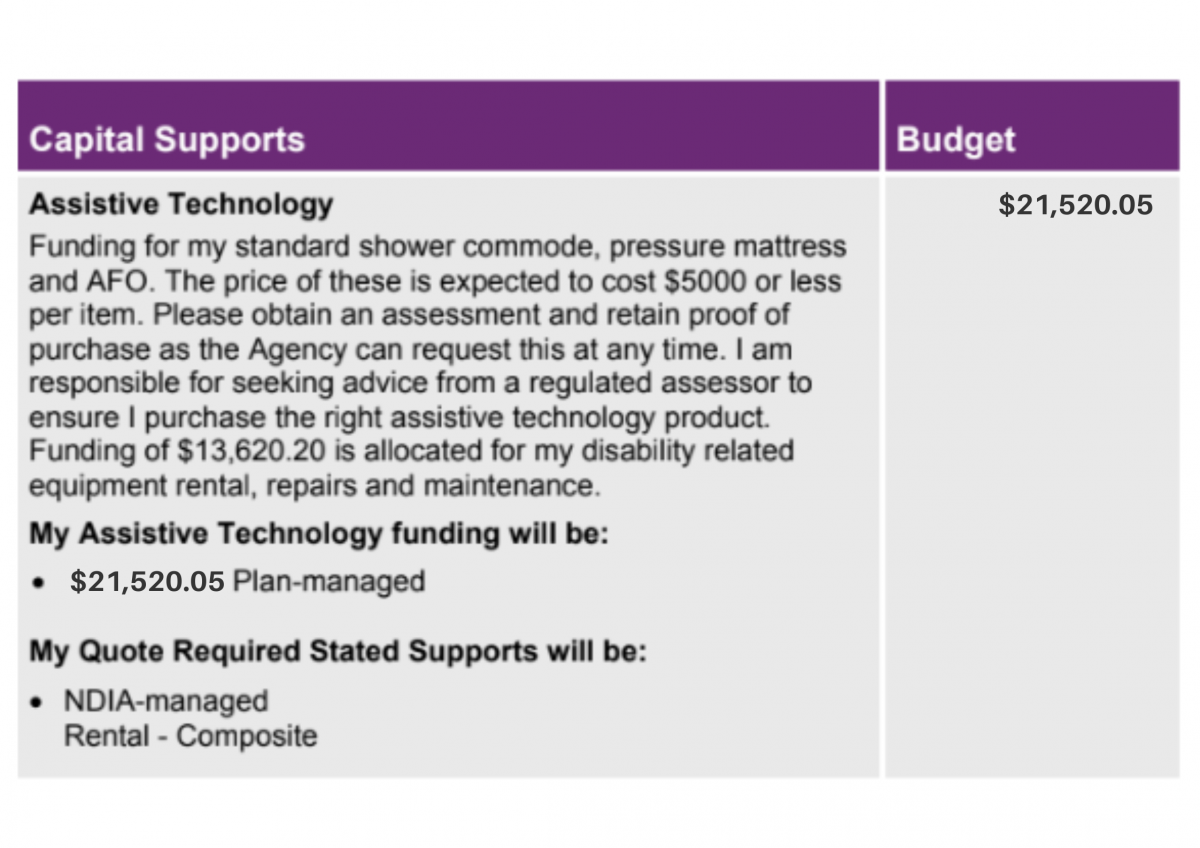
Funding for low cost technology is allocated in either your:

  • Consumables budget, located in your Core Support budget
  • Assistive Technology budget, located in your Capital Support budget

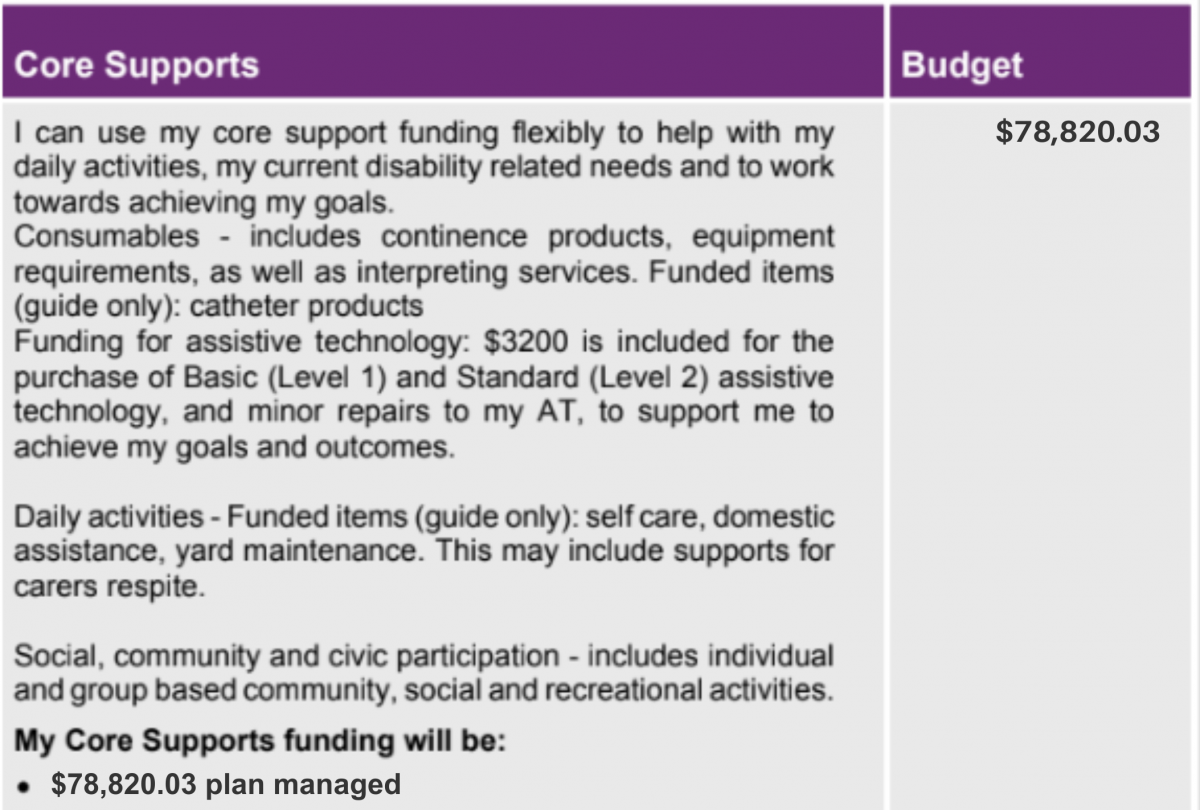
Tip: If your Consumables and/or Assistive Technology budget are NDIA Managed, you must use an NDIS registered assistive technology provider. If self or plan managed, this is not a requirement. In your NDIS Plan you will find a description of how each budget is managed. Refer to the bolded description at the bottom of the budget. The example below displays that Core Support funding will be plan managed:

Below are the steps to purchase low cost assistive technology. This is the process for low risk assistive technology only. High risk assistive technology requires more intensive input from a relevant therapist.

Planning for Low Cost Assistive Technology

When exploring low cost assistive technology options, complete the following:

  1. Consider what you have difficulty with in day to day life, and where aids or devices may help to increase your independence or make a task easier.
  2. Discuss these difficulties with a therapist (i.e. Occupational Therapist, Speech Pathologist, Physiotherapist etc) who will identify some assistive technology solutions OR 
  3. Determine the assistive technology you require through your own research.

Trial of Low Cost Assistive Technology

While completing a trial low cost assistive technology is not essential, it is a useful step to include to ensure the item meets your needs. A trial can occur:

  • At your home
  • At an assistive technology showroom
  • In the community

Trialing a range of similar products with different features helps to narrow down what is best suited for you and is specific to your disability-related needs.

How to arrange a trial of low cost assistive technology items:

  1. Once you have identified the assistive technology you wish to explore, contact the assistive technology supplier who stocks the items that you are interested in. Their phone and email contact details are typically stated on their website. Some suppliers may have an online request form on their website that they prefer you to complete.

  2. Provide relevant details via email or in the trial request form. An example email request submission has been provided below.

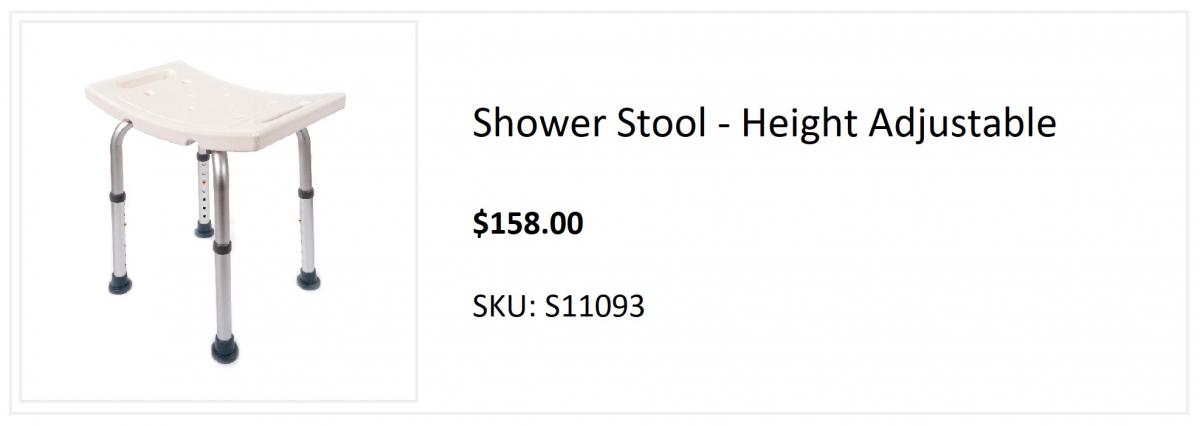
  3. In your email or the online form, specify the assistive technology items you wish to trial. It is helpful to include the product code, often displayed as an SKU, from the suppliers website. Here is an example:

  4. Consider the location when scheduling a trial. A trial at home is helpful to ensure the product is suited to your environment i.e. shower chair or shower stool trialled in your shower recess. A community-based trial is necessary for items you intend to use when out and about i.e. four-point walking stick or four wheeled walker at your local shops you visit each week. A showroom trial is beneficial when exploring a wide range of options.


Example Trial Request Email

Hi AT Pro Suppliers,

My name is Jane. I wish to complete an in-home trial of your assistive technology. Please see my details below:
Name: Jane Smith
NDIS Number: 430001002
NDIS Plan Date: 12/01/2023 - 12/01/2024
Contact: [email protected] | 0412 345 678
Address: 1/10 Bridge Road, Sydney NSW 2000
Delivery Details: Street parking available. Level access into building. Unit on ground floor.

I wish to trial the following assistive technology in my home:
SKU 1101 - Shower chair (height adjustable)
SKU 1104 - Shower stool (padded seat, no backrest)
SKU 1105 - Shower stool (padded seat with backrest and armrests)
SKU 1112 - Shower transfer bench

Proposed trial dates:
24th July, between 10.00am - 3.00pm
25th July, between 9.00am - 5.00pm
26th July, between 9.00am - 5.00pm

Kind regards,
Jane

If you are involved with a therapist, they will complete the above steps on your behalf, including coordinating and facilitating the trial.

Invoice for Low Cost Assistive Technology

Once you have selected the assistive technology you wish to purchase, request a PDF invoice of the item/s from your preferred assistive technology supplier. An invoice will display the individaul and total cost of the items, as well as a delivery/set up fee.

Why an invoice instead of a quote?

Some Plan Managers have difficulty processing quotes. Instead of the heading “quote”, make sure you see one of the following headings:

  • Invoice
  • Tax Invoice
  • Proforma invoice

If you are provided with a quote, request for it to be converted into an invoice. Ensure the supplier payment details are also included somewhere on the invoice, usually at the bottom of the document.

Paying for Low Cost Assistive Technology

The method of payment for low cost assistive technology will depend on how your funding is managed. Your funds can be managed the following ways:

  • Self Managed
  • Plan Managed
  • NDIA Managed

The MyCareSpace Self, Plan and NDIS Management Guide provides further detail.

Self Managed Payment for Low Cost Assistive Technology:

  • Make a payment request through the myplace portal for the total amount and then pay the assistive technology supplier, OR
  • Pay the assistive technology supplier and then make a request through the myplace portal.

Access the NDIS Guide to Self Management for further details.

Plan Managed Payment for Low Cost Assistive Technology:

  • Submit the invoice to your plan manager for payment.

NDIA Managed Payment for Low Cost Assistive Technology:

  • Request the supplier to create a service booking directly through the NDIS portal. Remember, the supplier must be a registered NDIS provider to access the portal.

Arrival of Low Cost Assistive Technology

Once the NDIS funding are processed, the assistive technology will be delivered to your home address. Depending on the complexity of the item, set up may be provided by the supplier. Alternatively, you may need to contact your therapist to set up the item for you.

Additional training may be required to ensure appropriate use. Consult with your prescribing therapist for training requirements for you or for your family/carers.

FAQ:

1. Does Low Cost Assistive Technology have to be Reasonable and Necessary?

Yes - Every support purchased with NDIS funding must meet the NDIS Reasonable and Necessary Criteria. Find out more on What is Reasonable and Necessary under the NDIS here.
 

2. Can I trial any assistive technology product available on a supplier's website?

Not all items are available for trial due to hygiene precautions. Some items can be removed from their packaging for trial purposes, however some items cannot. The supplier decides which items can and cannot be trialled. Typically, personal care assistive technology products (i.e. long-handled bath sponge) or products that are not easy to sanitise (i.e. pillows) are not available to trial.
 

3. Can I trial shower chairs and shower stools at home when I have a shower?

All in-home and showroom trials are considered a “dry trial”. This means you will trial items fully clothed and practice using the item only. The trial will determine which item best suits your home environment and is most useful for your self-care routine. Once you purchase the item, you can remove all packaging and use it in your daily routines.
 

4. How do I trial meal preparation aids such as a modified chopping board or modified cutlery?

You will be unable to trial the devices with real food. However, you can practice grasping and handling the devices and act out how you may use the item to see if it is right for you if the supplier allows it.
 

5. Do all suppliers offer in-home trials of assistive technology?

Suppliers are not required to offer trials of assistive technology that they sell. They may have low cost items available in their showroom which are not offered for in-home trial. Alternatively, some suppliers have a smaller selection of stock available for trial from their full purchase range. You or your therapist can discuss trial and purchase stock availability directly with the supplier.
 

6. Where can I find low assistive technology?

Your therapist will have relationships with assistive technology suppliers to explore assistive technology for your disability-specific needs.

MyCareSpace have an Assistive Technology Providers Directory for a range of AT suppliers.

Search for AT Providers

You may also search for products on the AT Australia Product Search Guide.
 

7. How do I find a therapist to prescribe assistive technology?

The MyCareSpace Connections Team can help you access assistive technology by linking you in with a therapist who prescribes assistive technology.

Get started

Alternatively, access the MyCareSpace Directory to find a therapist who can assist with accessing the assistive technology you need.


MyCareSpace resources may be shared provided they are credited to MyCareSpace with backlinks to the original resource.
Resource Author: Bianca S. | NDIS Expert   Last Updated: 11 March 2026
NDIS

What is Assistive Technology

Assistive technology may be a device or piece of equipment that helps you perform a task in your daily life. It is often abbreviated to AT.

If you have a disability, assistive technology can improve your independence, autonomy and safety. Assistive technology may also help others who care for you. Assistive technology should make it easier to do the activities that you want to do.


Does everyone have the same Assistive Technology funding?

The short answer - No

Each NDIS participant has an individual plan that is unique to them. You may know someone who has a large assistive technology budget. Some participants do not have one at all. 

The National Disability Insurance Agency (NDIA), makes decisions on how funding is allocated in your NDIS Plan. The NDIA allocates funding based on evidence provided to them. This means, if the NDIA does not know you need assistive technology, they won’t allocate funding for it. If you need to purchase assistive technology, you can request for more funding.


Assistive Technology: What are the levels?

Previously, assistive technology was classified by low cost/low risk (Level 1 & 2) and high cost/high risk (Level 3 & 4). These levels are no longer referred to.

Assistive technology is currently classified into three levels:

  • Low cost assistive technology: under $1,500 per item

  • Mid cost assistive technology: between $1,500 - $15,000 per item

  • High cost assistive technology: over $15,000 per item


Low Cost Assistive Technology

Amount: Under $1,500 per item

What: Low Cost Assistive Technology is any device or equipment that relates specifically to your disability. All items are “off the shelf” and not customised. Typically, there is little to no set up involved and the devices are not complex.

Where: In your NDIS plan, low cost assistive technology can be funded in your:

  • Consumables budget, located in your Core Support budget
  • Assistive Technology budget, located in your Capital Support budget

The amount available across these budgets in your NDIS plan is the maximum amount available to spend on assistive technology.

Which Budget: You can decide whether you use your Consumables or Assistive Technology budget based on the following factors:

  • how much funding is allocated in your plan
  • the cost of the item you are purchasing

Note: If you are purchasing continence-related products, these are typically purchased using your Consumables budget.

Who: Assessment from a therapist is recommended to ensure the assistive technology aligns with your needs. Speak with your Plan Manager before any purchases to confirm you have funding available.

Example:

Jane is 45 years old and is diagnosed with Down Syndrome. Jane experiences reduced strength and balance due to her disability. Jane is becoming more unsteady when standing in the shower and is worried she may fall when bending to wash her legs. Jane discussed this difficulty with her Occupational Therapist, who suggested exploring showering aids. The Occupational Therapist arranged for a trial of a range of assistive technology at Jane’s home. Together, they determined the correct shower stool for Jane which is height adjustable and has padded armrests and a backrest that was comfortable and sturdy. The shower stool recommended for Jane is $416.00, therefore is low cost. They also trialled a long handled sponge which is $45.00, also a low cost item.

Jane checked with her Plan Manager who confirmed funding is available in her Assistive Technology budget for these items. Jane’s Occupational Therapist sourced an invoice from the supplier and submitted it to Jane’s Plan Manager with her consent. The plan manager paid the invoice and the items were delivered to Jane’s home.


Mid Cost Assistive Technology

Amount: Between $1,500 per item - $15,000 per item

What: Mid Cost Assistive Technology is any device or equipment that relates specifically to your disability. Items may be “off the shelf” or have some level of customisation. Off the shelf means it can be purchased in full with little to no set up required. Customised assistive technology includes features that have been designed or adapted to meet your needs.

Where: In your NDIS plan, mid cost assistive technology can be funded in your:

  • Assistive Technology budget, located in your Capital Support budget

To purchase a mid cost item without requiring further NDIS approval, your assistive technology budget must include the following:

  • A statement of the specific item included in the description
  • A funding amount allocated in the budget

You will have to apply to the NDIA for the assistive technology you wish to purchase when:

  • The item is not specifically stated in the assistive technology budget of your plan
  • There is no funding allocated in the assistive technology budget of your plan
  • The item is stated and funding is allocated, but the allocated funding is not enough to purchase the item you need.

Who: You need an assessment from a therapist or other AT advisor to identify your need for assistive technology. This is to ensure the correctassistive technology is prescribed in line with your needs related to your disability. The therapist or OT advisor must prepare evidence to justify the need and suitability of the item.

Example:

Brad sustained an Incomplete L1 Spinal Cord Injury and has difficulty getting in and out of bed due to his injury. Brad discussed his need for a hi-lo adjustable bed with his Occupational Therapist who coordinated the trial of various options. It was determined a king-single hi-lo adjustable bed was suitable, costing $4,699.99. Brad checked with his Plan Manager who confirmed a bed is specifically stated in his NDIS plan with $5,000 allocated for purchase. The Occupational Therapist prepared a Mid-Cost Assistive Technology report which Brad kept a record of. This report doesn’t need to be submitted to the NDIA. The invoice was submitted to the Plan Manager for payment and the bed was delivered and set up for Brad a week later.


High Cost Assistive Technology

Amount: Over $15,000 per item

What: High Cost Assistive Technology is any device or equipment that relates specifically to your disability. Items may be customised, meaning it includes features that have been designed or adapted to meet your needs. High cost assistive technology is typically complex to prescribe, set up and use, which is why they are costly.

Where: In your NDIS plan, high cost assistive technology can be funded in your:

  • Assistive Technology budget, located in your Capital Support budget

You will require NDIA approval and funding allocated in your assistive technology budget to purchase high cost items.

Who: Specialised knowledge for prescription and set up is needed to access high cost assistive technology. You must complete an assessment with a therapist/AT advisor to ensure the items meet your needs.

Example:

Leanne has Motor Neurone Disease and is finding it more difficult to walk with her four-wheeled walker due to weakeness experienced. Leanne met with her Occupational Therapist who coordinated the trial of powered wheelchair options. Following several trials in the home and community, the Occupational Therapist wrote an Assistive Technology Report and submitted it to the NDIA with a quote for a $48,520 powered wheelchair. Once approved, the invoice was processed and Leanne received her wheelchair.


How can I Spend my Assistive Technology Funding

You must consider the following factors before purchasing assistive technology:

  • Does the item directly relate to my disability?
  • What does the item help me achieve?
  • What does the item cost?
  • What funding do I have in my plan already?


Who can Support me to get Assistive Technology

You should seek advice from relevant people before purchasing any assistive technology. This may include:

  • Support Coordinator
  • Plan Manager
  • Local Area Coordinator
  • Therapist - Occupational Therapist, Physiotherapist, Speech Pathologist, Exercise Physiologist etc

The Decoding Allied Health resource available through MyCareSpace is helpful in understanding which therapist may be right for you.


Get Connected

The MyCareSpace Connections Team are ready to help you find NDIS service providers near you!

Get started


MyCareSpace resources may be shared provided they are credited to MyCareSpace with backlinks to the original resource.

Resource Author: Bianca S. | NDIS Expert   Last Updated: 11 March 2026
NDIS

MyCareSpace is your Digital Support Coordinator


MyCareSpace resources may be shared provided they are credited to MyCareSpace with backlinks to the original resource.

Resource Author: Bianca S. | NDIS Expert   Last Updated: 11 March 2026
NDIS

Therapies and supports can help autistic children develop well.

The Raising Children Network have created a summary of the main types of therapies and supports for autistic children, using behavioural, developmental, family-based, medical and alternative categories.

This is just one way to categorise therapies and supports, and you’ll find that some therapies and supports are based on or combine others.

In each category below, we also look at what the research says about whether therapies and supports help autistic children. Behavioural and developmental therapies and supports seem to help the most. And therapies and supports are most helpful when there’s family input.

Read More About Therapies for Autistic Children

MyCareSpace resources may be shared provided they are credited to MyCareSpace with backlinks to the original resource.

Resource Author: Bianca S. | NDIS Expert   Last Updated: 11 March 2026
NDIS

How much therapy should my autistic child be receiving?

This is a really important question, especially when applying for the NDIS or trying to make your NDIS funding stretch as far as possible.

Unfortunately, there is no simple answer. Here's why:

1. Every child is different.

All autistic children have unique strengths, challenges, interests and personalities. Every child is different in how they learn, and what gives them purpose and belonging.

Every family supporting an autistic child is different.

Each family is different in their make-up and family culture, in what gives them joy, and in what creates stress.

These unique attributes make it impossible to make specific therapy recommendations that will suit all children and all families.


2. Autism is different.

Autism is different to other areas of health and medicine that may have fairly standard recommendations that apply to large number of people.

While the origin of autism may be biological, the therapies and supports that create positive change are most often educational, environmental and social.


So what do we know?

Considerable research over the past three decades have provided good evidence to help us understand more about this area. We would like to credit the work being done by Professor Andrew Whitehouse, Professor of Autism at Telethon Kids Institute and The University of Western Australia, who recently wrote about this topic. We have summarised Andrew and his colleague, Sarah Pillar's insights, in this easily digestible resource below:

We do know these 4 things:

1. Early therapies and supports are important

Early experiences (including therapy) can help shape early brain development and helps in the development of more advanced skills.

Early therapy can also provide a way for parents to receive important advice and guidance at a time when this is particularly needed. 


2. There is no ‘standard amount’ of therapy

Some children need more ‘intensive’ supports, which may require subsantial weekly therapy time.

However, many children do not require such intensive supports, and may benefit best from only a small amount of therapy weekly, fortnightly or monthly.


3. ‘More’ does not necessarily mean ‘better’

Research evidence does not indicate that more therapy leads to better outcomes for all children.


4. Quality is as important as quantity

We should rather focus on the ‘quality’ of therapy.

It is important to find therapists who are qualified, have current knowledge and skills, and who have access to supervision. Of course this is easier said than done as parents are often making decisons based on wait times.

The quality of therapy is every bit as important as the amount of therapy a child receives, so make the best decision you can.


How much is the right amount of therapy for my child and my family, right now?

Evidence tells us that the answer to this question emerges through a partnership between the child, their family and the therapist. 

How much therapy is needed is determined by the child’s goals, strengths, challenges, and family context.

It is only by weighing up all of the information available that a shared decision can be made as to what is the right amount of support now.

Ongoing monitoring and review of support gaps or successes is important so you can make any necessary changes to achieve better outcomes - this can be done in time for your plan review or even half yearly.


What else should I know?

There are a number of other considerations that can be important families when making therapy decisions.

1. Sometimes we have to “slow down to speed up”

Taking time to slow down and consider which supports will have the biggest positive impact on a child is very important.

It can be easy to get caught up in one course of therapy and just keep going. We are all time poor and often parents are juggling work and supporting the rest of the family as well. You can only do your best.


2. Community connection is ‘therapy time’

It is important that the time a child spends in therapy adds to their participation and connection with their community, rather than takes away from it.

Time spent at the local playground, visiting friends, or attending school are all a part of connecting a child with their community and is as valuable as time spent with therapists.

This seems like a very appropriate time to intro The A List - an online platform where young autistic people can find social options. 


Therapy needs change over time

As children grow, and their families grow with them, they will have different needs.

A child's environment will change, and their goals will evolve and change focus.

Any therapy recommendation for a child and their family is specific to a ‘snapshot’ in time. These will change as life progresses.

Family wellbeing is important in supporting autistic children.

Children are surrounded by their family, and that environment plays a major role in their development and wellbeing.

Children tend to learn and participate best when their family have skills and resources to manage stressors, as well as having strong connections to formal and informal social supports (friends, extended family, counselling, support groups etc).

Understanding how the family environment can be best structured to support the child – including through managing time demands on parents and children - is a very important consideration.


How do I Find Therapy?

MyCareSpace can help you find therapy providers with capacity.

Many parents and carers face frustration when trying to spend their NDIS therapy funding on therapies like Occupational Therapy, Physiotherapy, Psychology and Speech Therapy because there is a shortage of therapists in most metro areas - not to mention the more remote areas.

MyCareSpace will try and give you both face-to-face options and online therapy options (where applicable) or at least let you know what kind of wait times you may be facing.

Are you looking for therapists for your autistic child, friend or family member?

The MyCareSpace team has partnered with a number of therapy providers (both large and small) to be able to share with families where to find therapy providers that have capacity today! 

Let us match you with a therapy provider with capacity today so that you can get your child's therapy started!

Find Me Therapies


CREDIT:

Read the full version of this amazing article published by CliniKids Director, Professor Andrew Whitehouse and his colleague Sarah Pillar.

MyCareSpace resources may be shared provided they are credited to MyCareSpace with backlinks to the original resource.

Resource Author: Bianca S. | NDIS Expert   Last Updated: 11 March 2026
NDIS

What is Respite or Short Term Accommodation (STA) in the NDIS? 

Short Term Accommodation, including Respite, is support provided by the NDIS for when an individual needs to live out of home for a short period.

Short Term Accommodation funding can be used for respite to:

  • support an individual 
  • give their carers a short break from their caring role

You can use specific STA/Respite funding in your NDIS plan for this support (if you have it). You can also use the funding in your Core budget (if you have enough).


What kind of support does STA/Respite include?

Short Term Accommodation includes:

  • personal care and supports received
  • accommodation
  • food
  • recreational activities you and the provider agree to

Short Term Accommodation may also suit your needs if your usual support network isn’t available for a short period (e.g work commitments, illness or holidays) or if they need a break.

This is all person-centred and related to each individual's support needs.


Why ask for STA/Respite in your NDIS plan?

Sometimes a short stay away from home:

  • gives individuals the chance to try new things
  • can be a place to make new friends, build capacity or develop new skills
  • may help to maintain their current living situation by giving their informal supports (parents/carers) a break.

Short Term Accommodation may also suit their needs if their usual support network isn’t available for a short period.

Most importantly, giving carers a break will help them better manage and improve their own health and well-being and prevent burn out.


How do I get Short Term Accommodation/Respite funding in my NDIS plan? 

If you’d like funding for Respite care included in your plan, you will need to request it in your planning or plan review meeting.

The NDIS provides STA/Respite funding where you can show

  • the need for ST/Respite is related to your disability
  • it helps you pursue your goals (specifically those of building skills and increasing independence)
  • it helps you to participate in the community
  • it’s value for money

You should thus explain how much support you need and how your informal support network or carers help to deliver that support day-to-day. Try to highlight the effect this has on both of you, and how STA would help both parties.

Example of goals to include in your NDIS plan:

"I would like Respite funding because I would like {insert goals 1,2 or 3}."

  • Goal 1 - To be more independent with my daily living activities and access the community
  • Goal 2 - To work towards being independent and being able to travel
  • Goal 3 - To build my capacity to manage daily activities
  • Goal 4 - To build my social skills by meeting new people

You should provide a letter from your carer/s, explaining their role and why respite care would help give them a break to avoid burn-out, can also be very useful.


How do I find Respite?

The MyCareSpace Connection Team can help give you options to choose from. Ask them today!

Find Respite Now


How much NDIS funding can I get for Respite?

The amount of funding you can receive depends on the level of support you require. Generally, the more support your informal network or carer provides, the more breaks they may need throughout the year and the more funding for STA you’ll receive.

Usually, the NDIS will fund up to 28 days of Short-Term Accommodation or Respite per year. This funding can be used flexibly throughout the year. For example, you might want to use it in a block timeframe at a time or for one weekend a month.

More information: NDIS Respite and STA 

Use our NDIS Price Search Tool to see how much funding you could have for STA/Respite - simply using a keyword of "respite":

Use NDIS Price Search Tool

See example prices here


What is the difference between STA/ Respite, Medium Term Accommodation (MTA) and Supported Independent Living (SIL)?

  • Short Term accommodation or Respite is can be used as a block period of 28 days or can be used flexibly throughout the year. E.g in 2 sessions of 2 weeks or any variation of that.
     
  • Medium-term Accommodation is funded as an interim accommodation option. NDIS will fund up to 90 days of medium-term accommodation at a time. For example,  when your home is being modified or you have been discharged from hospital and are yet to find suitable permanent accommodation.
     
  • Supported Independent Living helps an individual live as independently as possible to continue to build their own capacity. It can be provided in the home or in specialised accommodation. Supported Independent Living refers to the support provided to the participants and does not include the bricks and mortar (housing). 


MyCareSpace resources may be shared provided they are credited to MyCareSpace with backlinks to the original resource.

Resource Author: Bianca S. | NDIS Expert   Last Updated: 11 March 2026
NDIS

What is Positive Behaviour Support (PBS) in the NDIS?

Positive Behaviour Support (PBS) is an evidence-based model (hence funded by the NDIS) and supports the idea that all behaviours, whether good or bad have a meaning.

Behaviour is a means of communication.

When there is a mismatch between supports, environments and the needs of a person, there may be "behaviours of concern" or "behaviours that challenge", which can cause difficulties and limit a person’s ability to have a good life.

This behaviour challenges everyone who supports the person to understand why it is happening and seek a solution so that the person’s needs can be met in better ways.

Positive Behaviour Supports (PBS) Practitioners seek to understand behaviours of concern from multiple perspectives and work in partnership with the person, their family and the support network to develop a plan with goals for meaningful change

Behaviour support is about creating individualised strategies for people with disability that are responsive to the person’s needs, in a way that reduces and eliminates the need for the use of regulated restrictive practices.


What is a Behaviour Support Plan (BSP) and who can deliver it?

In the NDIS, a Behaviour Support Plan can only be developed by NDIS Registered Behaviour Support Practitioners (who may be employed by NDIS Registered Behaviour Support Providers).

Behaviour Support Practitioners (whether a sole provider or employed by a provider) must be registered with the NDIS to provide specialist behaviour support. They must also be supervised by Behaviour Support Practitioners with a greater level of experience than them and must also provide evidence of their capabilities to the NDIS commission via a Self Assessment.

They can also work with the person’s support staff, such as Occupational Therapists and Speech Pathologists to understand and develop the PBS support plan to assist the person or family member/carer.

Positive Behaviours Supports thus usually include a Behaviour Support Plan.

A Behaviour Support Plan is developed for a person with challenging behaviour to help them and the people that support them:

  • strengthen positive behaviours and personal interests
  • understand the causes of the behaviour, including the effects of trauma
  • equip them with appropriate strategies and skills to address or prevent challenging behaviours which have concerning consequences 
  • clearly identify the circumstances under which any restricted practices can be used within the context of behaviour management, and include the appropriate authorisation of those.

A  Behaviour Support Plan should be reviewed within the first few weeks, and then every 3 months from then on to ensure its success.

The Positive Behaviour Capability Framework governs who is suitable to create a behaviour support plan.


How to make sure you have NDIS funding to implement Positive Behaviour Supports

Positive Behaviour Supports are funded under "Behaviour Supports" (previously called “Improved Relationships”) in an NDIS Plan.

Specifically, this funding should appear as: 

  • Specialist Behavioural Intervention Support
  • Behaviour Management Plan Incl. Training In Behaviour Management Strategies

To receive this NDIS funding, participants will need to have GOALS that talk about:

  • emotional regulation,
  • improving communication skills and 
  • improving behaviours and relationships

Examples of NDIS Goals that attract Positive Behaviour Support Funding:

"I want to be able to manage my behaviours so that I can build relationships"
"I want to be able to regulate my emotions so that I can be more social and communicate better with others"
"I want to be able to regulate my emotions and self-manage my reactions and behaviour"
"I want to be able to express myself and engage confidently with others"

There is usually funding to develop a Behaviour Support Plan and then for someone to implement and/or train other people to put those strategies in place. 

If the relevant funding is not on the person’s plan, a plan review can be requested.

An Allied Health Practitioner will need to provide evidence as to why PBS is needed; e.g. restrictive practices in place, challenging behaviours are impacting safety and/or participation in everyday activities. The NDIS may want evidence to support this decision making.


Can I use non-registered NDIS providers to deliver PBS?

Behaviour Support Practitioners need to be registered as an individual with the NDIS Commission. A practitioner may work for a registered or non-registered NDIS provider.

Only registered providers can implement restrictive practices, so if there are no restrictive practices being implemented by the provider, non-registered providers can be used (so long as their PBS Practioner is registered).


Do you need positive behaviour support?

MyCareSpace can Connect You


MyCareSpace resources may be shared provided they are credited to MyCareSpace with backlinks to the original resource.

Resource Author: Bianca S. | NDIS Expert   Last Updated: 11 March 2026
NDIS


How to use MyCareSpace to help you find another service provider 

The NDIS is all about choice and control. There might be many reasons why you may want to change your service provider.

If you keep putting it off because you think it might be too complicated, then stop and read how easy it can be to change providers. Our friendly Connections Team are always ready to help you find new supports. 


When should I change service providers?

There are many practical reasons why might need to change service providers. For example:

  • You are moving interstate or suburbs and you don’t know who your local service providers are. 
  • Your service provider might no longer be providing the services you need.
  • Your service provider might have changed their service agreement or the cost of delivering services.
  • You are no longer happy with the quality of the service your current provider offers. 
  • Moving through life-stages your individual needs will change e.g a young adult may no longer need a SLES provider or a child no longer needs an ECIA provider
  • If your goal or NDIS plan changes, your current provider may no longer be relevant.
  • When the providers' values are no longer consistent with your values.
  • You have changed the way you manage your NDIS plan from Agency/ NDIA Managed to plan managed or self-managed  

Things to consider when changing services providers

  1. NDIS is all about supporting YOUR choice and control 
  2. There is no obligation by a participant to maintain the same provider if you are not happy with their service offering. 
  3. Keep your key stakeholders such as Support coordinator or Plan manager in the loop about changing service providers. They may have some practical advice.
  4. Do your research on which providers are reputable, and find out what others think about a service provider 
  5. Check to ensure the provider can in fact meet your individual support needs. Do not simply rely on their website being up to date 
  6. How is your plan managed? Will this restrict you to only NDIS registered providers for example if you are agency managed?

Changing your NDIS provider is easy

There are some important steps to consider when changing a service providers. Here are some things to consider:

  1. Notify your service provider, they may be able to change their agreement or service offering to suit your needs
  2. If you are unhappy with a providers service, think about giving them feedback. Most providers will value having the conversation.
  3. Check your service agreement on the conditions of termination, cancellation fees and notice periods. 
  4. Provide notice to your service provider of termination of service.  This can be provided verbally or written dependent on your service agreement.
  5. Notify your Support coordinator and plan manager so they are aware of your choices.
  6. Do your research properly before committing to a new service provider. Speak to the friendly MyCareSpace Connections Team who have indepth knowledge about a wide range of providers
  7. Notify the NDIA and ensure your service booking with your old provider has been cancelled in myplace portal.
  8. Select a new provider and commence a new agreement (so there is smooth transition timeline)


MyCareSpace resources may be shared provided they are credited to MyCareSpace with backlinks to the original resource.

Resource Author: Bianca S. | NDIS Expert   Last Updated: 11 March 2026
NDIS

What is Positive Behaviour Supports (PBS) 

Positive Behaviour Support (PBS) is an evidence-based model (hence funded by the NDIS) and supports the ideal that all behaviours, whether good or bad have a meaning.

Behaviour is a means of communication.

When there is a mismatch between supports, environments and the needs of a person, there may be "behaviours of concern" or "behaviours that challenge", which can cause difficulties and limit a person’s ability to have a good life.

This behaviour challenges everyone who supports the person to understand why it is happening and seek a solution so that the person’s needs can be met in better ways.

Positive Behaviour Supports (PBS) Practitioners seek to understand behaviours of concern from multiple perspectives and work in partnership with the person, person's family and the support network to develop plans and goals for meaningful change.

They can also work with the person’s support staff, such as Occupational Therapists and Speech Pathologists to understand and develop the PBS support plan to assist the person or family member/carer.

As the NDIS Commission states, “the aim of positive behaviour support is to reduce and eliminate restrictive practices."

What is a Behaviour Support Plan (BSP) and who can deliver it?

A behaviour support plan can only be developed by practitioners who:

  • are considered suitable by the Commissioner to undertake functional behaviour assessments and
  • develop behaviour support plans.

For example a psychologist.

A Behaviour Support Plan is developed for a person with challenging behaviour to help them and the people that support them:

  • strengthen positive behaviours and personal interests
  • understand the causes of the behaviour, including the effects of trauma
  • equip them with appropriate strategies and skills to address or prevent challenging behaviours which have concerning consequences 
  • clearly identify the circumstances under which any restricted practices can be used within the context of behaviour management, and include the appropriate authorisation of those.

A  Behaviour Support Plan should be reviewed within the first few weeks, and then every three months from then on to ensure its success.

The Positive Behaviour Capability Framework governs who is suitable to create a behaviour support plan.

IMPORTANT: In the NDIS, Behaviour Support Practitioners (whether a sole provider or employed by a provider) must be registered with the NDIS to provide specialist behaviour support. They must also be supervised by Behaviour Support Practitioners with a greater level of experience than them and must also provide evidence to the NDIS commission via a Self Assessment. 

Can I use non-registered NDIS providers to deliver PBS?

Behaviour Support Practitioners need to be registered in their individual right with the NDIS Commission. A practitioner may work for a registered or non-registered NDIS provider.

Only registered providers can implement restrictive practices, so if there are no restrictive practices being implemented by the provider, non-registered providers can be used (so long as their PBS Practioner is registered).

Do you need positive behaviour support?

Ask the MyCareSpace Team to connect you


MyCareSpace resources may be shared provided they are credited to MyCareSpace with backlinks to the original resource.

Subscribe to Using your NDIS Funds

Our Preferred NDIS Plan Manager

Plan Hero Plan Management is our preferred NDIS Plan Manager because they are independent and specialist Plan Managers who have both lived experience and expert NDIS knowledge. Plan Management is all they do!

Plan Hero helps you keep your funding organised and on track within each funding period, so you don’t overspend or leave funds unused. They make sure providers are paid on time and help you stay on top of your budget. Their team is easy to reach, with clear, direct communication and no waiting on hold (ever).

Plan Hero gives you the support you need to use your NDIS funding with confidence.