Home / Using your NDIS Funds

Using your NDIS Funds

Resource Author: Bianca S. | NDIS Expert   Last Updated: 11 March 2026
NDIS

Will the NDIS pay for housing?

This is a common question and the simple answer is, 'in some cases, yes.'

There are different types of home and living supports the NDIS can fund.

Can the NDIS help with paying my rent?

Most participants will continue to access housing in the private market by owning or renting, or through social housing. The NDIS also provides funding for home modifications, if necessary. It also can contribute to the cost of accommodation in situations where a participant has a need for specialised housing

Your NDIS plan will include information about the supports the NDIS will fund as well as other supports that need to be provided by informal (family and friends), community and mainstream (non-disability specific) services. Each state or territory may also provide certain housing services. 

Having a Housing or 'Home and Living Supports' Goal in your NDIS Plan

If you have a goal about living independently in your plan. the NDIS may fund specific home and living supports, depending on your current situation and support network.

These are examples only and are not the only situations where these supports might be approved. We will continue to add other ‘Would we fund it’ examples about home and living supports.

Will the NDIS pay my rent?

No, the NDIS will not pay your rent. If you have the need for more specialised accommodation or support to live independently, you can apply for home and living supports like SDA (Specialised Disability Accommodation), SIL (Supported Independent Living), and other options like ILO (Independent Living Options).

What do I need in my NDIS plan to apply for home and living supports?

Check out this resource titled '4 Steps to Housing Success' which guides you through the process you need to follow to get NDIS funding for housing in your plan.

MyCareSpace resources may be shared provided they are credited to MyCareSpace with backlinks to the original resource.

Resource Author: Bianca S. | NDIS Expert   Last Updated: 11 March 2026
NDIS

The NDIA are rolling out a new billing system called PACE.

There is plenty of information available for providers regarding PACE, as it primarily impacts their billing processes

But what about participants?

Here are the top 5 things you as a participant need to know about PACE:

1. What do the changes with PACE involve?

The rollout of PACE will change how providers bill for the services you receive using your NDIS funding. This change involves your providers accessing the new PACE payment system.

The new PACE system, as well as the new My NDIS Provider Portal, will eventually replace the current online system and MyPlace Portal.

These new systems are rolling out from 30th October 2023 and is expected to be completed by Feb 2024. 


2. Will this change my NDIS plan?

Amount of Funding

There should be no changes to the amount of funding available to you in your plan, or any future plans in the PACE system.

How it Looks

Current plans will remain unchanged in their format. If you have a rollover before Feb 2024, it will also remain unchanged. 

New plans issued will use the new PACE format. The new format has the same type of information, it's just much easier to read.

Categories of Funding

PACE plans offer more plan flexibility for participants: Funding in NDIS plans will be built at the support category level. There will be no line items built into plans.

For example, your plan won't say you have funding for "Occupational Therapy", it would say you have funding for "Improved Daily Life" so you will have more flexibility over how you use your total budget. 

Participants will still have stated and flexible supports

Service Bookings

PACE NDIS plans won’t have service bookings. This means more choice and control for participants, as their funding is not pre-allocated to future supports. You are able to change your mind more easily.

Support Types

PACE is moving from 3 to 4 support types.

Support types now include:

  1. Core
  2. Capacity building
  3. Capital
  4. Recurring 
     

Support Categories

We will move from 15 to 21 support categories.

We have split some of the existing categories to make the new categories easier to understand.

Budgets are displayed at the support category level. 

NOTE: the 6 new support categories are all stated supports (this means you can only use them for very specific supports).

They include:

  1. Home and Living (Core) - includes SIL (Supported Independent Living)
  2. Behaviour Support (Capacity Building)
  3. Assistive Technology Repairs and Rental (Capital)
  4. Specialist Disability Accommodation (SDA) (Capital)
  5. Recurring Transport (Recurring)
  6. Specialist Disability Young People Living in Residential Aged Care (YPIRAC) - (Cross Billing Core)

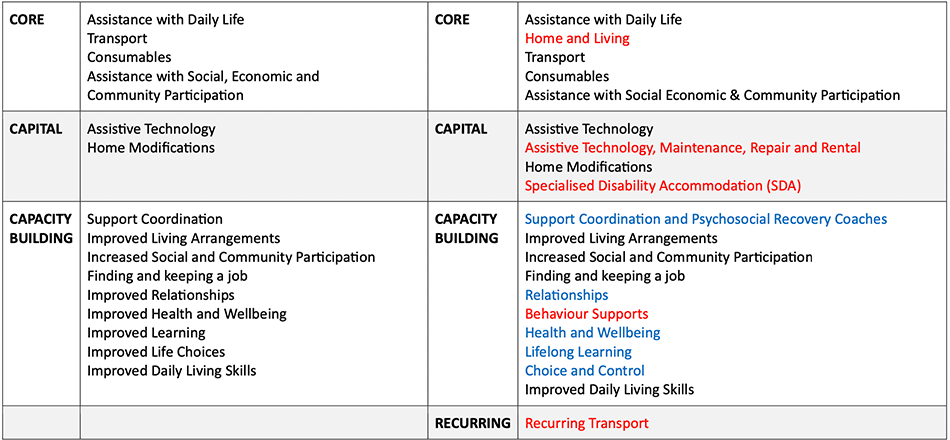
View NDIS PACE categories
 

See a comparison of NDIS Current VS PACE categories

Red = New categories

Blue = Category Name Change

Table showing NDIS pace categories vs current categories

Download Categories Comparison Table


Using Funds

All participants with: 

  • SDA (specialist disability accommodation),
  • home and living supports (includes SIL) and
  • behaviour supports

need to have their providers recorded as MyProviders (at a support category level in their NDIS plan), or their claims will automatically be rejected.

Transport Recurring is a new support category for participants who receive transport funding. It will appear in all plans and have a zero-dollar amount if you don't receive funding for transport.

Young People in Residential Aged Care (YPIRAC) - Cross Billing has been added so that funding can be allocated in plans for payments for residential aged care subsidies and supplements. 

See a sample NDIS PACE Plan


3. Will I need to go for a plan review?

Existing plans will continue as normal and PACE will not impact your NDIS plan dates.

When you have a new plan, you will be enrolled into the new PACE system with your new PACE plan.


4. Does anything change with my providers?

You can continue to work with your existing providers. 

Agency Managed participants will need to add their chosen providers as a “participant-endorsed provider” (myProvider) so they can access the funding for the services provided.  Note that providers will need to nominate specific staff from their organisation to have a role as the ‘person with consent’. Only those staff can act on behalf of a participant. 

Plan Managed participants don't need to record providers for their supports if they don't want to.

You can now give providers consent to view different parts of your plan (instead of the whole plan). You can choose when to share your budget information, your goals and funded supports so that they can better support you.

It is more important than ever to have a written service agreement set up with all of the providers you engage with so that it is clear to everyone involved how much funding will be used.

See our resource on Service Agreements


5. How does PACE benefit me as a Participant?

With category-level funding, your NDIS plan will give you more flexibility on how you spend your funding. PACE will thus empower you to have more control over your plan and the services you receive.

You can provide consent for your chosen providers to view different parts of your NDIS details in PACE, such as just your contact details and plan dates or your detailed NDIS goals. This streamlines processes for both you and your NDIS providers. 

Providers can deliver more outcomes-based services, which is something the NDIS feels is very important to make sure participants get the most from their funding.


For additional information, please access the following links:
NDIS - Information for NDIS providers about PACE and the new my NDIS provider portal

NDIS Improvements website

MyCareSpace resources may be shared provided they are credited to MyCareSpace with backlinks to the original resource.

Resource Author: Bianca S. | NDIS Expert   Last Updated: 11 March 2026
NDIS

What is a Support Worker?

A support worker is a term used to describe someone who is employed to provide disability support services. This term is often interchanged with carer, or support staff

A support worker can be employed by a larger organisation (a provider), or they may be a sole trader and work for themself.


Who Can Provide Support In the Home?

The NDIS can fund a support worker to assist you in the home. Assistance can cover a wide variety of tasks that you need help with. A support worker can be involved with you directly to meet a specific support need.

Alternatively, you can hire service providers to assist with domestic tasks on your behalf.


Support with Personal Care

Personal care tasks are the activities related to hygiene. 

If your capacity to engage in personal care tasks is impacted by your physical, intellectual or psychosocial disability, or due to a neurodivergent condition, a support worker can assist you with the following personal care tasks:

  • Showering
  • Dressing
  • Brushing teeth
  • Washing face
  • Brushing hair
  • Applying deodorant
  • Applying makeup
  • Toileting, bladder and bowel management and menstrual care

A support worker can provide hands-on assistance at varying levels, depending on your support needs. Perhaps you need total physical assistance for washing your whole body, or can manage washing your upper body in a seated position and need help for washing your legs and feet.

The support worker’s role is to promote your independence and help out with the tasks in the activity you have difficulty completing.

Perhaps you don’t require physical support, but require verbal prompting and encouragement to stay on task or maintain safety. Verbal assistance can also be provided at a minimal level, i.e. gentle reminder, or a moderate/maximal level, i.e. step by step instructions.


Support Mobility and Transfers

If your mobility is impacted by a physical disability, a support worker can assist with your mobility.

This may involve physically assisting you to walk and move, or assistance to use or operate a mobility aid or device. This can range from setting up a four-wheeled walking frame or walking stick, to operating a powered wheelchair.

A support worker can assist with your transfers between surfaces. Examples include transferring between bed and wheelchair, on and off the toilet, between couch to dining chair etc. Assistance provided may involve the use of assistive technology, i.e. slide board, or the operation transfer aids, i.e. sit to stand lifter or a mobile hoist.


Support with Appliances and Aids

Set up assistance can be provided if you use appliances such as hearing and communication devices related to your disability. Augmentative and Alternative Communication (AAC) devices can be complex and require support to set up and position devices to promote communication, such as an Eye Gaze technology.


Support with Domestic Tasks

Due to your disability, you may be unable to complete some or all domestic tasks. If this is the case, funding may be available to you for the following activities:

  • Cleaning, ranging from light cleaning/tidying to heavy duty cleaning
  • Meal Preparation
  • Home Maintenance
  • Gardening

This support may be provided to assist you with completing certain activities, such as cooking a meal or cleaning the home alongside each other. Or depending on your functional capacity and goals, this activity can be completed on your behalf.


Support Worker Ratios of Support

You may require one support worker to provide direct physical assistance with an activity, i.e. showering and dressing. This is referred to 1:1 support, where one support worker is assisting one participant.


In some cases, 2:1 support is necessary. This is where two support workers assist one participant.

2:1 support may be required when higher support needs are present due to:

  • complex disability needs and/or complex health-related disability supports
  • manual handling requirements to reduce the risk of injury to the participant and support workers involved
  • use of assistive technology that requires to be operated by two people, such as a mobile hoist
  • supporting behaviours of concern, in line with recommendations outlined in an individualised behaviour support plan


In other cases, a shared ratio of support is deemed appropriate. Some examples of shared support are:

  • 1:2 support = one support worker to two participants
  • 1:3 support = one support worker to three participants
  • 2:3 support = two support workers to three participants

Typically shared support provided will not be as hands on, as it usually involves close by or distant supervision, as care responsibilities are divided between the participants present.


Your ratio of support may vary across the day depending on your activities and support needs.


How do I know my Ratio of Support?

If you need help determining the ratio of support you require across a variety of activities, you can seek out a Functional Capacity Assessment.

This is completed by an Occupational Therapist who assesses your functional capacity and support needs across all of your activities of daily living.

The Occupational Therapist prepares a Functional Capacity Assessment Report that provides an overview of your functional capacity and support needs. It includes recommendations for NDIS-funded supports across Core, Capacity Building and Capital Support funding categories.

To connect with an Occupational Therapist, ask the MyCareSpace Connections Team to find you an OT with availability today.

Find an OT


Is a Support Worker For Me?

If you are considering whether you need a support worker, ask yourself these three questions:

  1. What are my day to day activities - what makes up my daily life and what is important to me?
  2. What difficulties do I have across my usual activities - what do I struggle with or need help with?
  3. Are the challenges I experience related to my disability? Find the link between difficulties and your condition/s recognised by the NDIS.

Is A Support Worker For Me is a great place to start on your support worker journey.


Finding the Right Support Worker For Me?

Finding a support worker can be a daunting process. If you have not had support before from someone outside of your family, inviting someone new into your home can be overwhelming.

Some people can even find it invasive. This is completely understandable and reasonable!

Finding the Right Support Worker For Me? is a fantastic resource to guide you on what to consider when seeking out support.


Support Outside of the Home

In addition to support in the home, support can be provided across any of the activities discussed in the following settings:

  • The home of friends/family
  • Social/recreation activities
  • Education
  • Employment
  • Holidays away from home


How do I access Support Work in my NDIS Plan?

In your NDIS Plan, you may have a Core Support budget.

Core Support funding includes supports to help you with:

  • your everyday living activities
  • your current disability-related needs
  • to help you work towards your longer-term goals

You can use this Core Support funding to access support workers for your needs in the home and in the community, transport and low cost products related to your disability.

Review the MyCareSpace Core Support: Quick Guide for further information.


Where do I find a Support Worker?

MyCareSpace offer a FREE concierge service where our Connections Team review your details and source services in your local area with capacity to support you. It’s that easy!

All you have to do is provide your details and basic information on what you are looking for. Cleaning? Gardening? Personal care assistance? Let the team know!

Get started

The Connections Team will provide you with some options to choose from to ensure you are in control of your provider choices.

MyCareSpace resources may be shared provided they are credited to MyCareSpace with backlinks to the original resource.

Resource Author: Bianca S. | NDIS Expert   Last Updated: 11 March 2026
NDIS


Listen to podcast

This webinar supports Participants and their families, Support Coordinators, and LACS in understanding the role that allied health providers (therapists) can play in reaching your NDIS goals and how to make the most of the funding you have.

Delivered by Occupational Therapist and Clinical Advisor, Tiffany Hurwitz (MyCareSpace) together with NDIS expert and Plan Manager, Kim Mc Murchy (Plan Hero Plan Management).

Developed to support Participants and their families, Support Coordinators, and LACS in understanding the role that Allied Health Providers (therapists) can play in helping you reach your NDIS goals and how to make the most of the NDIS therapy funding you have.

This webinar addresses the practical aspects of what type of therapy you can use with your NDIS funding. Kim explains in detail how to understand the different parts of your NDIS plan, where to find that therapy funding, and how to flexibly use it.

Tiffany explains the different types of therapy and where they can in fact cross-over or complement each other. This is particularly helpful in an environment where there is a shortage of certain therapies in many areas. She shows us how there are ways to overcome this problem by getting started with other therapies or alternative therapies.

In this 1.5 hour webinar, we covered:

  • Understanding the different types of therapy and who delivers them
  • What therapy can I use to reach each goal?
  • Working with a ‘Multidisciplinary Team’ - what does that mean?
  • Where do I find therapy funding in my NDIS plan and how much do I actually have to spend?
  • How to find therapy providers with availability

Contact our MyCareSpace Connections Team if you need help finding NDIS services.

Contact Plan Hero Plan Management to find out more about this amazing Plan Manager.

View our Allied Health Resources


Panelists

Tiffany Hurwitz

Tiffany is an experienced and practicing Occupational Therapist, supporting many NDIS participants. She not only delivers therapy, but also supports NDIS participants to access NDIS funding and get the most from their Planning Meeting/Plan Review (Re assessment). 

She has a deep understanding of how the NDIS works within the therapy arena.

Tiffany regularly supports her clients to understand the kind of therapy that will help them reach their goals, the different types of therapies (and therapists), and how they all can work together.


Kim Mc Murchy

Plan Hero

As General Manager of a boutique Plan Manager (Plan Hero Plan Management), Kim has not only seen hundreds of NDIS plans, but has also had just as many conversations with Participants and their support network.

She regularly shows them where to find therapy funding in their NDIS plan, and how to make the best use of it.

In this webinar, Kim shares her 'on the ground' knowledge about how therapy funding can look in your NDIS plan, how much you actually have to spend, and how to use it (not to mention where to find it).


Who will benefit from this webinar? 

This webinar is relevant to NDIS Participants, their families, and other NDIS supports like Support Coordinators, LACS and even Providers.

It is an absolute must for Participants who have an NDIS plan that has therapy funding or will be needing therapy in the future.

Perhaps you are already involved with a team of therapists and want to learn about how to maximise your funding to produce better therapy outcomes? Don't miss this session.

Service providers who are looking to learn more about allied health (therapy) supports will also find this webinar beneficial. 


Resources

All Therapy Resources

Featured Resources


MyCareSpace resources may be shared provided they are credited to MyCareSpace with backlinks to the original resource.

Resource Author: Bianca S. | NDIS Expert   Last Updated: 11 March 2026
NDIS

MyCareSpace has created an NDIS Price Search tool just for you.

You can find prices for services and supports using line item number (if you know them), the category or even key terms like 'Support workers', 'OT' or 'nappies'.

Give it a try today and be completely amazed!

SEARCH NDIS PRICES


MyCareSpace resources may be shared provided they are credited to MyCareSpace with backlinks to the original resource.

Resource Author: Bianca S. | NDIS Expert   Last Updated: 11 March 2026
NDIS

What is a Support Worker?

A support worker is a term used to describe someone who is employed to provide disability support services. This term is often interchanged with carer, or support staff

A support worker can assist you in your home and in the community.

A support worker can be employed by a larger organisation, usually called a provider, or they may be a sole trader and work for themself.

Considering my need for a support worker? 

If you are considering whether you need a support worker, ask yourself these three questions:

  1. What are my day to day activities - what makes up my daily life and what is important to me?

  2. What difficulties do I have across my usual activities - what do I struggle with or need help with?
     
  3. Are the challenges I experience related to my disability? Find the link between difficulties and your condition/s recognised by the NDIS.

See below for advice on how to unpack these questions.

What are my day to day activities?

Every person's daily activities are unique to them. Your activities are what you complete each day or across the week that involves caring for yourself, maintaining your home, participating in the community, engaging in work/volunteering and potentially caring for others.

Your daily activities may include:

  • Personal Care Activities - Showering, toileting, grooming, brushing teeth, shaving, applying deodorant, styling hair, make up etc
  • Domestic Activities - Cooking, cleaning, laundry etc
  • Community - Attending appointments, shopping, socialising, leisure, study etc
  • Carer - Are you a parent or carer for someone else?
  • Work - Do you work? What kind of role do you have? Is travel required to get to work?
     

ACTIVITY 1 - DAILY ACTIVITY LOG

With a pen and paper, or on a device, map out your daily activities.

Option 1: List each heading (personal care, domestic, community, carer, work) in separate columns on a blank page. Create a list under each heading of what activities you complete.

Option 2: Create a timeline from when you wake up in the morning to when you go to sleep at night. List what you get up to throughout your day and evening on a regular day. If your days vary, create multiple timelines.

Option 3: Draw pictures to represent what activities you do in your day to day activities.


What difficulties do I have across my usual activities?

Due to your disability, you may have challenges that impact how you engage in your daily activities

Difficulties may be due to:

  • Physical limitations, such as difficulties walking, standing, reaching, lifting and handling items
  • Cognitive impairment, such as challenges with information processing skills, planning, problem-solving, attention etc
  • Psychological factors, such as reduced motivation, emotional regulation, coping skills etc
  • Sensory processing, including difficulties engaging in the environment and managing sound, light, taste, touch, movement and understanding what is going on inside your body (hunger, thirst etc).

Across your daily activities, consider the following:

  1. Does a task take me longer to complete than I would like?
  2. Do I place myself at risk of injury by performing a task?
  3. Do I find it overwhelming to complete a task?
  4. If I complete a task, have I used up all my energy and need to rest?
  5. Is the way I am currently completing the task sustainable?
  6. Can I do some aspects of the task but not others?
  7. Without help from someone else, are there tasks I am unable to complete?
  8. Do I feel like I am burdening family or friends who help me with completing tasks?


ACTIVITY 2 - ACTIVITY RATING

Rate your activities according to the level of difficulty, risk, overwhelm, energy or burden.

Option 1: Review your activity list and highlight the activities you have the most trouble with.

Option 2: Create a tick and cross system, or alternative visual scale, to display what activities you have no issue completing, and where you may need some help.


If you have identified difficulties across one or more tasks or activities, introducing a support worker into your life may be beneficial.

Remember: To use your NDIS funding for a support worker, you must be able to relate the difficulties you experience to your disability.

How can a support worker help me?

A support worker can help you in any way you need across any of your daily activities, where you experience difficulty due to your disability.

A support worker can:

  • Complete the task with you - you are involved in the task and need varying degrees of assistance. For example, hanging out a load of washing to dry with your support worker.
  • Complete the task on your behalf - you are not directly involved in performing the task. For example, your support worker completes all laundry tasks for you.

You must clearly outline what support you do and don’t need, and find services that align with your requirements.

The NDIS funds support for:

  • Assistance with Daily Life in the Home
  • Assistance with Social, Economic and Community Participation
  • Transport

Review the Core Supports: Quick Guide to understand how to use your Core Supports.

Where do I find funding for support in my NDIS Plan?

Funding for support workers is located in your Core Support budget.

NDIA allows you to use funding flexibly throughout your Core Support Budget. 

For example: If you have funding allocated in Assistance with Daily Life that you have determined you are not using, and want to access support for community participation, the funding can be shared between these two budgets.

It is important to note in most cases, funding cannot be used flexibly across Core, Capacity Building, or even Capital Supports. Only funding allocated within Core is flexible amongst itself.

How can I find support providers?

The MyCareSpace Connections Team can help you find local providers with availability - just tell us about your unique needs.

Get Started

Alternatively, give our Connections Team a call by phone 1300 2888 93.

Find Supports

MyCareSpace resources may be shared provided they are credited to MyCareSpace with backlinks to the original resource.

Resource Author: Bianca S. | NDIS Expert   Last Updated: 11 March 2026
NDIS


You’re about to leave school and move into your adult life! It’s an exciting time, full of new possibilities, but it can be daunting, too, as you try to navigate all the different post-school options.

To help you decide on a path that is best for you, here’s a simple guide to the various options. But remember, you can try more than one to see what’s right for you. It might even be a combination of these options that best meets your goals. There is no one size fits all answer!

  • Further education or training
  • Day programs
  • Work options
    • Supported employment
    • Open employment
    • Volunteering

Further education or training  

If you’d like to build your skills through further study or gain some experience through training, there are many options that can suit school leavers who have a disability, including:

  • University – a higher education and research institution granting academic degrees in many subjects
  • TAFE – an Australia-wide organisation providing vocational education and training
  • Vocational Education and Training (VET) – offering skills and training for specific jobs and industries
  • Registered Training Organisations (RTO) – delivering VET programs with the Australian Skills Quality Authority
  • Apprenticeships/traineeships – providing qualifications through on-the-job training with an employer and classroom-based learning.

Day programs

Day programs have a recreational focus. They can be a great fit for many young people with disability with high support needs. They provide opportunities to participate in the community or focus on independent life skills.

Day programs are run by disability service providers and community organisations. You might go to a centre each week or do activities out in the community. There are lots of things to consider when choosing a day program, like how far you can travel, what your support needs are, and, importantly, what activities you enjoy.

In the past few years, exciting new day program options have emerged. For example, Avenue, which is different from your traditional day program. Avenue provides opportunities to take part in their work or social program, or both. In Avenue Work, participants complete real work tasks by joining microbusinesses that operate in a supported environment. So even if you don’t have a goal of open employment, you can still access meaningful and purpose-driven work, and share in the profits. At Avenue Social, the team designs a varied social calendar according to participants’ interests and input, as well as supporting participants to develop their individual skills and integrating learning into the social activities, such as independence, money-handling and communication.

Other day programs, like Plus, specialise in supporting people with more complex behaviours. Plus is a brand new day program that builds participant skills across four areas: daily life; health and wellbeing; work and social. Therapeutic services are also offered in the same place as the day program, in a more integrated, seamless way. They believe that this integrated model achieves the best outcomes for their people.

If a day program is something you’d like to pursue, take the time to research the ones in your area that best meet your needs and goals.

Your options for a future in work

Work is a great way to make a purposeful contribution, as well as earn money.  How we choose to make our contribution will depend on our unique hopes, skills, abilities, interests, and personal situation. You might decide to look for a job straight away, or join a training program to give you more on-the-job work experience and confidence. 

Here are some options for work you could choose from.

Supported employment

Supported employment is a job where a person with a disability gets assistance with their work tasks. It includes support to do the work, learn new skills and set goals.

This type of job is through Australian Disability Enterprises (ADE). They are businesses that make products or provide services. They are explicitly designed to provide employment to people with disability, but this employment is not paid at award-wage, and is not mainstream (you will not have colleagues who do not have a disability). 

Open employment

Open employment is also called mainstream employment. It is where people with and without disability do their jobs together in the same workplace.

If this is your goal, it is important to make sure you think about what training and support you may require. There are several pathways that people with disability can take to access open employment:

Disability Employment Services (DES)

DES providers can help you find jobs to apply to, and fill out applications. Their aim is to place people with disability into work. If you are already confident in your work-ready skills, this could be a good option. If you think you need a bit more support to build up your confidence and skills, you might want to consider joining a training pathway before, or alongside, enrolling with a DES.

Specialised training pathways

If you want to build up your job-ready skills and confidence before applying to jobs, you may want to find a work-readiness training pathway. This will give you support tailored to your abilities, interests and support needs.

In your last year of school, or when you leave, you can access NDIS funding called School Leaver Employment Support (SLES). You can use this funding to pay for a training pathway with a SLES provider of your choice. 

Specialist providers like Jigsaw can connect you with valuable vocational opportunities. This includes work experience, mentoring, on-the-job training, and skills like time management. They will also support your search for mainstream employment with job interview training, resume preparation and more. Jigsaw believes SLES enables a type of support that can best meet the needs of many school leavers with disability. It can help you to reach your potential in the world of work from day one.

Only school leavers with an NDIS plan are eligible for SLES, but do not worry if you don’t have SLES funding, or if you left school more than two years ago. You can also access providers like Jigsaw with Core and Capacity Building NDIS funding, for example “Finding and Keeping a Job”.

Community or volunteer work

Volunteering means giving your time freely to help a person, cause, or group. It’s an excellent way to expose yourself to new challenges, and gain job skills and work experience. Volunteering can also build your independence to transition into employment. It can even increase your wellbeing and reduce stress and loneliness.

So many organisations rely on help from volunteers. It might be an animal welfare group, op shop, charity or community organisation like Meals on Wheels.

And you don’t have to go it alone. If you feel you’d like support to volunteer, you can apply for an NDIS-funded support worker through a package called Core funding, under the category of ‘Assistance with social and community participation’.

As you can see, there are lots of options! Before settling on a particular pathway, spend some time thinking about what your goals are, how you like to spend your time, and what your support needs are. Then once you’ve narrowed down your choices, do a trial day or two. It will help you make up your mind about whether it is the right fit for you. And don’t forget; you can choose more than one option!

Quick links


This information is provided by Fighting Chance - Find out more about the services they offer school-leavers.

Fighting Chance

MyCareSpace resources may be shared provided they are credited to MyCareSpace with backlinks to the original resource.

Resource Author: Bianca S. | NDIS Expert   Last Updated: 11 March 2026
NDIS

In your NDIS plan, you can access a broad range of supports and services to help you in your day to day life and build your skills.

Supports can span from self-care assistance, transportation, assistive technology and day programs... just to name a few! 

Allied health services are also supports funded by the NDIS. 

What is an allied health professional?

An allied health professional is a qualified therapist working in their field of practice.

A therapist is a university-qualified practitioner with specialised expertise in completing assessment and intervention/treatment for a range of conditions and illnesses.

A therapist can also be referred to as a:

  • Allied health professional
  • Allied health practitioner
  • Allied health provider

These terms are interchangeable so don’t worry about getting it wrong!

Learn more about Allied Health from the Allied Health Professions Australia.

Who can be a therapist?

A therapist working in the NDIS may be a:

  • Occupational Therapist
  • Physiotherapist
  • Speech Pathologist
  • Exercise Physiologist
  • Behaviour Support Practitioner
  • Dietitian
  • Psychologist
  • Music Therapist
  • Key Worker
  • Podiatrist
  • Orthoptist
  • Social Worker
  • Rehabilitation Counsellor

Decoding the Role of the Therapist

If you have never worked with a therapist before, knowing how each therapist can help you can be overwhelming.

A therapist working in the NDIS may work across the following practice areas:

  • Physical Disability
  • Neurological Disability
  • Intellectual Disability / Cognitive Impairment
  • Psychosocial Disability / Mental Health
  • Neurodiverse population, i.e. diagnosed with Autism Spectrum Disorder or ADHD

Below is an overview of the more commonly seen therapists working in the NDIS.

Occupational Therapist

An Occupational Therapist, often abbreviated to OT, works with you to enhance your engagement and participation in day to day life.

An Occupational Therapist can complete the following:

  • Functional Capacity Assessment
  • Therapy and Skill Development - described by the NDIA as Capacity Building
  • Assistive Technology Prescription
  • Manual Handling Plan
  • Upper Limb Therapy
  • Home Modifications Assessment and Recommendations, including scope of works (i.e. diagrams)
  • Driving Assessment and prescription of Vehicle Modifications
  • Housing Needs Assessment, including assessments for SIL, SDA and ILO

An Occupational Therapist takes a holistic approach when working with you to address your goals.

This means they consider all the factors that impact your life and develop strategies with you to improve your independence, autonomy and safety.

SPOTLIGHT: Functional Capacity Assessment

You may have heard this term before in planning meetings or mentioned by other providers.

A Functional Capacity Assessment is an in-depth assessment completed by an Occupational Therapist which addresses every aspect of your day to day life. 

A report is typically completed following the assessment which outlines your daily life, difficulties experienced related to your disability and includes recommendations for NDIS supports and services you required to address any challenges and goals you wish to achieve. 

Keep an eye out for an upcoming resource that unpacks what is involved in this highly sought-after assessment…


View the Occupational Therapy Australia website for further information about the profession.

When you’re ready to connect with an OT, ask the MyCareSpace connections team to find you an Occupational Therapist with availability today.

Get started

Physiotherapist

A Physiotherapist is often abbreviated to Physio, or sometimes PT (not to be confused with Personal Trainer).

A Physiotherapist works with participants with a range of physical conditions with a focus on:

  • Mobility
  • Balance
  • Movement
  • Posture
  • Strength
  • Coordination
  • Management of chronic conditions

Physiotherapists work with participants to improve their physical capacity and manage pain.

Physiotherapists are qualified to prescribe assistive technology to assist with your mobility. A Respiratory Physiotherapist is a specialist within the profession who may prescribe respiratory devices.

View the Australian Physiotherapy Association website for further information about the profession.

When you’re ready to connect with a Physio, ask the MyCareSpace Connections team to find you a Physio with availability.

Get started

Speech Pathologist

A Speech Pathologist is often referred to as a Speech Therapist, SP or even Speechie.

Speech Pathologists address communication skills. Due to your disability, you may have difficulties with:

  • Speaking
  • Listening
  • Understanding language
  • Reading
  • Writing
  • Social skills
  • Stuttering
  • Using voice

A Speech Pathologist works to increase your skills across these areas to increase your capacity to communicate effectively with others. This may involve the use of Alternative Augmentative Communication (AAC). Find out more about AAC here.

A Speech Pathologist also plays a role in supporting difficulties with swallowing food and fluids.

View the Speech Pathology Australia website for further information about the profession.

When you’re ready to connect with a Speechie, ask the MyCareSpace Connections Team to find you a Speech Pathologist with availability.

Get started

Exercise Physiologist

Exercise Physiology is commonly abbreviated to EP. It is not to be confused with Physiotherapy - these are different qualifications!

Exercise Physiologists focus on exercise-based interventions to promote health and well-being. Areas addressed may include:

  • Aerobic fitness
  • Strength
  • Flexibility
  • Balance

The overall goal is to prescribe exercises that can be incorporated into your weekly routine to achieve your desired outcomes and goals.

View the Exercise and Sport Science Australia website for further information about the profession.

When you’re ready to connect with an EP, let the MyCareSpace Connections Team connect you with an Exercise Physiologist today.

Get started

Behaviour Support Practitioner

Behaviour Support Practitioners (BSP) can also be referred to as Positive Behavioural Supports (PBS). 

A Behaviour Support Practitioner works closely with you and your support team, often involving family and support workers, to focus on your quality of life by promoting positive behaviours and reducing behaviours of concern.

A Behavioural Support Plan is developed by a Behaviour Support Practitioner to act as a guide for those supporting an individual who demonstrates behaviours of concern. It outlines how to promote positive behaviours, reduce triggers and respond when a challenging behaviour has occurred

View the Behaviour Support Practitioners Australia website for further information about the profession.

When you’re ready to connect with a BSP, let the MyCareSpace Connections Team connect you with a Behaviour Support Practitioner with availability. Learn How to get Positive Behaviour Support (PBS) in my NDIS Plan here.

Get started

Dietitian

If you need help to manage your nutrition because of your disability, the NDIS can fund a Dietitian.

A Dietitian can be involved to create a nutritional meal plan, and provide training and education to yourself, family and carers.

Dietitians are also involved in prescribing and implementing Home Enteral Nutrition (HEN) and Percutaneous Endoscopic Gastrostomy (PEG) feeding. These are alternative feeding strategies that may be required due to a disability or disability-related health condition.

View the Dietitians Australia website for further information about the profession.

When you’re ready to connect, let the MyCareSpace Connections Team connect you with a Dietitian with availability.

Get started

Psychologist

Psychologists working in the NDIS provide specialised assessment, treatment and diagnosis of mental health conditions. You can access a psychologist if you are diagnosed with a psychosocial disability, or if psychology services are needed to improve daily living skills.

Psychologists can seek to support your emotional and psychological well-being, as well as address social skills and behavioural management strategies.

View the Australian Psychology Association website for further information about the profession.

When you’re ready to connect, let the MyCareSpace Connections Team connect you with a Psychologist with availability.

Get started

Where can I receive therapy?

Therapy can be completed at a clinic space if your therapist has one for you to visit.

Therapy can also be provided in your home.

IMPORTANT: Remember to discuss travel costs with your therapist to ensure this is accounted for when budgeting for your services. Travel costs should be outlined in the providers service agreement.

Therapy can also sometimes occur in the community. For example, travel training with an Occupational Therapist may involve catching public transport together to develop your skills. Ordering a coffee at your local cafe with a Speech Pathologist may be required to address your communication-related goals.

How do I access funding for a therapist?

Funding for the therapy services may be included in your NDIS plan already. Below is a breakdown of some of the common therapy services funded by the NDIS:

Therapist Budget Line Item Code Category
Occupational Therapist Improved Daily Living Skills 15_617_0128_1_3 Capacity Building
Physiotherapist Improved Daily Living Skills 15_055_0128_1_3 Capacity Building
Speech Pathologist Improved Daily Living Skills 15_622_0128_1_3 Capacity Building
Exercise Physiologist

Improved Health and Wellbeing

OR

Improved Daily Living Skills

12_027_0126_3_3

12_027_0128_3_3

15_609_0118_1_3

Capacity Building
Behaviour Support Practitioner Improved Daily Living Skills

11_022_0110_7_3 

11_023_0110_7_3

Capacity Building
Dietitian

Improved Health and Wellbeing

OR

Improved Daily Living Skills

OR

Assistance with Daily Life (for Disability-Related Health Supports)

01_760_0128_3_3 


12_025_0128_3_3


15_062_0128_3_3


Capacity Building

OR

Core Supports (for Disability-Related Health Supports)


Psychologist Improved Daily Living Skills 15_054_0128_1_3 Capacity Building


Access the Easy to Read NDIS Price List to search for NDIS prices from the latest NDIS price list.

NDIS Price List

How do I get in touch with a therapist?

When you’re ready to connect, let the MyCareSpace Connections Team connect you with a therapist with availability.

Get started

For further support, get in touch with our Connections Team online or by phone 1300 288 893.

If you have a Support Coordinator or Local Area Coordinator, they may be able to direct you to local allied health providers to access therapy services.
 

MyCareSpace resources may be shared provided they are credited to MyCareSpace with backlinks to the original resource.

Resource Author: Bianca S. | NDIS Expert   Last Updated: 11 March 2026
NDIS

First things first...

You are the expert!

You may have a very clear idea of what assistive technology you want and what you need.

Of course you do! You are the expert in your own life and your own needs.

It can be exhausting having to explain what you need time again to the different service providers who come into your home and ask you a million questions. These assessments are completed by allied health professionals, also known as therapists or AT assessors, in order to identify and analyse your support needs and provide recommendations.

But are all the questions and conversations needed every time you need one small thing?

Is the assessment necessary?

Question: Is it always necessary to undergo an assessment every time you need a new item related to your disability?

Answer: Not necessarily! It may be that you can proceed with purchasing assistive technology without therapist input at all!

Considerations for purchasing assistive technology without a therapist

STEP 1 - First you must consider:

  • Is the item low cost i.e. under $1500?
  • Is the item something I need that relates to my disability?
  • Does it align with my NDIS goals?

STEP 2 - If so, you may be able to purchase assistive technology using your NDIS funding without any extra steps. Before proceeding, you must consider:

  • Do I need input from a therapist to determine that this product is right for me?
  • Does the item require set-up and training from a therapist, or can I manage this myself?
  • What are the risks associated with the item? Could there be potential for harm?

Following Step 1, if you find you do not need any input from an allied health provider for assessment, prescription, set up or training, and risks involving use of the product are deemed to be low, you should be able to proceed with purchasing this low cost item.

How to purchase low-cost assistive technology when an assessment isn’t required?

1. Do you have the funding?

  • Assistive Technology - this budget located in Capital Supports may be available for you to purchase low cost items. Read the description next to the total amount allocated. View more information on purchasing low cost assistive technology and consumables here.
  • Consumables - this budget located in Core Supports can also be used to purchase low cost items. Again, review the description in yoyr plan and check the funding amount available.

2. Request an invoice:

Request an invoice from the assistive technology supplier who sells the item you need by providing the following details:

  • Name
  • NDIS number
  • Contact details
  • Address and delivery instructions (parking availability & access to your home - this will indicate to the supplier if they need more than one person to attend delivery and set up the item depending on size/weight of your purchase).

Ensure the document received is formatted as an invoice, tax invoice or proforma invoice. One of these descriptions should be the stated heading on the top of the document. If it is a quote, it may not be able to be processed by a Plan Manager.

There will be a delivery fee and sometimes a set-up fee included in the invoice. Your NDIS funding can be used to cover this cost.

3. Arrange payment:

Arrange payment according to how your NDIS funding is managed. The Self, Plan and NDIS Management Guide provides further detail.

Keep in mind that some plan managers may require a letter of recommendation from a therapist. If this is the case, review the steps below.

When is input needed from a therapist for assistive technology?

Consider the following factors:

  • Is the item mid or high cost i.e. between $1500 - $15,000 or $15,000+
  • Do applications/reports need to be completed for the item?
  • Do I need specialist input from a therapist to assess my needs for this item?
  • Is set-up and follow-up training required to use the item?
  • Is there a level of risk that needs to be addressed and managed by a therapist?

If the answer is YES to one or more of the questions above, you will require a therapist to complete an assessment for the prescription of the item. 

What kind of therapist can prescribe assistive technology?

There are a broad range of therapists working in the NDIS. Therapists who prescribe assistive technology may be a:

  • Physiotherapist
  • Occupational Therapist
  • Speech Pathologist
  • Exercise Physiologist
  • Behavioural Support Practitioner
  • Psychologist

Within each discipline, therapists have varying skill levels, training and specialities.

The MyCareSpace Connections Team can find a therapist for you in your local area with availability.

Get started

How do I find the right therapist for me?

Some questions to ask yourself when connecting with a therapist to prescribe your assistive technology include:

  • Is the item relevant to their profession? You would seek advice about a mobility aid from a Physiotherapist/Exercise Physiologist, or sometimes an Occupational Therapist, but not a Speech Pathologist. Is this therapist the most skilled clinician to prescribe the item?
  • Does the therapist have the skills? Ask about their experience prescribing this item with other participants. Ask about the assessment and prescription process. Do they have any success stories to share?
  • What is their product knowledge? Ask about the different products they may consider to support you in addressing the specific need being addressed. Do they have one or more potential solutions that could be trialled?
  • Do they have the connections? Are they linked in with a small or wide range of equipment suppliers? What are the benefits and disadvantages of each supplier?
  • Do they have the right mentality? Ultimately, you need to find a therapist that aligns with your values and who you can trust. Implementing assistive technology often involves regular and ongoing input from the prescribing therapist. It is important to find someone who you get along with.

By gathering information about the therapist's skills and capabilities, you place yourself in the best position to determine if they are the right therapist for you.

What is the assistive technology prescription process?

Your therapist will guide you through the assistive technology prescription process. They will typically complete the following steps:

  1. Facilitate one or more assistive technology trials
  2. Liaise with the equipment supplier, including obtaining an itemised quote
  3. Complete product research
  4. Prepare an assistive technology report
  5. Provide you with a copy of the report prior to submission to review, provide feedback and prompt for you to provide signed consent for the NDIA to contact them as the prescribing therapist if needed throughout the approval process
  6. Submit the application (AT report and quote) to the NDIA
  7. Once approved, facilitate delivery and set up alongside the assistive technology provider
  8. Provide any necessary follow-up implementation and training support

Every assistive technology assessment is unique to the individual. The assessment of the assistive technology must consider the individual, the activity, the environment and the context. For this reason, several trials may be required, across one or several environments. This depends on where it is intended for the assistive technology to be used. For example, it is important to trial a wheelchair in the home and in the community if these are the settings it will be used across.

Remember, you may not find one piece of assistive technology that meets all your needs. Sometimes a range of assistive technology is required to address a range of your needs across various activities or settings. For example, a compact folding mobility scooter will perform well in a flat shopping centre environment, but may not manage an outdoor hilly footpath.

Your therapist will consider all options in light of your needs following their initial assessment and throughout the trial phase. It is important that the prescribed assistive technology will make your life better!

How do I access a therapist to prescribe assistive technology?

The MyCareSpace Connections Team can help you to find the right therapist for you.

Get started

Alternatively, view the MyCareSpace Directory for a range of allied health providers who may be able to support you.


MyCareSpace resources may be shared provided they are credited to MyCareSpace with backlinks to the original resource.

Resource Author: Bianca S. | NDIS Expert   Last Updated: 11 March 2026
NDIS

One of the goals of the NDIS is to give children living with a disability, access to early intervention, but with a serious shortage of therapy services like Occupational Therapy, Speech Therapy and Psychology, many parents are unable to activate their NDIS plans and use their NDIS therapy funding.

In some areas, waiting lists can be more than 12 months! There are, however, more opportunities to access online therapy - the delivery of therapy online using your computer or iPad (or even phone).

Online Therapy is often the only option available in more regional and remote areas where the supply is simply not available at all. 

Even if you are not living in regional or remote areas, there may also be lots of reasons why teletherapy is the best option for your child.

Online therapy (often called teletherapy or telehealth) may be a way of getting your therapy started sooner and may actually be a better way of receiving therapy for you or your child.

Remember, you can always transition from online to face-to-face when availability comes up in your area or with the same therapy company.  

Why could online online therapy be the first choice for my child? 

Here are the key reasons why Online Therapy may in fact be the solution, or even the better choice for your child:

  1. TIMING - Does your child have less than 6 months left on their NDIS plan? If the answer is yes, then it's unlikely that you will be able to get face-to-face therapy setup as there are extended wait times. Online therapy will help you get started so that you ‘use it and don't lose it’. 
     
  2. ACCESSIBILITY - Online Therapy makes therapy services accessible to children who may live in remote areas or lack transportation options. This would be especially important for children with disabilities who may have limited mobility or face challenges traveling. 
     
  3. SUITABILITY & FLEXIBILITY - Being at home is convenient, especially if you have other children or your child is at school (which means your availability is limited). 
    Online therapy allows families to schedule sessions at times that are convenient for them, supporting their child’s daily routine without the need to travel to a specific location.

    This flexibility is especially helpful for children with disabilities who may have complex schedules or medical needs that require careful planning.
     

  4. REDUCED ANXIETY: Some children with disabilities may experience anxiety or difficulty adjusting to new environments or unfamiliar faces. 
    Being online may also be better suited for those who experience anxiety traveling or attending therapy appointments in person. Online therapy has been especially helpful for young autistic people.
     
  5. FAMILIAR ENVIRONMENT: Children with disabilities often feel more comfortable and at ease in their own environment. Online therapy enables them to receive therapy in the comfort of their own homes, which can promote relaxation and a sense of security, leading to more effective therapy outcomes.
     
  6. PARENT INVOLVEMENT: Online therapy enables more active participation from parents or caregivers during therapy sessions. Parents can play a crucial role in supporting their child's progress by observing the therapy techniques and strategies and incorporating them into the child's daily routine. Online Therapy allows parents to actively engage and collaborate with the therapist, leading to better outcomes for the child.
     
  7. VALUE FOR MONEY - Your funding spent is 100% on therapy. There are no travel costs. Since The travel is charged at the same rate as the therapy, this can eat away at your funding! Travel can be charged by therapists on both ways up to 50%, so you could end up paying double.
     
  8. CAPACITY - Online therapy may mean you don't need to wait 6 months for a face-to-face appointment - you can get started immediately. It may also give you access to that assessment that you need before you can access other supports.
     
  9. CONTINUITY OF CARE - the ability to secure continued access to therapy despite COVID, environmental challenges (flooding), remote locations or any other challenges that may prevent you from attending a clinic.

Is online therapy suitable for my child?

The suitability of online therapy does indeed depend on the type of therapy being delivered as well as your child's disability.

Many parents have success with online Speech Therapy, Occupational Therapy, Psychology and Counselling. Therapists are also able to perform a number of diagnoses and assessments using online therapy.

How do I know if my child will be able to do online therapy?

Therapists tell us that parents are often worried that their child won’t stay engaged. If your child likes to game online, they should be able to do online therapy.

Of course, just like face-to-face sessions, the degree of engagement will also depend on how engaging the therapist is and how the child feels on the day, but you would have these same challenges in a face-to-face environment.

An online therapist uses a wide variety of online tools, evidence-based techniques and a creative approach to deliver therapy online and keep children engaged - online therapy is not just a face-to-face delivered on a screen.

Before you engage a new therapist, ask them what tools and methods they are using to ensure the best delivery of online therapy for children.

What happens if my child misbehaves during therapy?           

This is a common question! Therapists reassure us, that it's actually not a bad thing to have a child ‘misbehaving' in their natural home environment on camera. It provides a real-life picture, which is very necessary to perform an assessment or to work on with therapy.

What about if I or my child can't sit still for that long?

No need for concern that some participants may not be able to attend to the computer screen for lengthy periods.

Online therapists are used to this challenge and will encourage you can get up and move around to take breaks.

I'm not a tech geek - will I be able to manage online therapy?

Firstly, you are not expected to get set up alone. Online therapists will help make sure you have the right programs installed before you start your child's first session.

So what actually happens when we decide to use online therapy/telehealth?

All telehealth providers will have their own systems and processes in place. 

They first ensure that patients are set up and able to take part in online therapy and will guide (and assist with their tech geek) them through the setup and consultation process.

There is no obligation to stay with Telehealth if a place becomes available with a face-to-face provider. They completely understand this. It’s about giving the best possible outcome for the participant

How much does online therapy cost?

In general, the cost of online therapy = the price of therapy delivered at the location of the provider. So, even if a participant is in a remote area, the rate charged depends on where the provider is located.

For example: if the speech therapist is located in metro Sydney area, and the participant in a very remote area in Western Australia, the rate charged would be the regular metro Sydney rate.

BUT, participants in Remote or Very Remote areas can agree to pay the remote or very remote prices, if they are satisfied that the support provides value for money.

We have prepared a resource that includes the pricing for online therapy in metro and rural areas: How much is Online Therapy?

Can I get an autism assessment online?

MyCareSpace works with providers that have deep experience in delivering online autism assessments. This is a welcome relief for families that have been waiting for months to get a diagnosis.

Let our Connection Team help you by calling us on 1300 2888 93 or by submitting an online support request.

I'm looking for therapy or other supports


MyCareSpace resources may be shared provided they are credited to MyCareSpace with backlinks to the original resource.

Subscribe to Using your NDIS Funds

Our Preferred NDIS Plan Manager

Plan Hero Plan Management is our preferred NDIS Plan Manager because they are independent and specialist Plan Managers who have both lived experience and expert NDIS knowledge. Plan Management is all they do!

Plan Hero helps you keep your funding organised and on track within each funding period, so you don’t overspend or leave funds unused. They make sure providers are paid on time and help you stay on top of your budget. Their team is easy to reach, with clear, direct communication and no waiting on hold (ever).

Plan Hero gives you the support you need to use your NDIS funding with confidence.