Home / Using your NDIS Funds

Using your NDIS Funds

Resource Author: Bianca S. | NDIS Expert   Last Updated: 11 March 2026
NDIS

Are you an NDIS Support Coordinator or Support Worker?

Case notes are an absolute requirement of every NDIS Support Coordinator's life and take time, energy and effort and great Support Workers should also be taking notes after each support session.

You also often need to make them on the run (after seeing a Participant), so taking case notes should be quick and easy to do.

We have put together some tips to help you smash your case notes!

Otter.ai

Ottter.ai is a transcription or speech-to-text app powered by artificial intelligence and machine learning.

It can be used or installed:

  1. In a web browser
  2. As an Apple app
  3. As an Android app
  4. Integrated with:
    • Zoom
    • Google Meet
    • Microsoft Teams

Otter.ai is our number 1 choice for the following reasons:

  • Easy to record voice notes at your desk or on the rule as it's supported in your browser, on iPhone and Android
  • Creates a transcript of your voice recording on the fly - as you are speaking, it is transcribing
  • Transcription is closely accurate (even with accents)
  • You can add notes to any part of the transcription.
  • Forward your transcription anywhere - your email, teams, other CRM software where you want to store it
  • Share as a transcript or a voice memo - both options are available
  • You can search your recordings - any part of them!!
  • Base product is free with a wide range of functionality. Has paid upgrade options

Find out more about Otter.ai

Another option for NDIS Case Notes

If you don't have access to Otter.ai, you can use what you have on your phone.

iPhone Voice Memo

If you don't have anything else on hand, your iPhone Voice Memo app is a great option. It comes standard with all iPhones. Find out how to use it here.

Samsung Voice Recorder

Same with Samsung. It also has a native Voice Recorder with transcription options. Find out how to use it here.

How to Write Good Case Notes for Support Coordinators and Support Workers

Do these 3 things to write the best case notes.

  1. Do it immediately - you don't need to wait until you get back to your desk if you had a face-to-face meeting - use one of these apps to do it immediately while the info is still fresh in your mind.
     
  2. Create a 'template' for yourself that you follow every time. This will make it easy to read through them in the future.

    For example, record your case notes in the same order EVERY time:

    • Name of Participant
    • Location of meeting and if it is in person or on the phone
    • Time spent at the meeting.
    • Topics covered/Actions that happened
    • Outcomes achieved or Incidents
    • Actionable items
    • Follow up date 
       
  3. Create a file naming convention for your case notes: lastname.firstname date 


Download Otter.ai

MyCareSpace resources may be shared provided they are credited to MyCareSpace with backlinks to the original resource.

Resource Author: Bianca S. | NDIS Expert   Last Updated: 11 March 2026
NDIS

The NDIA are rolling out a new billing system called PACE.

There is plenty of information available for providers regarding PACE, as it primarily impacts their billing processes

But what about participants?

Here are the top 5 things you as a participant need to know about PACE:
1. What do the changes with PACE involve?

The roll out of PACE will change how providers bill for the services you receive using your NDIS funding. This change involves your providers accessing the new PACE payment system.

The new PACE system, as well as the new My NDIS Provider Portal, will eventually replace the current online system and MyPlace Portal.

These new systems are rolling out from 30th October 2023 and is expected to be completed by Feb 2024. 

2. Will this change my NDIS plan?

Amount of Funding

There should be no changes to the amount of funding available to you in your plan, or any future plans in the PACE system.

How it Looks

Current plans will remain unchanged in their format. If you have a rollover before Feb 2024, it will also remain unchanged. 

New plans issued will use the new PACE format. The new format has the same type of information, its just much easier to read.

Categories of Funding

PACE plans offfer more plan flexibility for participants: Funding in NDIS plans will be built at the support category level. There will be no line items built into plans.

For example, your plan won't say you have funding for "Occupational Therapy", it would say you have funding for "Improved Daily Life" so you will have more flexibility over how you use your total budget. 

Participants will still have stated and flexible supports

Service Bookings

PACE NDIS plans won’t have service bookings. This means more choice and control for participants, as their funding is not pre-allocated to future supports. You are able to cahnge your mind more easily.

Support Types

PACE is moving from 3 to 4 support types.

Support types now include:

  1. Core
  2. Capacity building
  3. Capital
  4. Recurring 
     

Support Categories

We will move from 15 to 21 support categories.

We have split some of the existing categories to make the new categories easier to understand.

Budgets are displayed at the support category level. 

NOTE: the 6 new support categories are all stated supports (this means you can only use them for very specific supports).

They include:

  1. Home and Living (Core) - includes SIL (Supported Independent Living)
  2. Behaviour Support (Capacity Building)
  3. Assistive Technology Repairs and Rental (Capital)
  4. Specialist Disability Accommodation (SDA) (Capital)
  5. Recurring Transport (Recurring)
  6. Specialist Disability Young People Living in Residential Aged Care (YPIRAC) - (Cross Billing Core)

View NDIS PACE categories
 

Using Funds

All participants with: 

  • SDA (specialist disability accommodation),
  • home and living supports (includes SIL) and
  • behaviour supports

need to have their providers recorded as MyProviders (at a support category level in their NDIS plan), or their claims will automatically be rejected.

Transport Recurring is a new support category for participants who receive transport funding. It will appear in all plans and have a zero-dollar amount if you don't receive funding for transport.

Young People in Residential Aged Care (YPIRAC) - Cross Billing has been added so that funding can be allocated in plans for payments for residential aged care subsidies and supplements. 

See a sample NDIS PACE Plan

View a Sample PACE Plan

3. Will I need to go for a plan review?

Existing plans will continue as normal and PACE will not impact your NDIS plan dates.

When you have a new plan, you will be enrolled into the new PACE system with your new PACE plan.

4. Does anything change with my providers?

You can continue to work with your existing providers. 

Agency-Managed participants will need to add their chosen providers as a “participant-endorsed provider” (myProvider) so they can access the funding for the services provided.  Note that providers will need to nominate specific staff from their organisation to have a role as the ‘person with consent’. Only those staff can act on behalf of a participant. 

Plan managed participants don't need to record providers for their supports if they don't want to.

You can now give providers consent to view different parts of your plan (instead of the whole plan). You can choose when to share your budget information, your goals and funded supports so that they can better support you.

It is more important than ever to have a written service agreement set up with all of the providers you engage with so that it is clear to everyone involved how much funding will be used.

See our resource on Service Agreements

5. How does PACE benefit me as a Participant?

With category-level funding, your NDIS plan will give you more flexibility on how you spend your funding. PACE will thus empower you to have more control over your plan and the services you receive.

You can provide consent for your chosen providers to view different parts of your NDIS details in PACE, such as just your contact details and plan dates or your detailed NDIS goals. This streamlines processes for both you and your NDIS providers. 

Providers can deliver more outcomes-based services, which is something the NDIS feels is very important to make sure participants get the most from their funding.

For additional information, please access the following links:
NDIS - Information for NDIS providers about PACE and the new my NDIS provider portal

NDIS Improvements website

MyCareSpace resources may be shared provided they are credited to MyCareSpace with backlinks to the original resource.

Resource Author: Bianca S. | NDIS Expert   Last Updated: 11 March 2026
NDIS

Price Differentiation and Fair Pricing

Price Differentiation is not allowed.

Price differentiation is when a provider charges an NDIS Participant more for something than they would charge if the person was not an NDIS Participant.

Fair pricing is when there is no major price difference between the cost of a product or service for an NDIS participant compared to other customers.

NDIS Commission Code of Conduct

The NDIS Commission Code of Conduct applies to both Registered and Unregistered Providers operating in the NDIS.

In Dec 2023, it was updated with new rules on price differentiation.

If a provider sets a higher price for NDIS participants and cannot justify the price difference, they may be in breach of the Code of Conduct and could face penalties. The Code of Conduct now includes rules about price differentiation.

The new NDIS Rules are:

  • Providers must not charge a higher price for goods to an NDIS participant than to a person who is not an NDIS participant. For example, a provider would not be allowed to sell a shower chair to a person who is not an NDIS participant for $100, but sell the same kind of chair to an NDIS participant for $170. 
  • Providers cannot say (for example advertise or tell people) they charge a higher price to NDIS participants. For example, they cannot advertise on their website a sale price of the shower chair, but say the sale price isn’t for NDIS participants.
  • This change is only about goods, not services. Goods are things that you can touch, feel and see. Services are work done or help provided to a person. In the future, further changes might be made about other supports, such as allied health services or in-home supports services.
  • The new rules also highlight that all key personnel of NDIS providers are bound by the Code of Conduct, stating:
    • Key personnel of NDIS providers are subject to the NDIS Code of Conduct, in the same way as NDIS providers and workers. 
    • Key personnel include people who make executive decisions for an NDIS provider, like members of the board or senior executives.

A New Taskforce

A new taskforce to crackdown on unfair price hikes for National Disability Insurance Scheme (NDIS) Participants is now operational.

The taskforce is made up of:

  1. The Australian Consumer and Competition Commission (ACCC) (chair)
  2. NDIS Quality and Safeguards Commission 
  3. National Disability Insurance Agency

The NDIS Commission will:

  • tackle illegal overcharging of NDIS participants.

The ACCC will focus on:

  • investigating and clamping down on misleading conduct,
  • unfair contract terms and
  • anti-competitive agreements that might impact NDIS participants, while supporting the taskforce’s work.

What happens if Providers overcharge?

Those found in breach of this federal law could face severe action imposed by the NDIS Commission.

Penalties include:

  • permanent banning
  • infringement and compliance notices
  • civil financial penalties
  • injunctions imposed
  • where fraud is suspected, urgent referral to the fraud fusion taskforce for criminal sanctions against the provider found guilty of 'rip-offs'.

The NDIS Quality and Safeguards Commission respects the rights of participants to choose the products and services they need, and understands that convenience, quality and availability may be considered when choosing providers.

What if you feel you are being overcharged?

If you think you’re being overcharged by a provider, take these steps:

  1. Do a price check: Go online and search for the same or similar products.
  2. Check your service agreement: Make sure you've received everything listed in the written agreement. If you do not have this document, or it's out of date, ask your provider for a copy.
  3. Talk to your provider: If you’re comfortable speaking with your provider, ask them to explain any price differences – they should be able to give you reasons.
  4. Contact the NDIS Commission: If you cannot resolve the issue with your provider, email [email protected]

Who to contact

If you feel you are being overcharged:

Email [email protected] or call 1800 035 544

Unsafe or poor-quality NDIS supports or services

Make a complaint online or call 1800 035 544 (TTY 133 677)

Other complaints about goods and services

We encourage you to report conduct to the ACCC when you think you have:

  • been misled or deceived by a provider or business
  • paid for goods or services and not received them
  • been pressured into signing a service agreement or other contract that has unfair terms
  • bought goods  that are faulty, don’t match the description, or don’t do what the seller said they would
  • bought services that were provided late or not at all, or which do not meet the needs you communicated.

You can learn more about your rights when buying products and services on ACCC website.

Provider obligations

We expect all registered and unregistered providers to act with honesty, integrity and transparency when pricing their products and services for NDIS participants.

You must be able to justify your pricing. If you think you may be charging too much, review your pricing and adjust it.

Penalties apply if the Commission believes providers are breaching the Code of Conduct.

If you suspect another provider is overcharging, you can report it to the Commission by emailing [email protected]

MyCareSpace resources may be shared provided they are credited to MyCareSpace with backlinks to the original resource.

Resource Author: Bianca S. | NDIS Expert   Last Updated: 11 March 2026
NDIS

What is Supported Independent Living (SIL)?

SIL is the support or supervision of daily tasks by paid support workers to help you live as independently as possible.

This support can be received individually in your own home, or by a group of people who live together.

Support provided must relate directly to your spinal cord injury and any other conditions recognised by the NDIS.

SIL may be suitable for you if you require both:

  • active disability support for more than 8 hours per day to complete daily activities in the home
  • some level of support for the other hours

SIL is typically funded for those who require support 24 hours per day, 7 days per week, including overnight support.

Overnight support may be active, where more than two hours of direct assistance is provided. Inactive or sleepover support involves less than two hours of assistance provided to you.

If your support needs are less than this, you may not be considered eligible for SIL.

Does SIL include accommodation?

SIL involves the funding for support provided to you in the home environment. It does NOT include funding for the accommodation where you live.

This means, SIL does not cover the following costs:

  • rent, board or lodging costs
  • home modifications
  • groceries and household supplies

If you require disability-specific accommodation to meet your needs related to your disability, you may be eligible for Specialist Disability Accommodation (SDA).

See further details here: What is SDA and SIL?

Where is SIL funded in my NDIS Plan?

Home and Living (Category 16) is a new category which appears under the Core Supports budget in your NDIS plan.

This funding can ONLY be used flexibly WITHIN this category, not across the remaining CORE budgets.

Is SIL short term or long term?

If you need to move away from your home for a brief period of time, or your existing supports require respite, you can access short-term accommodation (STA).

STA is different from SIL, as SIL is not designed to be a short term solution.

SIL is considered a longer term option, with the primary purpose of supporting you in your home to live alone or with others.

Goals for SIL - What do I want to achieve?

Like all services with the NDIS, SIL must help you to work towards achieving a goal.

SIL should be considered as more than just daily living support. SIL is to provide you with support specifically related to:

  • maximising your independence
  • Meeting your daily care needs to you to engage in activities that are meaningful to you
  • increasing your opportunities for participation in activities and tasks
  • ensuring you feel safe and secure

Support provided should be personalised to meet your unique needs related to your spinal cord injury.

How can SIL help me?

SIL services must cater to your individual needs for the various activities that make up your day at home over a 24 hour period. You may require a higher intensity of support in the morning compared to the afternoon and overnight, for example. This needs to be reflected by the SIL provider and the allocation of support.

SIL may include the following supports for you:

  • Assistance with personal care, like showering, dressing and toileting
  • Assistance with household tasks such as cleaning, preparing meals, washing clothes and cleaning
  • Active overnight and/or sleepover support
  • Assistance with complex medical needs
  • Positive behaviour support management
  • Assisting with administering medication and management of health needs related to your disability

What do I need to consider when searching for the right SIL provider for me?

Current Support Needs

It is important you have a clear idea of what your current support needs are to ensure the SIL provider can meet your needs for now, and over the longer term. This makes sure there are no surprises down the track when you request a particular support or service from the SIL team.

It is helpful to have a recent Functional Capacity Assessment (FCA) Report completed by an Occupational Therapist which provides a clear overview of your functional capacity across all activities of daily living. The report should detail your specific support needs, including:

  • type of support
  • intensity of support
  • the ratio of support (how many support staff are needed)
  • assistive technology requirements

Find an Occupational Therapist

You need to be clear on what your support needs are before engaging with a SIL provider to make sure they can meet your needs over the long term.

Future Goals

What do you want to achieve over the next 5 years…10 years? Does the SIL service available align with your goals and aspirations?

For example:

  • if you want to increase participation in cooking, will the SIL provider be able to accommodate this goal and support you to cook? Alternatively, will they allow for an external support worker to assist you with this goal?
  • If your goal is to increase social participation, are there opportunities for residents and staff to cook and dine together as a group? Is there any potential to go out together to a restaurant for a meal?

Consider what the SIL provider can offer you to flourish and live the life you want to live.

Staff Matching, Qualifications and Experience

Enquire about the staff matching process and how the SIL provider ensures that the skills and communication style of the staff members providing your care align with you and your needs. 

Ask how is staff matching is addressed ongoing when new support workers are hired by the SIL provider.

To ensure the SIL provider employs suitably qualified and experienced staff who can meet your care needs, be clear on what your specific support needs involve. 

If you have any disability-related health supports, consider whether these can these needs be met by the SIL provider staff?

Disability-related health supports include:

  • Dysphagia supports
  • Nutrition supports
  • Diabetes management supports
  • Continence supports
  • Wound and pressure care support
  • Podiatry supports
  • Epilepsy supports

Find out more about: NDIS Disability-related Health Supports

Staff should regularly engage in continued professional development (CPD) to ensure their skills are up to date. Ask your potential SIL provider about the training schedule for existing and new staff, and whether training is provided in house or externally.

Transparency and Clear Communication

It is important to find a SIL provider who is transparent about their services and can communicate clearly about what they both can and can’t offer.

If you meet with a SIL provider who promises you the world, the chances are that they might not have a clear understanding of your needs and whether it is realistic for them to be met.

SIL providers are required to prepare a Roster of Care for each participant. To ensure you are choosing a provider that has a well-established service, ask for samples or copies of the following documents:

  • Roster of Care - this is an NDIS spreadsheet that the SIL provider should have completed for all NDIS participants in their care
  • Service Agreement - this outlines all of the terms and conditions you agree to when engaging with their service
  • Schedule of Support - this clarifies their rates and fees related to the services provided.

If a SIL provider cannot be transparent and upfront about their service, this may be a red flag that they are not as established as you need them to be to trust them with your care.

Provider Compliance

Providers who deliver supports and services under the NDIS must operate and comply with relevant Australian laws, rules and regulations.

Does the SIL provider meet the necessary compliance requirements?

SIL providers are required to undergo certification audits. The Core Module of the NDIS (Provider Registration and Practice Standards) Rules 2018 requires demonstration of compliance with Practice Standards providing strong oversight measures for NDIS participants in receipt of NDIS support and services, including SIL.

Details about the provider's compliance obligations and the NDIA's compliance monitoring, including what actions may be taken, can be found on NDIS Provider Legal Requirements.

Accommodation Setting

Some SIL providers have a lease agreement with the property where they provide a service. Other SIL providers might own the accommodation setting. 

Perhaps the home is also registered as SDA. Consider if you are eligible for SDA and if you require this funding in your plan to live in this setting and receive support from this SIL provider.

It’s best to visit prospective facilities and settings to help you make your decision whether this is somewhere you would like to live.

Consider the following factors:

  • Property accessibility - does the environment align with your needs?
  • Location - how close is the setting to your doctor, usual pharmacy, work, day program etc?
  • Transport - if you use public transport, are there easy transport options available near the home?
  • Home maintenance - is the property maintained well and does it meet your standards?
  • Surroundings - do you like living in a busy environment with nearby shops and cafes? Do you prefer a quieter suburban setting?

It is just as important to consider WHERE you will be living alongside WHO will be providing your support. In some cases, SIL can be provided in your own home and you will not have to move.

Resident Dynamic

A lot of SIL settings are shared between residents. If you are entering an existing home where a SIL service is established, you will want to make sure you connect well with the other residents.

Gathering information from the SIL provider about the residents you will be living with will help you to make a decision as to whether this setting is right for you.

Information that could be helpful to know about your potential co-residents:

  • Age
  • Disability
  • History with SIL provider - how long have they lived here?
  • Support needs - are these similar to yours?
  • Any behaviours of concern?
  • Any known triggers or potential risks for conflict?
  • What are the minimum and maximum number of residents?

It is not a requirement for all residents to have a spinal cord injury, however, this may be an important underlying factor to consider when matching yourself to an existing setting.

It is important for both yourself and the other residents to feel safe and happy at home. While not essential, it is ideal for you to share a SIL service with residents who have similar support needs to you, so the roster of care can be divided equally when support is shared.

The SIL roster should incorporate individual 1:1 support for you if this is what you require i.e. for personal care routines, however, other supports will likely be in a shared capacity.

When there is a mismatch in resident support needs, there is a risk that you may not be receiving the support that you need. Ask the SIL provider how they will address this to maintain the safety and well-being of all residents.

How do I find a SIL provider?

You are not automatically allocated to a SIL provider. You have choice and control over which provider you engage with for SIL.

The SIL provider you select will assist in preparing a roster of care. This will be submitted to the NDIA alongside any other reports and evidence as part of your Home and Living application.

Get in touch with our Connections Team for assistance in navigating the NDIS and finding a SIL provider in your area.

Find SIL


MyCareSpace resources may be shared provided they are credited to MyCareSpace with backlinks to the original resource.

Resource Author: Bianca S. | NDIS Expert   Last Updated: 11 March 2026
NDIS

What is Supported Independent Living (SIL)?

SIL is the support or supervision of daily tasks by paid support workers to help you to live as independently as possible.

This support can be received individually in your own home, or to a group of people who live together.

Support provided must relate directly to your intellectual disability and any other conditions recognised by the NDIS.

SIL may be suitable for you if you require both:

  • active disability support for more than 8 hours per day to complete daily activities in the home
  • some level of support for the other hours

SIL is typically funded for those who require support for 24 hours per day, 7 days per week, including overnight support.

Overnight support may be active, where more than two hours of direct assistance is provided. Inactive or sleepover support involves less than two hours of assistance provided to you.

If your support needs are less than this, you may not be considered eligible for SIL.

Does SIL include accommodation?

SIL involves the funding for support provided to you in the home environment. It does NOT include funding for the accommodation where you live.

This means, SIL does not cover the following costs:

  • rent, board or lodging costs
  • home modifications
  • groceries and household supplies

If you require disability-specific accommodation to meet your needs related to your disability, you may be eligible for Specialist Disability Accommodation (SDA).

See further details here: What is SDA and SIL?

Where is SIL funded in my NDIS Plan?

Home and Living (Category 16) is a new category which appears under the Core Supports budget in your NDIS plan.

This funding can ONLY be used flexibly WITHIN this category, not across the remaining CORE budgets.

Is SIL short term or long term?

If you need to move away from your home for a brief period of time, or your existing supports require respite, you can access short-term accommodation (STA).

STA is different from SIL, as SIL is not designed to be a short term solution.

SIL is considered a longer term option, with the primary purpose of supporting you in your home to live alone or with others.

Goals for SIL - What do I want to achieve?

Like all services with the NDIS, SIL must help you to work towards achieving a goal.

SIL should be considered as more than just daily living support. SIL is to provide you with support specific related to:

  • maximising your independence
  • Meeting your daily care needs to you get engage in activities that are meaningful to you
  • increasing your opportunities for participation in activities and tasks
  • ensuring you feel safe and secure

Support provided should be personalised to meet your unique needs related to your intellectual disability.

How can SIL help me?

SIL services must cater to your individual needs for the various activities that make up your day at home over a 24 hour period. You may require a higher intensity of support in the morning compared to the afternoon and overnight, for example. This needs to be reflected by the SIL provider and the allocation of support.

SIL may include the following supports for you:

  • Assistance with personal care, like showering, dressing and toileting
  • Assistance with household tasks such as cleaning, preparing meals, washing clothes and cleaning
  • Active overnight and/or sleepover support
  • Assistance with complex medical needs
  • Positive behaviour support management
  • Assisting with administering medication and management of health needs related to your disability

What do I need to consider when searching for the right SIL provider for me?

Current Support Needs

It is important you have a clear idea of what your current support needs are to ensure the SIL provider can meet your needs for now, and over the longer term. This makes sure there are no surprises down the track when you request a particular support or service from the SIL team.

It is helpful to have a recent Functional Capacity Assessment (FCA) Report completed by an Occupational Therapist which provides a clear overview of your functional capacity across all activities of daily living. The report should detail your specific support needs, including:

  • type of support
  • intensity of support
  • the ratio of support (how many support staff are needed)
  • assistive technology requirements

Find an Occupational Therapist

You need to be clear on what your support needs are before engaging with a SIL provider to make sure they can meet your needs over the long term.

Future Goals

What do you want to achieve over the next 5 years…10 years? Does the SIL service available align with your goals and aspirations?

For example:

  • if you want to increase participation in cooking, will the SIL provider be able to accommodate this goal and support you to cook? Alternatively, will they allow for an external support worker to assist you with this goal?
  • If your goal is to increase social participation, are there opportunities for residents and staff to cook and dine together as a group? Is there any potential to go out together to a restaurant for a meal?

Consider what the SIL provider can offer you to flourish and live the life you want to live.

Staff Matching, Qualifications and Experience

Enquire about the staff matching process and how the SIL provider ensure that the skills and communication-style of the staff members providing your care align with you and your needs. 

Ask how is staff matching is addressed ongoing when new support workers are hired by the SIL provider.

To ensure the SIL provider employ suitably qualified and experienced staff who can meet your care needs, be clear on your what your specific support needs involve. 

If you have any disability-related health supports, consider whether these can these needs be met by the SIL provider staff?

Disability-related health supports include:

  • Dysphagia supports
  • Nutrition supports
  • Diabetes management supports
  • Continence supports
  • Wound and pressure care supports
  • Podiatry supports
  • Epilepsy supports

Find out more about: NDIS Disability-related Health Supports

Staff should regularly engage in continued professional development (CPD) to ensure their skills are up to date. Ask your potential SIL provider about the training schedule for existing and new staff, and whether training is provided in house or externally.

Transparency and Clear Communication

It is important to find a SIL provider who is transparent about their services and can communicate clearly about what they both can and can’t offer.

If you meet with a SIL provider who promises you the world, the chances are that they might not have a clear understanding of your needs and whether it is realistic for them to be met.

SIL providers are required to prepare a Roster of Care for each participant. To ensure you are choosing a provider that has a well established service, ask for samples or copies of the following documents:

  • Roster of Care - this is an NDIS spreadsheet which the SIL provider should have completed for all NDIS participants in their care
  • Service Agreement - this outlines all of the terms and conditions you agree to when engaging with their service
  • Schedule of Support - this clarifies their rates and fees related to the services provided.

If a SIL provider cannot be transparent and upfront about their service, this may be a red flag that they are not as established as you need them to be to trust them with your care.

Provider Compliance

Providers who deliver supports and services under the NDIS must operate and comply with relevant Australian laws, rules and regulations.

Does the SIL provider meet the necessary compliance requirements?

SIL providers are required to undergo certification audits. The Core Module of the NDIS (Provider Registration and Practice Standards) Rules 2018 requires demonstration of compliance with Practice Standards providing strong oversight measures for NDIS participants in receipt of NDIS support and services, including SIL.

Details about provider's compliance obligations and the NDIA's compliance monitoring, including what actions may be taken, can be found on NDIS Provider Legal Requirements.

Accommodation Setting

Some SIL providers have a lease agreement with the property where they provide a service. Other SIL providers might own the accommodation setting. 

Perhaps the home is also registered as SDA. Consider if you are eligible for SDA and if you require to have this funding in your plan to live in this setting and receive support from this SIL provider.

It’s best to visit prospective facilities and settings to help you make your decision whether this is somewhere you would like to live.

Consider the following factors:

  • Property accessibility - does the environment align with your needs?
  • Location - how close is the setting to your doctor, usual pharmacy, work, day program etc?
  • Transport - if you use public transport, are there easy transport options available near the home?
  • Home maintenance - is the property maintained well and does it meet your standards?
  • Surroundings - do you like living in a busy environment with nearby shops and cafes? Do you prefer a quieter suburban setting?

It is just as important to consider WHERE you will be living alongside WHO will be providing your support. In some cases, SIL can be provided in your own home and you will not have to move.

Resident Dynamic

A lot of SIL settings are shared between residents. If you are entering an existing home where a SIL service is established, you will want to make sure you connect well with the other residents.

Gathering information from the SIL provider about the residents you will be living with will help you to make a decision as to whether this setting is right for you.

Information that could be helpful to know about your potential co-residents:

  • Age
  • Disability
  • History with SIL provider - how long have they lived here?
  • Support needs - are these similar to yours?
  • Any behaviours of concern?
  • Any known triggers or potential risks for conflict?
  • What are the minimum and maximum number of residents?

It is not a requirement for all residents to have an intellectual disability, however this may be an important underlying factor to consider when matching yourself to an existing setting.

It is important for both yourself and the other residents to feel safe and happy at home. While not essential, it is ideal for you to share a SIL service with residents who have similar support needs to you, so the roster of care can be divided equally when support is shared.

The SIL roster should incorporate individual 1:1 support for you if this is what you require i.e. for personal care routines, however other supports will likely be in a shared capacity.

When there is a mismatch in resident support needs, there is a risk that you may not be receiving the support that you need. Ask the SIL provider how they will address this to maintain the safety and well-being of all residents.

How do I find a SIL provider?

You are not automatically allocated to a SIL provider. You have choice and control over which provider you engage with for SIL.

The SIL provider you select will assist in preparing a roster of care. This will be submitted to the NDIA alongside any other reports and evidence as part of your Home and Living application.

Get in touch with our Connections Team for assistance in navigating the NDIS and finding a SIL provider in your area.

Find SIL

MyCareSpace resources may be shared provided they are credited to MyCareSpace with backlinks to the original resource.

Resource Author: Bianca S. | NDIS Expert   Last Updated: 11 March 2026
NDIS

What is Supported Independent Living (SIL)?

SIL is the support or supervision of daily tasks by paid support workers to help you live as independently as possible.

This support can be received individually in your own home, or by a group of people who live together.

SIL may be suitable for you if you require both:

  • active disability support for more than 8 hours per day to complete daily activities in the home
  • some level of support for the other hours

SIL is typically funded for those who require support 24 hours per day, 7 days per week, including overnight support.

Overnight support may be active, where more than two hours of direct assistance is provided. Inactive or sleepover support involves less than two hours of assistance provided to you.

If your support needs are less than this, you may not be considered eligible for SIL.

Does SIL include accommodation?

SIL involves the funding for support provided to you in the home environment. It does NOT include funding for the accommodation where you live.

This means, SIL does not cover the following costs:

  • rent, board or lodging costs
  • home modifications
  • groceries and household supplies

If you require disability-specific accommodation to meet your needs related to your disability, you may be eligible for Specialist Disability Accommodation (SDA).

See further details here: What is SDA and SIL?

Where is SIL funded in my NDIS Plan?

Home and Living (Category 16) is a new category which appears under the Core Supports budget in your NDIS plan.

This funding can ONLY be used flexibly WITHIN this category, not across the remaining CORE budgets.

Is SIL short term or long term?

If you need to move away from your home for a brief period of time, or your existing supports require respite, you can access short-term accommodation (STA).

STA is different from SIL, as SIL is not designed to be a short term solution.

SIL is considered a longer term option, with the primary purpose of supporting you in your home to live alone or with others.

Goals for SIL - What do I want to achieve?

Like all services with the NDIS, SIL must help you to work towards achieving a goal.

SIL should be considered as more than just daily living support. SIL is to provide you with support specific related to:

  • maximising your independence
  • Meeting your daily care needs to you get to engage in activities that are meaningful to you
  • increasing your opportunities for participation in activities and tasks
  • ensuring you feel safe and secure

The support provided should be personalised to meet your unique needs.

How can SIL help me?

SIL services must cater to your individual needs for the various activities that make up your day at home over a 24 hour period. You may require a higher intensity of support in the morning compared to the afternoon and overnight, for example. This needs to be reflected by the SIL provider and the allocation of support.

SIL may include the following supports for you:

  • Assistance with personal care, like showering, dressing and toileting
  • Assistance with household tasks such as cleaning, preparing meals, washing clothes and cleaning
  • Active overnight and/or sleepover support
  • Assistance with complex medical needs
  • Positive behaviour support management
  • Assisting with administering medication and management of health needs related to your disability

What do I need to consider when searching for the right SIL provider for me?

Current Support Needs

It is important you have a clear idea of what your current support needs are to ensure the SIL provider can meet your needs for now, and over the longer term. This makes sure there are no surprises down the track when you request a particular support or service from the SIL team.

It is helpful to have a recent Functional Capacity Assessment (FCA) Report completed by an Occupational Therapist which provides a clear overview of your functional capacity across all activities of daily living. The report should detail your specific support needs, including:

  • type of support
  • intensity of support
  • the ratio of support (how many support staff are needed)
  • assistive technology requirements

Find an Occupational Therapist

You need to be clear on what your support needs are before engaging with a SIL provider to make sure they can meet your needs over the long term.

Future Goals

What do you want to achieve over the next 5 years…10 years? Does the SIL service available align with your goals and aspirations?

For example:

  • if you want to increase participation in cooking, will the SIL provider be able to accommodate this goal and support you to cook? Alternatively, will they allow for an external support worker to assist you with this goal?
  • If your goal is to increase social participation, are there opportunities for residents and staff to cook and dine together as a group? Is there any potential to go out together to a restaurant for a meal?

Consider what the SIL provider can offer you to flourish and live the life you want to live.

Staff Matching, Qualifications and Experience

Enquire about the staff matching process and how the SIL provider ensures that the skills and communication style of the staff members providing your care align with you and your needs. 

Ask how is staff matching is addressed ongoing when new support workers are hired by the SIL provider.

To ensure the SIL provider employ suitably qualified and experienced staff who can meet your care needs, be clear on what your specific support needs involve. 

If you have any disability-related health supports, consider whether these can these needs be met by the SIL provider staff.

Disability-related health supports include:

  • Dysphagia supports
  • Nutrition supports
  • Diabetes management supports
  • Continence supports
  • Wound and pressure care supports
  • Podiatry supports
  • Epilepsy supports

Find out more about: NDIS Disability-related Health Supports

Staff should regularly engage in continued professional development (CPD) to ensure their skills are up to date. Ask your potential SIL provider about the training schedule for existing and new staff, and whether training is provided in house or externally.

Transparency and Clear Communication

It is important to find a SIL provider who is transparent about their services and can communicate clearly about what they both can and can’t offer.

If you meet with a SIL provider who promises you the world, the chances are that they might not have a clear understanding of your needs and whether it is realistic for them to be met.

SIL providers are required to prepare a Roster of Care for each participant. To ensure you are choosing a provider that has a well-established service, ask for samples or copies of the following documents:

  • Roster of Care - this is an NDIS spreadsheet that the SIL provider should have completed for all NDIS participants in their care
  • Service Agreement - this outlines all of the terms and conditions you agree to when engaging with their service
  • Schedule of Support - this clarifies their rates and fees related to the services provided.

If a SIL provider cannot be transparent and upfront about their service, this may be a red flag that they are not as established as you need them to be to trust them with your care.

Provider Compliance

Providers who deliver supports and services under the NDIS must operate and comply with relevant Australian laws, rules and regulations.

Does the SIL provider meet the necessary compliance requirements?

SIL providers are required to undergo certification audits. The Core Module of the NDIS (Provider Registration and Practice Standards) Rules 2018 requires demonstration of compliance with Practice Standards providing strong oversight measures for NDIS participants in receipt of NDIS support and services, including SIL.

Details about the provider's compliance obligations and the NDIA's compliance monitoring, including what actions may be taken, can be found on NDIS Provider Legal Requirements.

Accommodation Setting

Some SIL providers have a lease agreement with the property where they provide a service. Other SIL providers might own the accommodation setting. 

Perhaps the home is also registered as SDA. Consider if you are eligible for SDA and if you require to have this funding in your plan to live in this setting and receive support from this SIL provider.

It’s best to visit prospective facilities and settings to help you make your decision whether this is somewhere you would like to live.

Consider the following factors:

  • Property accessibility - does the environment align with your needs?
  • Location - how close is the setting to your doctor, usual pharmacy, work, day program etc?
  • Transport - if you use public transport, are there easy transport options available near the home?
  • Home maintenance - is the property maintained well and does it meet your standards?
  • Surroundings - do you like living in a busy environment with nearby shops and cafes? Do you prefer a quieter suburban setting?

It is just as important to consider WHERE you will be living alongside WHO will be providing your support. In some cases, SIL can be provided in your own home and you will not have to move.

Resident Dynamic

A lot of SIL settings are shared between residents. If you are entering an existing home where a SIL service is established, you will want to make sure you connect well with the other residents.

Gathering information from the SIL provider about the residents you will be living with will help you to make a decision as to whether this setting is right for you.

Information that could be helpful to know about your potential co-residents:

  • Age
  • Disability
  • History with SIL provider - how long have they lived here?
  • Support needs - are these similar to yours?
  • Any behaviours of concern?
  • Any known triggers or potential risks for conflict?
  • What are the minimum and maximum number of residents?

It is important for both yourself and the other residents to feel safe and happy at home. While not essential, it is ideal for you to share a SIL service with residents who have similar support needs to you, so the roster of care can be divided equally when support is shared.

The SIL roster should incorporate individual 1:1 support for you if this is what you require i.e. for personal care routines, however, other supports will likely be in a shared capacity.

When there is a mismatch in resident support needs, there is a risk that you may not be receiving the support that you need. Ask the SIL provider how they will address this to maintain the safety and well-being of all residents.

How do I find a SIL provider?

You are not automatically allocated to a SIL provider. You have choice and control over which provider you engage with for SIL.

The SIL provider you select will assist in preparing a roster of care. This will be submitted to the NDIA alongside any other reports and evidence as part of your Home and Living application.

Get in touch with our Connections Team for assistance in navigating the NDIS and finding a SIL provider in your area.

Find SIL


MyCareSpace resources may be shared provided they are credited to MyCareSpace with backlinks to the original resource.

Resource Author: Bianca S. | NDIS Expert   Last Updated: 11 March 2026
NDIS

Overview of Intellectual Disability

The terms mild, moderate, severe and profound are used to describe the severity of a person's intellectual disability.

An intellectual disability can result in difficulties in a range of areas related to understanding, communicating, socialising and emotions.

An intellectual disability can impact your ability to care for yourself and manage your daily living needs.

An intellectual disability may coincide with a physical disability, where a co-occurring condition is diagnosed, such as Cerebral Palsy.

A severe or profound intellectual disability is likely to coincide with a physical disability that may necessitate the following:

  • High level of care support
  • Use of assistive technology for mobility, transfers and engaging in personal care routines
  • Accessible home environment to perform your daily routines

If this is the case, SDA may be a support suitable for you.

What is SDA?

SDA is the acronym for Specialist Disability Accommodation. 

The NDIS describe SDA as being a range of housing designed for people with extreme functional impairment or very high support needs.

SDA dwellings have accessible features to help residents live more independently and allow other supports to be delivered better or more safely.

SDA can be provided across the following settings:

  • Apartment
  • Villa
  • Duplex
  • Townhouse
  • House

There are different levels of SDA with varying accessibility features you require depending on the complexity of your physical support needs. These levels are:

SDA Design Categories


Does SDA also include support?

No, SDA refers to the physical environment only. SDA does not include support.

To meet your support requirements, this will need to be arranged separately. Support needs can be met through drop in supports, Supported Independent Living (SIL), concierge support etc.

Find out more about SIL for Intellectual Disability here:

What is the eligibility criteria for SDA?

There is quite strict eligibility criteria for SDA, as only a small percentage of participants on the NDIS are considered entitled to SDA.

The NDIA advise that most participants don’t need to live in SDA, and there may be other home and living supports that are more suitable.

To meet the eligibility criteria for SDA, you must be able to demonstrate one of the following:

  • have an extreme functional impairment
  • have very high support needs

SDA and Intellectual Disability

Extreme Functional Impairment

To be considered as having an extreme functional impairment related to your intellectual disability, you need to have difficulties completing daily tasks on your own, or not be able to complete them at all.

You must present with difficulties with one or more of the following:

  • Mobility – such as walking, climbing stairs, getting in and out of a bed or a chair, carrying or moving items, and getting out of the house.
  • Self-care – such as washing yourself, going to the toilet, getting dressed, eating, drinking, talking and taking medication.
  • Self-management – such as housework, following routines, making friends and relationships, maintaining boundaries and managing your behaviour.

Very High Support Needs

To be considered as having very high support needs, this means you require a lot of person-to-person support for a significant part of the day. You either need direct access to support, by having a support person with you or contactable for immediate support.

In this case, SDA may be considered most appropriate for you if:

  • Your family or friends can’t give you this support or maintain the level of support you need. 
  • SDA will help reduce any safety risks to you or to others around you.

The NDIA have made allowances for individuals who have lived in a place like SDA for a long time, supporting a transition to SDA. The aim here is to reduce the difficulties that may be experienced for someone with an intellectual disability to explore and transition to other housing options.

How do the NDIS know if I have an extreme functional impairment or very high support needs?

To apply for SDA, you must submit a Home and Living Supporting Evidence Form. This includes a form you can complete yourself or it can be completed by someone else, such as:

  • Family
  • Close friend
  • Support Coordinator

This must be submitted alongside a Change in Situation Form to the NDIS.

Alongside this request, it is recommended that you gather other information regarding your disability and support needs, with specific recommendations relating to your eligibility for SDA and requirements of an accessible property.

This information may be prepared by an allied health professional, such as an Occupational Therapist, to provide a detailed overview of your functional capacity and support needs.

How can I be assessed for SDA?

You will also have the best chance of success applying for SDA by undertaking a Functional Capacity Assessment completed by an Occupational Therapist.

The Function Capacity Assessment Report for SDA should include additional recommendations that specify your requirements for SDA related to your disability, and other considerations for SDA regarding the design type, building type, location etc.

Find an OT

You are not guaranteed approval for SDA even if you have an OT report that recommends SDA for you. Ultimately, the decision to approve or decline requests for funding is up to the NDIA.

What happens if I am not eligible for SDA?

If you have an intellectual disability that is classified as mild or moderate, it is not likely that you will be deemed eligible for SDA. This is because the level of impairment and subsequent support needs do not meet the NDIA’s expectations for what is required to be approved for SDA.

You will need to explore alternative housing options, such as home ownership, private rental or subsidised housing through other agencies, such as DCJ Housing.

You can still arrange to receive support across these home settings in line with your needs.

Find an SDA Provider

The MyCareSpace Connections Team can assist you with finding the right SDA provider for you with vacancies.

Connect with our team to find out more.

Find SDA
 

MyCareSpace resources may be shared provided they are credited to MyCareSpace with backlinks to the original resource.

Resource Author: Bianca S. | NDIS Expert   Last Updated: 11 March 2026
NDIS

Cerebral Palsy - What is involved?

A diagnosis of Cerebral Palsy may result in minor muscle stiffness or spasticity. With these symptoms, you may be able to perform day to day activities with little to no difficulty.

On the other hand, cerebral palsy may result in a more severe level of impairment. This is referred to in the NDIS as high support needs.

Cerebral Palsy and High Physical Support Needs

High physical support needs involve a high level of person-to-person support and the use of assistive technology. 

Person-to-person support may involve one person or two people helping you with the various routines that make up your day, including showering, eating, drinking, toileting, etc.

These tasks typically involve manual handling, where you may require assistance to transfer or reposition. 

Manual handling involves the practice of safe movements and lifting to reduce the risk of injury to the participant and support workers involved. In this case, using assistive technology may be necessary. This is to keep you and your support workers or carers safe.

Due to cognitive impairment that may be associated with your cerebral palsy diagnosis, it may not be safe to operate assistive technology independently. In most cases, assistance is needed to operate devices to ensure your safety and the safety of others.

What Assistive Technology Will Help Participants with Cerebral Palsy?

There is a wide range of assistive technology that can support NDIS Participants with cerebral palsy.

A common question our NDIS Navigators get is "What assistive technology can I use my NDIS funds for to help with cerebral palsy?"

We asked our resident OT to tell us what type of equipment she regularly prescribes to assist NDIS Participants with cerebral palsy.

Here are the main assistive technology solutions she mentioned:

  • ​Mobility Devices such as a wheelchair
  • Transfer Assistive Technology such as hoists and slings
  • Bedroom Assistive Technology such as adjustable beds and pressure mattresses
  • Bathroom Assistive Technology such as shower commodes and toilet equipment
  • Living and Dining Assistive Technology such as seating and special trays
  • Kitchen Assistive Technology such as tools to help you cut and prepare food
  • Communication Assistive Technology such as the use of ipads or tablets with communication applications
  • Hearing Devices such as hearing aids
  • Assistive Technology for Children during Early Intervention including therapy aids.

Mobility Devices to Support NDIS Participants with Cerebral Palsy

Manual and Powered Wheelchairs

A manual wheelchair involves a seat and backrest attached to a frame with two large wheels with push-rims. Either the user self-propels the wheelchair, or it is attendant propelled via handlebars positioned at the rear of the backrest.

It can be difficult to accommodate seating and positioning needs for someone with a cerebral palsy in a manual wheelchair.

A powered wheelchair involves a base with motorised wheels that are controlled by a joystick. Attached to the base include a cushion, backrest, armrests and any other postural supports required.

A powered wheelchair offers a high level of customisation for seating and postural supports. This is often necessary for individuals with an cerebral palsy with significant impact to their functional capacity.

To operate a powered wheelchair, the joystick can be placed at the front of the armrests for the user to operate, or at the top of the backrest for carers to operate (or both). Carer operation may be necessary if you also have an intellectual disability.

Specialised seating and positioning aids may be necessary when cerebral palsy has resulted in postural changes and contractures that require additional support.

Young person in a wheelchair propelling down ramp

  Young woman operating powered wheelchair in park with dog running behind her


Ankle Foot Orthosis

An Ankle Foot Orthosis (AFO) is a brace worn to support one or both ankles which may be weak due to cerebral palsy.

AFO’s are to help with ankle and lower leg alignment and positioning.

Depending on your needs, an AFO may be hinged (made to bend at the ankle) or solid (no movement at the ankle). AFO’s can be worn underneath and inside your shoe to assist with walking.

Walking Aid - Walking Stick or four-wheeled Walker

Walking aids and devices are helpful for people with cerebral palsy who have the capacity to stand and walk with varying difficulty, and therefore may need a bit of extra support for some or all of the time.

There are various types of walking sticks, walking frames and walkers available, depending on your mobility needs.

Transfer Assistive Technology

Mobile Hoist

A mobile hoist is a device that is designed to lift and carry (transfer) you from one surface to another. This may be from your bed to your wheelchair, or from your wheelchair to shower commode.

It has a mobile base that can be wheeled from room to room, so long as there are no steps inside the home or other obstacles. Typically, two support workers or carers are required to operate a mobile hoist.

Mobile hoist operated by two care workers to lift a man out of bed using a sling


Ceiling Hoist

A ceiling hoist is a device attached to a frame that is built into your ceiling. It can transfer you between surfaces, and can sometimes travel between rooms.

It is usually easier to handle compared to a mobile hoist and usually requires one or two support workers or carers to operate.
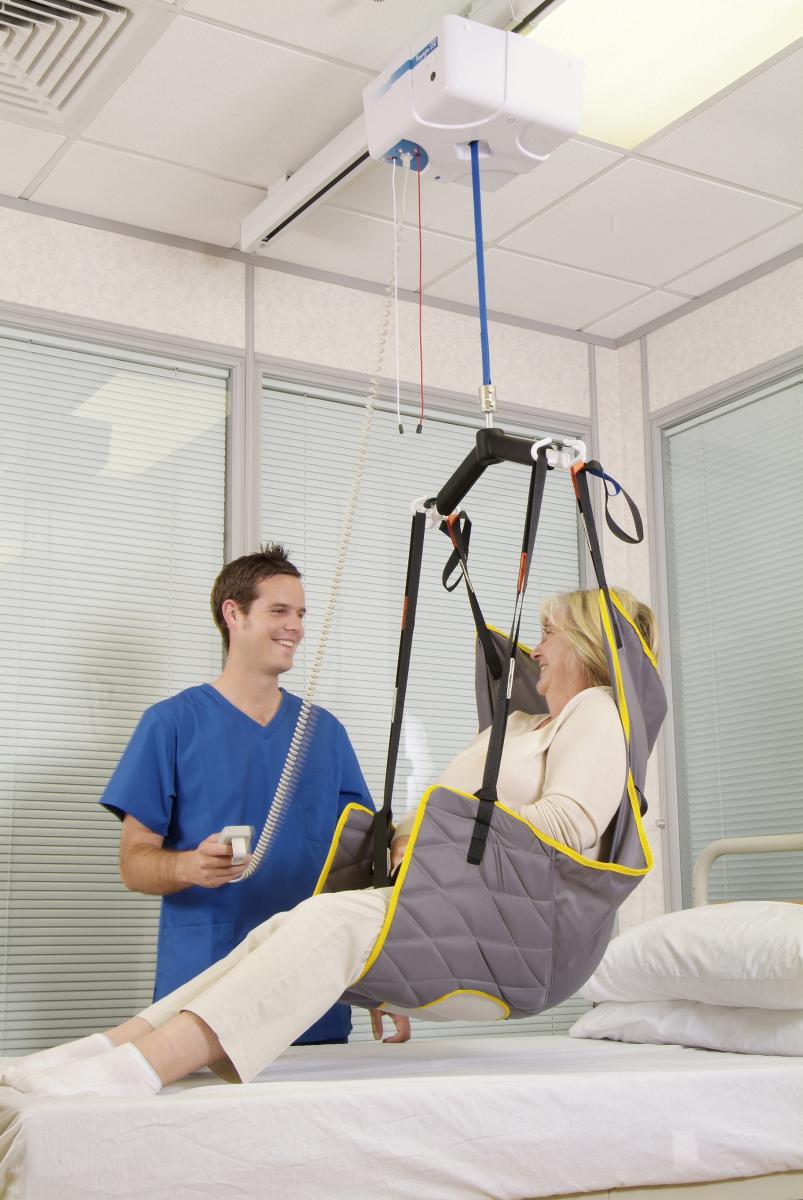
Ceiling hoist operated by one care worker to lift a women out of bed using a sling


Sling

Both a mobile hoist and a ceiling hoist require the use of a sling that attaches to the hoist via straps. A large fabric sling supports your whole body when you are lifted between surfaces.

Slings can come in all different shapes and sizes, and be made of different materials and straps designed for a variety of hoists.

A transfer sling attached to a mobile hoist being operated by two support workers to transfer out of a wheelchair


Standing Hoist

If you can weight-bear, but require a bit of additional support to stand up, a standing hoist can help you with completing transfers i.e. standing from sitting at the edge of your bed, wheelchair, or recliner chair.

Various slings and straps are available to assist you in using your standing hoist. Typically, a standing hoist is operated by one support worker or carer.

A standing hoist and sling operated by two support workers and clinician to sit to stand from a manual wheelchair

Bedroom Assistive Technology

Hi-lo Adjustable Bed

Bedroom assistive technology involves a hi-lo adjustable bed.

An electronically powered hand remote is available to adjust the power features of the bed. 

The power features have various benefits, including:

  • Raised back section - elevates the head and body for comfort, positioning, breathing, and eating.
  • Lower limb elevation and knee break - supports the lower limb in an elevated position for comfort, pressure care management, management of swelling etc.
  • Height adjustability - the bed can be lowered to assist you with standing transfers (if completed), or raise the bed to a height best suited for support workers or carers providing care to you in bed.

An adjustable bed is beneficial for someone with cerebral palsy who has difficulty adjusting and repositioning in bed.

Height adjustable bed with foam mattress


Pressure Relieving Mattress

Various pressure relieving mattresses are necessary for individuals with cerebral palsy.

Pressure-relieving mattresses may be:

  • Foam mattress - consisting of various layers of foam to immerse the body and distribute pressure
  • Alternating air mattress - Air cells within a mattress that are inflated and deflated by an automated pump to redistribute pressure throughout the body for pressure care management
  • Combination of foam and air mattress - a pump-free mattress that combines air cells and foam padding to achieve comfort and pressure care management

Pressure relieving foam mattress


Bed Positioning Aids/Sleep Systems

In some cases, additional cushions and support pads are required to support someone with cerebral palsy sleep and rest in bed.

Their purpose is to provide support that may be necessary for hip alignment and supporting contractures caused by spasticity to improve comfort.

Bathroom Assistive Technology

Mobile Shower Commode

A mobile shower commode is a waterproof wheeled device that has a similar setup to a wheelchair. It may be helpful for you if you cannot stand to shower and/or require support for personal-care routines.

A mobile shower commode typically has an oval gap in the centre of the padded commode seat, similar to the inside of a toilet seat. This is beneficial as the commode can be wheeled over a toilet so that it can also be used for toileting.

A mobile shower commode requires an accessible bathroom. This involves level (flat) access into a shower recess which ideally does not contain glass screens or doors. The toilet seat needs to be low enough for the commode to wheel over.

Mobile shower commodes are more commonly required by people with cerebral palsy who require a hoist to complete transfers. This is because they may not be able to transfer on and off a standard toilet or shower chair. Additional positioning aids and supports can be attached to the commode.
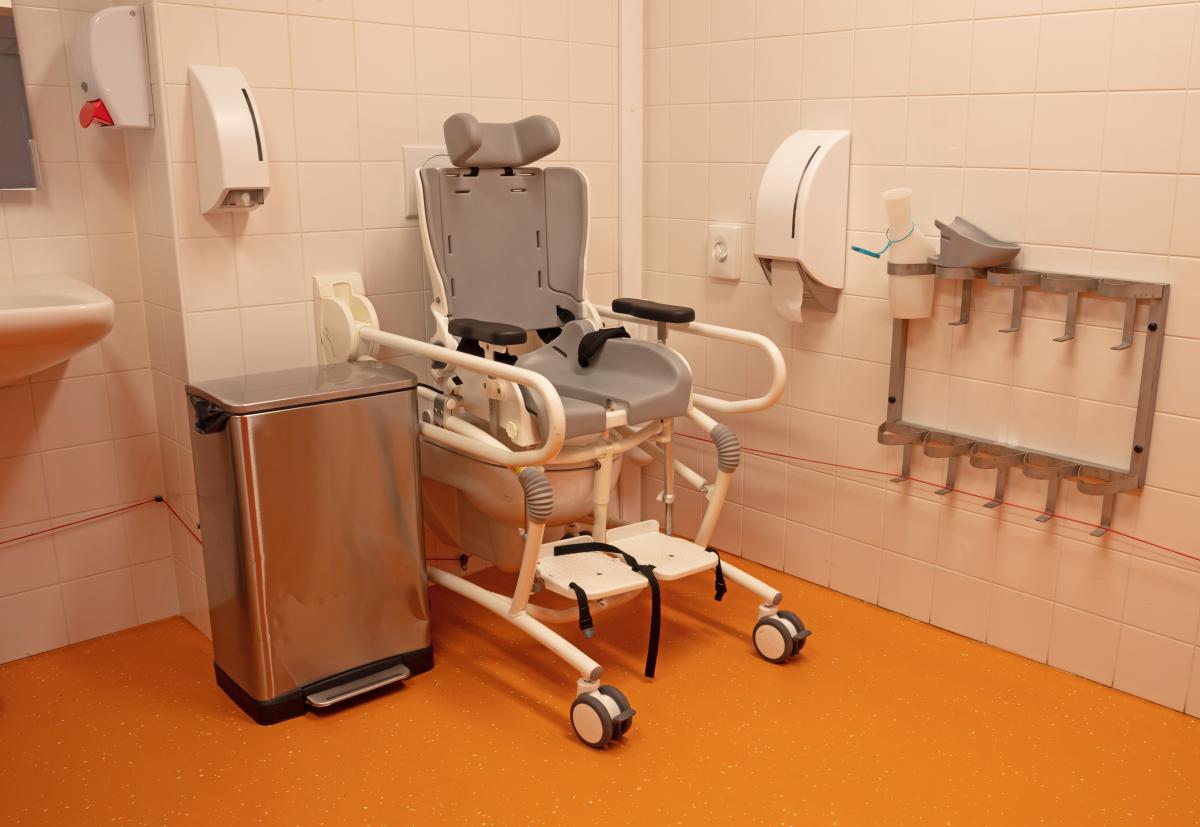
Mobile shower commode positioned over toilet in accessible bathroom


Over Toilet Aid

An over toilet aid is a frame that can be positioned over your toilet to assist with sit to stand transfers. This is beneficial for people with cerebral palsy who can stand and walk, and need a little more support with transfers.

An over-toilet aid can promote your independence and reduce the need to rely on a support worker or carer to get on and off the toilet.
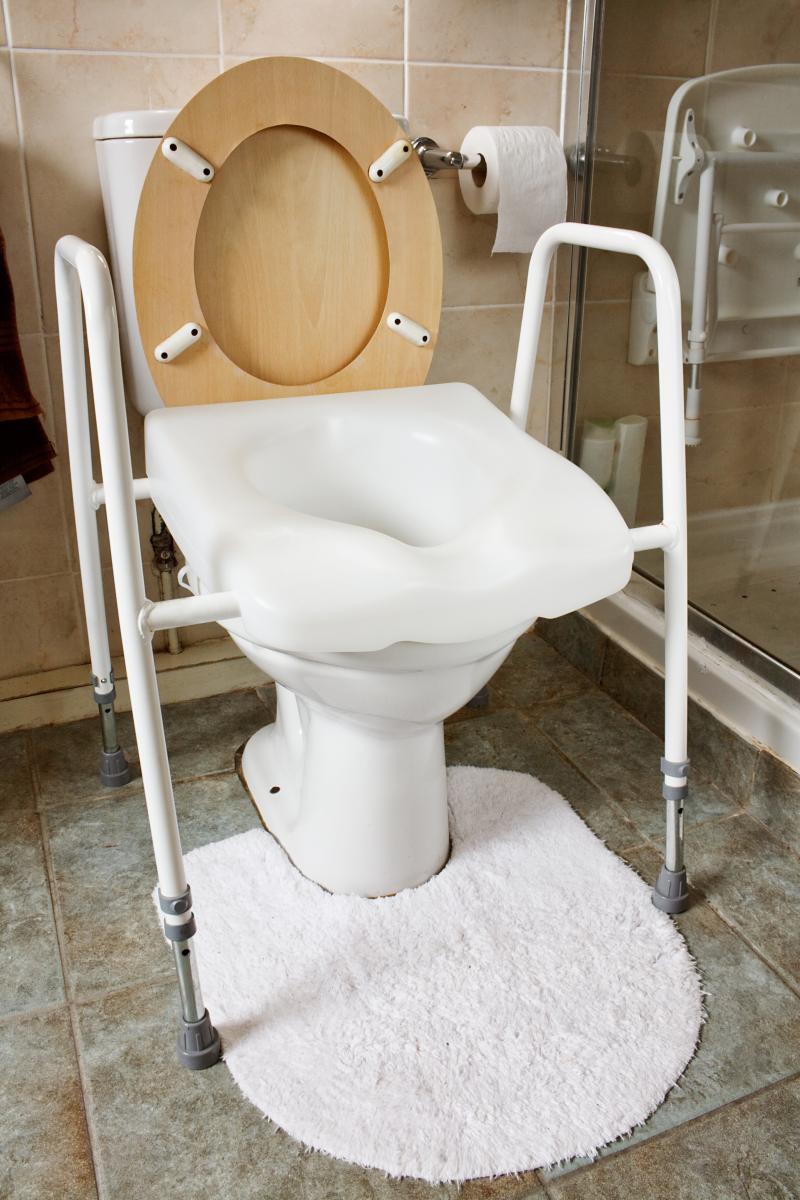
Raised toilet seat with arm rests positioned over toilet


Shower Chair

In some cases, a shower chair may be the support you require in the shower if standing and balancing during your showering activity is difficult.

Shower chairs come in all shapes and sizes, including shower stools with or without backrests and armrests.
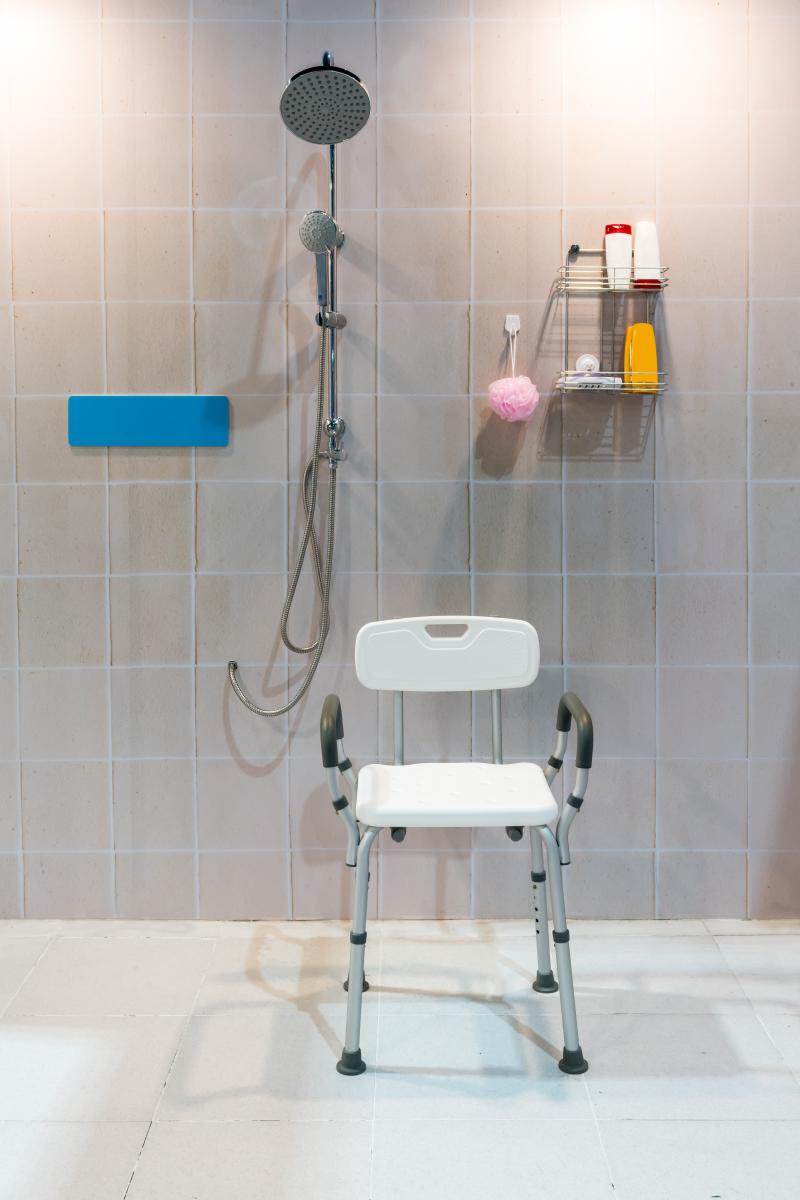
Shower chair positioned in accessible shower recess

Living and Dining Assistive Technology

Living and dining supports can often be overlooked when mobility and transfer assistive technology are prioritised. For someone with cerebral palsy and high physical support needs, a standard couch or armchair is unlikely to meet your needs and sitting upright and maintaining comfort will be a challenge.

In this case, a disability-specific recliner chair with additional positioning features is required, to provide an opportunity to sit somewhere else that isn’t your wheelchair or bed for relaxation, leisure and social engagement.

A tray table on wheels that is compatible with the recliner chair is beneficial for eating meals and performing activities.

Recliner chair with adjustable seating and positioning aids

Kitchen Assistive Technology

Meal preparation aids can be beneficial for individuals with cerebral palsy that may have difficulties engaging in the kitchen for meal preparation. Due to reduced finger strength, hand strength and range of motion, difficulties can be experienced completing some tasks.

Some examples of kitchen and meal preparation aids include:

  • Modified chopping board
  • Spreader boards
  • Modified knives and utensils (thicker or different handle designs)
  • Easy open devices - one-touch bottle, jar and can openers
  • Kettle tipper device
  • Thermomix (in some cases if deemed appropriate following trial with an OT)

Modified chopping board with adaptive features including spokes and a clamp

Communication Assistive Technology

Communication difficulties may be experienced by someone with cerebral palsy due to muscle spasms in the throat, mouth and tongue. This can impact word formation.

With limitations in the ability to communicate, it can be challenging and frustrating to express wants, needs and emotions.

There are a wide variety of communication aids available, ranging from low technology solutions to high technology solutions.

Low Technology Communication Aids:

  • Picture exchange
  • Symbol boards
  • Printed word board with common phrases
  • Communication books
  • Sign language

High Technology Communication Aids:

  • Electronic communication boards
  • Software vocabularies with voices
  • Eye-tracking devices
  • Difficulties with typing and writing may also be necessary if impaired hand function is experienced.

Typing and Writing Aids

Typing Aids

Typing aids may involve a modified keyboard and mouse. This is to accommodate people with limitations in upper limb skills.

There is also talk to type software available which may be beneficial for you if your speech is not impacted but your physical capacity to access computer controls and accessories is limited.

Writing Aids

Adaptive writing aids and tools are beneficial, particularly for children, who may have difficulties with grasping a pencil or pen, or manage writing tasks on a level desk.

Writing aids may include:

  • Specialist pencil grips and writing claws
  • Handcuffs or cuffs
  • Wrist supports
  • Slanted writing board

Hearing Devices

Hearing loss is prevalent in the cerebral palsy population. There are several hearing devices available, including hearing aids and the cochlear implant.

The Hearing Services Program, funded by the Australian Government, provides partially and fully subsidised hearing device options.

The NDIS funds hearing support for NDIS participants aged 26 and over who are not eligible for the HSP. The NDIS also funds additional reasonable and necessary hearing support for participants if they are not available through the HSP. This includes people under 26.

See resources below:

Hearing Services available through the Health Department

Understanding NDIS and other Government Services Hearing Supports

Assistive Technology for Therapy

Assistive technology can play a large role in therapy and capacity building, particularly in the early intervention stages of your NDIS journey.

Assistive technology and adaptive equipment for therapy can include:

Summary

There is a wide range of assistive technology available, with only some of the useful daily living aids discussed above. To learn what is right for you, you may benefit from a Functional Capacity Assessment from an Occupational Therapist.

Find an Occupational Therapist


The MyCareSpace NDIS Navigators can connect you with support workers who have experience with cerebral palsy in your area.

Find a Support Worker 
 

MyCareSpace resources may be shared provided they are credited to MyCareSpace with backlinks to the original resource.

Resource Author: Bianca S. | NDIS Expert   Last Updated: 11 March 2026
NDIS

What is Capacity Building?

Capacity building is a term the NDIS used to describe funded services and supports to help build your independence and skills to help you pursue your goals.

Capacity building typically refers to allied health therapists who provide interventions to address your goals and build your capacity.

There are other service providers who can also work with you to build your capacity, such as support workers and employment services.


Capacity Building and Intellectual Disability

An intellectual disability affects how a person thinks, learns and processes information.

An intellectual disability can result in difficulties in a range of areas related to understanding, communicating, socialising and emotions.

Working with an allied health professional or another professional with training in capacity building for intellectual disability may assist you in developing skills to achieve your goals. These skills can be across a wide range of activities that make up your life at home, school, work and out in the community.

Capacity building intervention may be beneficial for people with intellectual disability across the lifespan, including children to adults.


Who can provide capacity building services for an intellectual disability?

Capacity building services can be provided by a therapist, such as:

  • Occupational Therapist
  • Speech Pathologist
  • Physiotherapist
  • Psychologist
  • Social Worker

Under the NDIS, there are other early childhood support professionals that can be explored, such as:

  • Developmental Educator
  • Early Childhood Teacher or Educator
  • Early Childhood Therapy Assistant
  • Early Childhood Counsellor
  • Keyworker

Learn more about keyworker services here: Keyworker in the NDIS


Capacity Building for Children

Depending on the needs of the child, there is a wide range of capacity building options to be explored.

Capacity building for young children is described as early intervention, which seeks to address difficulties experienced by a child at a young age to reduce the severity or impact experienced later in life.

Capacity building can be accessed in a variety of methods listed below.

Individualised Therapy

This gives the child direct attention with a therapist to focus on their goals in a one-one-one setting. Sessions may occur at a clinic setting, at home or in school, depending on what works best for the child and therapist.

Group Therapy

Group programs provide opportunities for children to work towards their individualised capacity building goals, while benefiting from engaging in a group environment. This provides them the opportunity to develop play and social skills, learning from others, sharing and turn taking etc.

Intensive Therapy Programs

These therapy blocks are designed around the principles of neuroplasticity to accelerate skill development over a short period of time. Intensive therapy programs can be delivered 1:1 or in a group setting, depending on the goals and interventions addressed.

Parent Training

This is a key component of capacity building, where a therapist is reliant on a parent or caregiver to implement interventions and recommendations into daily routines. Parent training enables children to continue to work towards their therapy goals at home.

Find out more about childhood supports for intellectual disability funded by the NDIS


Capacity Building for Adolescents

There is a huge scope for capacity building for adolescents, as these are the formative years where independence is explored and boundaries can be pushed.

Daily Living Interventions

Capacity building can seek to increase independence and participation in daily routines at home. Areas for capacity building includes:

  • Personal care routines, such as showering, dressing, grooming & hygiene
  • Meal preparation activities, including the planning and preparation of small and larger meals
  • Domestic activities, such as laundry tasks, cleaning and maintaining a home

An Occupational Therapist would typically work with you to address goals related to these areas.

Social Skills Interventions

Effective social communication skills are essential to establish and build meaningful relationships with others. This enhances daily interactions across a range of settings.

Social communication interventions may address:

  • Forming and maintaining authentic, meaningful relationships
  • Self-advocacy and conflict resolution
  • Conversation skills
  • Understanding social differences
  • Job interview skills
  • Work readiness
  • Interpreting social cues (understanding emotions, sarcasm and social context)

A Speech Pathologist would usually be involved to address goals related to these areas.

Community Participation Interventions

Engaging in your local and broader community is a key part of life. Due to your intellectual disability, you may require additional support to develop skills across the following:

  • Shopping, attending appointments and running errands
  • Work, in mainstream workplaces and supported employment
  • Transport, such as using public transportation and driving
  • Participation in community-based activities and events

Depending on your goals related to these skills, a variety of therapists may be involved to build your capacity to increase your independence.


Capacity Building for Adults

Capacity building interventions for adults can be similar to those addressed in adolescent years. Particularly if someone did not have access to capacity building supports throughout their childhood or adolescence, there is much to be gained from capacity building intervention throughout your adult years.

Typically, the primary goal of capacity building interventions for adults is to improve independent daily living skills at home and in the community. This can be addressed by a wide range of therapists and service providers to build your capacity.


Capacity Building NDIS Budget

Unlike your Core Supports budget, your Capacity Building Supports budget cannot be moved from one support category to another.

Funding can only be used to purchase approved individual supports that fall within that Capacity Building category.

The Capacity Building categories are:

  • Support Coordination
  • Improved Living Arrangements (referred to as CB Home Living)
  • Increased Social & Community Participation (referred to as CB Social Community and Civic Participation)
  • Finding & Keeping a Job (referred to as CB Employment)
  • Improved Relationships (referred to as CB Relationships)
  • Improved Health & Wellbeing (referred to as CB Health and Wellbeing)
  • Improved Learning (referred to as CB Lifelong Learning)
  • Improved Life Choices (referred to as CB Choice and Control)
  • Improved Daily Living (referred to as CB Daily Activity)

Funding for an allied health provider (a therapist) is available in the Improved Daily Living category. 


How do I find a therapist for a child, teenager or adult with an intellectual disability?

At MyCareSpace, we are connected with many therapy providers. 

More importantly, we monitor their capacity real-time could be the perfect match for you. Let us help you navigate the NDIS and find the therapist you need.

Find A Therapist

MyCareSpace resources may be shared provided they are credited to MyCareSpace with backlinks to the original resource.

Resource Author: Bianca S. | NDIS Expert   Last Updated: 11 March 2026
NDIS

What is an Intellectual Disability

Intellectual disabilities are identified by the NDIA as mild, moderate, severe or profound in accordance with current DSM-5 criteria. The severity of your disability reduces your level of independence and increases your reliance on others. 

An intellectual disability affects how a person thinks, learns and processes information. As a result of a severe or profound disability, you are likely to also demonstrate high physical support needs due an associated physical impairment.


Intellectual Disability and Physical Impairment

What is physical impairment?

This describes the difficulties someone experiences moving their body to walk, sit down, roll over and move their limbs.

In severe cases, people with intellectual disability demonstrate high physical support needs. This is due the significant impact their cognitive impairment has on their physical skills and abilities.

Physical impairment may also be a result of a condition co-occurring with an intellectual disability, such as Cerebral Palsy.

Physical impairment can also be attributed to delays in achieving developmental milestones and overall physical development, whereby an intellectual disability can impact motor coordination skills.


High Physical Support Needs

High physical support needs involve a high level of person-to-person support and the use of assistive technology.  This is directly related to a physical impairment.

What is person-to-person support?

Person-to-person support may involve one person or two people helping you with the various routines that make up your day, including showering, eating, drinking, toileting, etc.

These tasks typically involve manual handling, where you may require assistance to transfer or reposition. 


What is manual handling?

Manual handling involves the practice of safe movements and lifting to reduce the risk of injury to the participant and support workers involved.

In this case, using assistive technology may be necessary. This is to keep you and your support workers or carers safe.

Due to cognitive impairment resulting from your intellectual disability, it may not be safe to operate assistive technology independently. In most cases, assistance is needed to operate devices to ensure your safety and the safety of others.


What Assistive Technology Will Help Participants with Intellectual Disability?

There is a wide range of assistive technology that can support NDIS Participants with severe or profound intellectual disability.

A common question our NDIS Navigators are asked is "What assistive technology can I use my NDIS funds for to help with my intellectual disability?"

We asked our resident OT to tell us what type of equipment she regularly prescribes to assist NDIS Participants with severe or profound intellectual disabilities.

Here are the main assistive technology solutions she mentioned:

  • ​Mobility Devices such as a wheelchair
  • Transfer Assistive Technology such as hoists and slings
  • Bedroom Assistive Technology such as adjustable beds and pressure mattresses
  • Bathroom Assistive Technology such as shower commodes and toilet equipment
  • Living and Dining Assistive Technology such as seating and special trays
  • Kitchen Assistive Technology such as tools to help you cut and prepare food


Mobility Devices to Support NDIS Participants with Intellectual Disability

Manual and Powered Wheelchairs

A manual wheelchair involves a seat and backrest attached to a frame with two large wheels with push-rims. Either the user self-propels the wheelchair, or it is attendant propelled via handlebars positioned at the rear of the backrest.

It can be difficult to accommodate seating and positioning needs for someone with a severe or profound intellectual disability in a manual wheelchair.

A powered wheelchair involves a base with motorised wheels that are controlled by a joystick. Attached to the base include a cushion, backrest, armrests and any other postural supports required.

A powered wheelchair offers a high level of customisation for seating and postural supports. This is often necessary for individuals with a severe or profound intellectual disability with a significant impact on their functional capacity.

To operate a powered wheelchair, the joystick can be placed at the front of the armrests for the user to operate, or at the top of the backrest for carers to operate (or both). Carer operation may be necessary to cater to your intellectual disability.

Young person in a wheelchair propelling down ramp

  Young woman operating powered wheelchair in park with dog running behind her


Transfer Assistive Technology

Mobile Hoist

A mobile hoist is a device that is designed to lift and carry (transfer) you from one surface to another. This may be from your bed to your wheelchair, or from your wheelchair to shower commode.

It has a mobile base that can be wheeled from room to room, so long as there are no steps inside the home or other obstacles. Typically, two support workers or carers are required to operate a mobile hoist.

Mobile hoist operated by two care workers to lift a man out of bed using a sling


Ceiling Hoist

A ceiling hoist is a device attached to a frame that is built into your ceiling. It can transfer you between surfaces, and can sometimes travel between rooms. It is usually easier to handle compared to a mobile hoist and usually requires one or two support workers or carers to operate.

Ceiling hoist operated by one care worker to lift a women out of bed using a sling


Sling

Both a mobile hoist and a ceiling hoist require the use of a sling that attaches to the hoist via straps. A large fabric sling supports your whole body when you are lifted between surfaces.

Slings can come in all different shapes and sizes, and be made of different materials and straps designed for a variety of hoists.

A transfer sling attached to a mobile hoist being operated by two support workers to transfer out of a wheelchair


Standing Hoist

If you can weight-bear, but require a bit of additional support to stand up, a standing hoist can help you with completing transfers i.e. standing from sitting at the edge of your bed, wheelchair, or recliner chair.

Various slings and straps are available to assist you in using your standing hoist. Typically, a standing hoist is operated by one support worker or carer.

A standing hoist and sling operated by two support workers and clinician to sit to stand from a manual wheelchair


Bedroom Assistive Technology

Hi-lo Adjustable Bed

Bedroom assistive technology involves a hi-lo adjustable bed.

An electronically powered hand remote is available to adjust the power features of the bed. 

The power features have various benefits, including:

  • Raised back section - elevates the head and body for comfort, positioning, breathing, and eating.
  • Lower limb elevation and knee break - supports the lower limb in an elevated position for comfort, pressure care management, management of swelling etc.
  • Height adjustability - the bed can be lowered to assist you with standing transfers (if completed), or raise the bed to a height best suited for support workers or carers providing care to you in bed.

An adjustable bed is beneficial for someone with a severe or profound intellectual disability who has difficulty adjusting and repositioning in bed.

Height adjustable bed with foam mattress


Pressure Relieving Mattress

Various pressure-relieving mattresses are necessary for individuals with a severe or profound intellectual disability.

Pressure-relieving mattresses may be:

  • Foam mattress - consisting of various layers of foam to immerse the body and distribute pressure
  • Alternating air mattress - Air cells within a mattress that are inflated and deflated by an automated pump to redistribute pressure throughout the body for pressure care management
  • Combination of foam and air mattress - a pump-free mattress that combines air cells and foam padding to achieve comfort and pressure care management

Pressure relieving foam mattress


Bathroom Assistive Technology

Mobile Shower Commode

A mobile shower commode is a waterproof wheeled device that has a similar setup to a wheelchair. It may be helpful for you if you cannot stand to shower and/or require support for personal-care routines.

A mobile shower commode typically has an oval gap in the centre of the padded commode seat, similar to the inside of a toilet seat. This is beneficial as the commode can be wheeled over a toilet so that it can also be used for toileting.

A mobile shower commode requires an accessible bathroom. This involves level (flat) access to a shower recess which ideally does not contain glass screens or doors. The toilet seat needs to be low enough for the commode to wheel over.

Mobile shower commodes are more commonly required by people with a severe or profound intellectual disability who require a hoist to complete transfers. This is because they may not be able to transfer on and off a standard toilet or shower chair.

Additional positioning aids and supports can be attached to the commode.

Mobile shower commode positioned over toilet in accessible bathroom


Over Toilet Aid

An over toilet aid is a frame that can be positioned over your toilet to assist with sit-to-stand transfers. This is beneficial for people with a moderate or severe intellectual disability who can stand and walk, and need a little more support with transfers.

An over toilet aid can promote your independence and reduce the need to rely on a support worker or carer to get on and off the toilet.

Raised toilet seat with arm rests positioned over toilet


Shower Chair

In some cases, a shower chair may be the support you require in the shower if standing and balancing during your showering activity is difficult.

Shower chairs come in all shapes and sizes, including shower stools with or without backrests and armrests.

Shower chair positioned in accessible shower recess


Living and Dining Assistive Technology

Living and dining supports can often be overlooked when mobility and transfer assistive technology are prioritised. For someone with a severe or profound intellectual disability and high physical support needs, a standard couch or armchair is unlikely to meet your needs and sitting upright and maintaining comfort will be a challenge.

In this case, a disability-specific recliner chair with additional positioning features is required, to provide an opportunity to sit somewhere else that isn’t your wheelchair or bed for relaxation, leisure and social engagement.

A tray table on wheels that is compatible with the recliner chair is beneficial for eating meals and performing activities.

Recliner chair with adjustable seating and positioning aids


Kitchen Assistive Technology

Meal preparation aids can be beneficial for individuals with moderate intellectual disability who may have difficulties engaging in the kitchen for meal preparation.

What are kitchen and meal preparation aids?

Kitchen and meal preparation aids are assistive technology or devices to reduce the demands of meal preparation by offering additional support, and stability and reducing the fine motor demands.

Some examples of kitchen and meal preparation aids include:

  • Modified chopping board
  • Spreader boards
  • Modified knives and utensils (thicker or different handle designs)
  • Easy open devices - one-touch bottle, jar and can openers
  • Kettle tipper device
  • Thermomix (in some cases if deemed appropriate following trial with an OT)

Modified chopping board with adaptive features including spokes and a clamp


Summary

There is a wide range of assistive technology available, with only some of the useful daily living aids discussed above. To learn what is right for you, you may benefit from a Functional Capacity Assessment from an Occupational Therapist.

Find an Occupational Therapist


The MyCareSpace NDIS Navigators can connect you with support workers who have experience with intellectual disability in your area.

Find a Support Worker 

MyCareSpace resources may be shared provided they are credited to MyCareSpace with backlinks to the original resource.

Subscribe to Using your NDIS Funds

Our Preferred NDIS Plan Manager

Plan Hero Plan Management is our preferred NDIS Plan Manager because they are independent and specialist Plan Managers who have both lived experience and expert NDIS knowledge. Plan Management is all they do!

Plan Hero helps you keep your funding organised and on track within each funding period, so you don’t overspend or leave funds unused. They make sure providers are paid on time and help you stay on top of your budget. Their team is easy to reach, with clear, direct communication and no waiting on hold (ever).

Plan Hero gives you the support you need to use your NDIS funding with confidence.