Home / Using your NDIS Funds

Using your NDIS Funds

Resource Author: Bianca S. | NDIS Expert   Last Updated: 11 March 2026
NDIS

What is Supported Independent Living (SIL)?

To learn the basics of SIL, the following resource provides a fantastic overview of: Understanding Supported Independent Living and Intellectual Disability


The Logistics of SIL

Whether you are applying for funding for SIL, or are already accessing SIL services, it is important to understand how SIL is funded in your NDIS plan and what is included and excluded when it comes to SIL supports. 

There is often confusion about how SIL can be funded in your home or a home you share with others. Read on to understand how it all works.


Where is SIL funded in my NDIS plan?

Across NDIS Plans, there is a new category called the Home and Living Supports (Category 16) which appears within the Core Support Budget. This budget is allocated for support for living options in line with your disability needs.

This funding can only be used flexibly within this category, and not across the remaining Core Support budget categories.

Within the Home and Living Supports budget, funding may be available in your NDIS plan for the following:

  • Short-term accommodation (STA)
  • Medium-term accommodation (MTA)
  • Supported Independent Living (SIL)
  • Independent Living Options (ILO)

SIL is considered a long term living option, with the primary purpose of supporting you in your home to live alone or with others.

SIL funding includes at-home support or supervision to build skills in self-care, independence and maintaining a safe home for people with higher support needs.


Does SIL include accommodation?

SIL involves the funding for support provided to you in the home environment.

It does NOT include the home environment where you live.

This means, SIL does not cover the cost of rent, board or lodging costs.

If you require disability-specific accommodation, you may be eligible for Specialist Disability Accommodation (SDA). See further details here: What is SDA and SIL?

The NDIS do not generally provide funding for housing, except for SDA. If you do not meet the criteria for SDA eligibility, you will be required to cover the cost of your accommodation.

If you require affordable housing or are at risk of homelessness, there are state or territory government programs that can help you. Learn more about Housing and Community Infrastructure outlined by from the NDIS directly.


Does SIL include groceries and other day-to-day expenses?

SIL does not include day-to-day living costs that are not related to your disability support needs.

The cost of groceries are not included in SIL. This is a cost you are required to cover.

If you live with others, you may arrange between yourselves to contribute towards shared groceries. In some SIL arrangements, the staff may assist by facilitating online orders and monitoring household supplies.

The cost of utilities such as gas, electricity, water, telephone, and internet bills are also not included in SIL. This is a personal expense for you to cover.

Expenses related to holidays, including travel costs, are also not funded by SIL.


What happens to SIL if I am in hospital?

SIL is not responsible for providing you with personal support while you are admitted to hospital.

The health system is responsible for you meeting your support needs while you are under hospital care.

You will need to discuss ongoing payments for SIL with your SIL provider directly if you are not home to receive it.

It is important to review your service agreement to understand the provider’s policies about the payment for services when the participant is not present. Make sure you are comfortable with these terms before signing the agreement with your chosen provider.


Is staff training required for Intellectual Disability in the NDIS?

Undertaking training specific to intellectual disability is not a requirement for service providers of SIL in the NDIS.

Some providers may be more familiar with supporting individuals with intellectual disabilities than others.

Before engaging with a service provider, it is important for you to understand the staff’s experience working with people with intellectual disabilities if you are after quality care that aligns with your needs.

Consider asking the following:

  • Do you support any existing participants who have intellectual disability? If yes, please describe the model of care, i.e. what does support in the home look like? How are supports shared? How are supports individualised?
  • If required, what assistive technology are your staff experienced with operating?
  • If required, do your staff have any manual handling training? When was training last completed?
  • Are they familiar with supporting any other medical conditions, such as epilepsy?

Receiving support from a provider who has the skills and capabilities is an important factor in maintaining your safety and ensuring your support needs will be met.


Does SIL = shared supports?

SIL can be provided across a variety of settings. SIL can be individual or shared.

Individual Support (Living Alone)

SIL can be provided individually to you in your own home. This means the roster of care is built around you alone, and may include a combination of 1:1 (one support worker to one participant), or 2:1 (two support workers to one participant). The ratio of care across different routines and activities depends on your functional capacity and relevant support needs.

Shared Support (Living Alone)

SIL can be provided to you in a shared capacity while you live in your own home. This model of care is described as Concierge Support.

Concierge Support involves on-site support shared between several participants, however the support provided is not considered live-in support. Instead, an office is set up nearby the residences and is typically staffed 24/7. Drop in support is available to residents on a needs basis and/or for scheduled check ins. Residents can contact the SIL Concierge Staff member at any time if they need one-off support during their day or evening i.e. support that is not part of their scheduled routine.

Shared Support (Living With Others)

SIL can also be provided in a shared living setting, where services are shared across two or more participants. It is not considered necessary for all participants to have an intellectual disability. However, all participants in the home must have the same or similar support needs to ensure the support can be shared appropriately.


Will I receive SIL if I don’t need support all of the time?

If you do not need some level of support all of the time when you are at home, it is unlikely that you will be considered eligible for SIL finding.

There are other options available to you for your support needs to be met. This may be through Assistance with Daily Life in your Core Support Budget, where drop in support is available as you require it.


How do I choose a SIL provider?

When SIL is approved in your plan, you will be provided with a sum of funding for SIL in your Core Support budget.

You are not automatically allocated to a provider, and have choice and control over which provider you engage with for SIL.

The SIL provider you select will assist in preparing a roster of care, utilising the funding allocated in your plan to cater to your needs across your week.


Need help finding a SIL provider? Get in touch with our Connections Team for assistance to navigate the NDIS and find a SIL provider in your area.

Find A SIL Provider

MyCareSpace resources may be shared provided they are credited to MyCareSpace with backlinks to the original resource.

Resource Author: Bianca S. | NDIS Expert   Last Updated: 11 March 2026
NDIS

Funding for support in your NDIS Plan with an Intellectual Disability

Support can be funded in your NDIS plan in a variety of ways. You can have funding for drop-in support, support to engage in the community, support based at home for all of your activities, support at a day program etc.

Supported Independent Living (SIL) is typically required in the home for participants who have high support needs due to their moderate, severe or profound intellectual disabilities.

To be eligible for funding for support, you must meet the NDIS eligibility criteria. This resource focuses on SIL and the eligibility requirements for SIL.


Supported Independent Living (SIL) Eligibility

The NDIS has eligibility criteria that must be met by the funding for any support to be included in your NDIS plan. This includes SIL.

You are required to demonstrate eligibility for SIL before receiving funding for your in-home support needs.

SIL is typically funded for those who require support 24 hours per day, 7 days per week, including overnight support. To be eligible for SIL, you must require direct support for 8 or more hours.

The support you require must relate directly to your intellectual disability and any other conditions recognised by the NDIS.


What if I don't require 24/7 support?

If you do not require such a high intensity of support, SIL might not be the right model of care for you. Consider exploring drop-in supports, or Individualised Living Options (ILO).


Is Supported Independent Living (SIL) Reasonable and Necessary?

Eligibility for SIL must meet the NDIS reasonable and necessary criteria. The reasonable and necessary criteria involve definitions and rules set by the NDIS which they must consider when approving or declining funded supports.

The NDIS will consider the following when approving or declining SIL:

1. Goals

SIL will assist you to pursue and achieve the goals in your plan.

2. Social & Economic Participation

SIL will assist you in undertaking activities to facilitate your social and economic participation.

3. Value for Money

The SIL model of care requested represents value for money. This means the cost of the recommended SIL supports is considered reasonable relative to both the benefits achieved and the cost of alternative supports.

4. Effective and Beneficial

SIL will be effective and beneficial for you. This means it will meet your needs related to your intellectual disability. Your lived experience in previous SIL settings or short-term accommodation (STA) will help in justifying this requirement.

5. Reasonable Expectations for Your Family and Informal Supports

Funding of SIL takes account of what it is reasonable to expect families, carers, informal networks, and the community to provide. They consider your existing supports available, and what must be provided by a SIL provider, in order for your needs to be met.

Intellectual disability can result in lifelong physical, cognitive, and emotional difficulties. You can also experience a wide range of co-occurring conditions. 

The impact of your disability and secondary health conditions can be used to justify how it is not considered reasonable to expect family members to cater to your support needs over the long term.

6. Related to NDIS & Your Disability

SIL is most appropriately funded or provided through the NDIS, instead of another funding body available. This means the need for SIL relates directly to your disability and your in-home support needs.


The NDIS also considers what other supports you need in your home, and how these supports will all work together to ensure SIL is the most appropriate support.

For an easy-to-understand breakdown of reasonable and necessary from MyCareSpace, see here:

MyCareSpace Explains Reasonable and Necessary


What does the NDIS consider when approving funding for Supported Independent Living (SIL)?

The NDIS considers a range of factors when determining if SIL is reasonable and necessary to fund for you. Considerations include:

  • your current situation, goals, and aspirations
  • where you live now and your future home and living goals
  • your independent living skills and potential to build on these
  • supports you need to achieve your home and living goals
  • information about your day-to-day support needs
  • any alternative home and living options

This is outlined in the SIL Operational Guidelines by the NDIS.

The NDIS will review any reports from allied health professionals or providers that are submitted to them as part of your application for SIL. 

The most sought-after assessment is a Functional Capacity Assessment, completed by an Occupational Therapist (OT). Following the assessment, the OT will prepare a Functional Capacity Assessment Report that also includes recommendations specific to SIL.

The NDIS to not provide a template for therapists to complete a SIL report. Each OT provider has their own template and assessment process. For this reason, it may also be called a SIL Assessment, Support Needs Assessment, or Housing Assessment.


What is a Functional Capacity Assessment?

A Functional Capacity Assessment is an in-depth assessment completed by an OT with you in your home. The assessment addresses every aspect of your day-to-day life.

A report is completed following the assessment which outlines your daily life, and difficulties experienced related to your disability and support needs.

The report includes recommendations for NDIS support and services you require to address any challenges and goals you wish to achieve.


How does a Functional Capacity Assessment for SIL differ from a standard Functional Capacity Assessment?

A quality assessment completed by an OT for SIL should include specific details and recommendations regarding your support needs across all of your daily activities and routines. Across every activity you engage in, the report should provide detail on:

  • The ratio of support required (how many people are involved in your care)
  • The intensity of support required (the type of care quality necessary based on your needs)
  • The best context for this support to succeed (the model of care best suited to you - who you live with, where you live etc.)

The report should include details on what support you require across the day and overnight. The report must refer to your informal supports (family and friends), and how they are unable to meet all of your daily living needs, which means that SIL is necessary for you.

The report should reference SIL eligibility, which includes the reasonable and necessary criteria, as discussed above.

When working with an OT for a SIL assessment, it is important to feel assured that they are skilled in this area and are confident in recommending SIL for you.

If they determine SIL may not be the best support model for you, they should discuss this with you during or following the assessment, particularly if they anticipate the NDIS will be unlikely to approve SIL funding. 

Remember, ultimately the decision to approve and decline SIL is the role of the NDIS. The role of the OT is to present evidence of your disability and provide recommendations, concerning relevant legislation so that the NDIS can decide funded supports.


How can I get a Functional Capacity Assessment for SIL?

To find an Occupational Therapist who is experienced in completing a Functional Capacity Assessment for SIL for people with Intellectual Disabilities, reach out to our Connections Team.

This FREE service can connect you with an OT in your area.

Request a SIL Assessment


Submitting evidence to the NDIS for SIL

Once your Functional Capacity Assessment has been completed and you have your report which includes recommendations for SIL, you may consider what other evidence is required to submit to the NDIS.

The more justification you provide that illustrates your support needs and need for SIL, the more evidence the NDIS have available to consider when approving SIL in your NDIS Plan.

Other information prepared by family members, carers, or yourself may help communicate your needs, and how insufficient access to support may impact your health, well-being and quality of life.

This is often described as an Impact Statement - click to find out more.

The final step is to prepare and submit a Home and Living Request to the NDIS.


Submitting a Home and Living Request for SIL

To request SIL funding, you are required as mentioned above to submit a Home and Living Request.

This involves preparing a supporting evidence form which you can download here.

The form can be completed and submitted in one of the following ways:

The form will help participants to select the correct option based on their current needs


If you have a Support Coordinator, they can assist you in completing and submitting the form by one of the following methods:

  • Via email to: [email protected]
  • Via mail to: NDIA, GPO Box 700, Canberra ACT 2601
  • In person at your local NDIS or partner office. 


Ensure the submission also includes the Home and Living Form, as well as any reports prepared by yourself, carers or health professionals. This includes the OT Functional Capacity Assessment with Recommendations for SIL.

The NDIS will review all documents provided to decide whether to fund SIL. You will typically be informed of their decision via email. If SIL is approved, this will likely result in the generation of a new NDIS plan. If SIL is declined, you will be offered the opportunity to have this decision reviewed.


How do I find a SIL provider in my area?

When SIL is approved in your plan, you will be provided with a sum of funding for SIL in your Core Support budget.

You are not automatically allocated to a Provider and have choice and control over which provider you engage with for SIL.

Need help finding a SIL provider? Get in touch with the MyCareSpace Connections Team for assistance navigating the NDIS and finding a SIL provider in your area.

Find A SIL Provider

MyCareSpace resources may be shared provided they are credited to MyCareSpace with backlinks to the original resource.

Resource Author: Bianca S. | NDIS Expert   Last Updated: 11 March 2026
NDIS

What is an Intellectual Disability?

An intellectual disability affects how a person thinks, learns and processes information.

It is a permanent and life-long disability that results in difficulties across a range of areas related to understanding, communicating, socialising and emotions.

In Australia, there are about 450,000 people with an intellectual disability.

Can you receive NDIS funding for an Intellectual Disability?

If you have been diagnosed with an intellectual disability, you may be able to access NDIS funding if you meet the eligibility criteria.

Funding can be used to support your needs directly related to your intellectual disability.

Intellectual Disability and NDIS Statistics

The following information has been collected by the NDIS and is up to date as of June 2023:

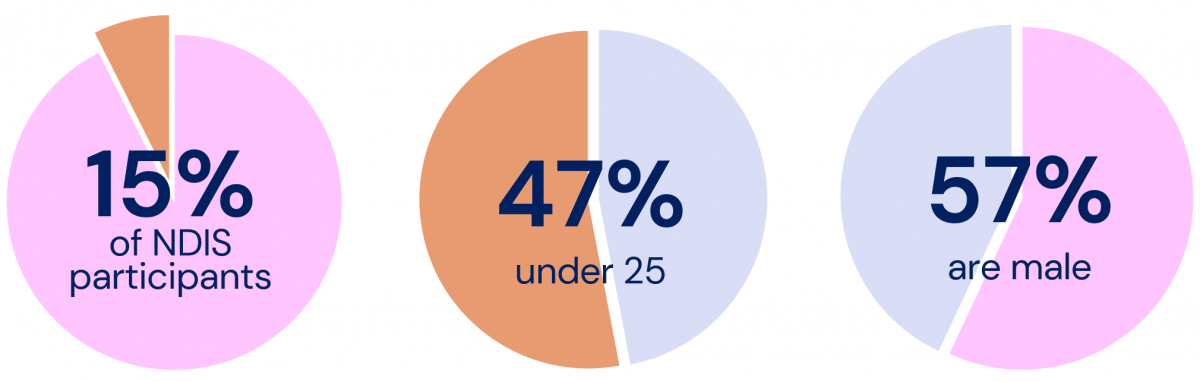
15% of the 610,502 active participants in the NDIS have a primary disability of an intellectual disability, making it the second most common disability for NDIS participants.

47% of participants with an intellectual disability are aged under 25 years.

57% of participants with an intellectual disability are male.

Intellectual Disability Statistics (visual representation of text above)


In the year ending June 2023:

89% of access decisions for applicants with an intellectual disability aged 18 years and under resulted in the applicant joining the Scheme, compared to 77% for those aged over 18 years

$98,100 was the average payment for a participant with an intellectual disability, an increase of 13% compared to the previous year

The number of participants with an intellectual disability has increased by 6% and 5% in the last two years.

Intellectual Disability Statistics (visual representation of text above)

These trends show that funded support for people with intellectual disabilities is increasing.


Childhood supports for Intellectual Disability is funded by the NDIS

Early Childhood Supports (EC) are available to children younger than 6 with developmental delays or children younger than 9 with disability.

Children younger than 6 do not need a diagnosis to get support through the NDIS early childhood approach where there are concerns about their development.

The support provided involves funding for capacity building supports in early childhood, including a key worker. Learn about the keyworker model in the NDIS here.

Funded supports are available for a child with developmental delay or disability and their family or carers across the following settings:

  • Home
  • Community
  • Early childhood education settings

The goal for early childhood support services is to work towards increased functional independence and social participation.

This approach aligns with research that finds early intervention can improve outcomes for children and families by targeting the circumstances that make supporting children's development difficult.

Therapy Supports (9 or older) for Intellectual Disability funded by the NDIS

Therapy supports are available for participants aged 9 and over with an established and diagnosed disability

The goal of therapy is to facilitate functional improvement where there is no more scope from a medical perspective to improve health and function.

Therapy or capacity building can seek to address your goals and build your independence across areas of your life that are meaningful to you.

What therapy services can I access using my NDIS funding?

The following therapists and supports relevant to your intellectual disability which you may be able to access using your NDIS funding:

  • Art Therapist
  • Counsellor
  • Developmental Educator
  • Dietitian
  • Exercise Physiologist
  • Music Therapist
  • Occupational Therapist
  • Physiotherapist
  • Podiatrist
  • Psychologist
  • Rehabilitation Counsellor
  • Social Worker
  • Speech Pathologist

There are also other professionals, described by the NDIA as a person who are not one of the types of professionals listed above but who the provider considers to be an appropriate professional to deliver therapeutic supports in line with the NDIS Quality and Safeguarding Commission’s requirements for the Therapeutic Supports Registration Group.

What other services can I access with NDIS funding?

NDIS funding is also available for other services outside of therapy. This includes day to day support provided by a support worker or support service.

If the support needs is related to your disability, you can access funding for a support worker to assist with:

  • Self-care routines
  • Cooking
  • Cleaning
  • Shopping
  • Transport
  • Programs and activities

These are just some examples of supports and services you can access using your NDIS funding related to your disability.

Our MyCareSpace Connections Team can help you navigate the NDIS and connect you with the services you need.

Get Started
 

MyCareSpace resources may be shared provided they are credited to MyCareSpace with backlinks to the original resource.
Resource Author: Bianca S. | NDIS Expert   Last Updated: 11 March 2026
NDIS

No one wants to admit they are not making a profit

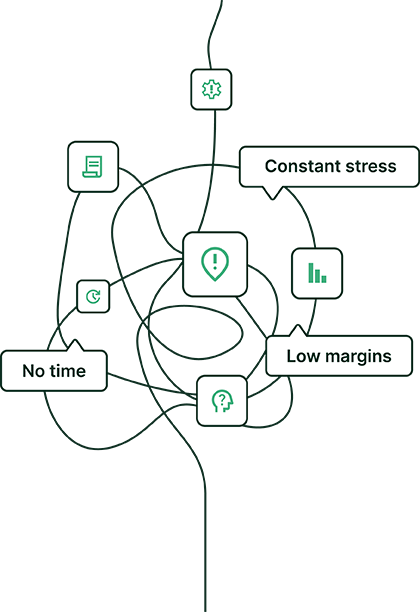
Most ​SIL providers are leaking significant revenue due to misalignment between funding, rostering and claiming because the NDIS has made it so complicated.

There is another way

Imagine if you had a team of SIL experts working with your business.

And this team was free of cost as it paid for itself from savings it delivered.

At the same time it saved you and your staff thousands of hours.

We give you money and time so you can focus on what is most important.

This is where Resolv comes in

The Resolv team will identify where you are losing money due to inefficient rostering, claiming and compliance. 

They will use proven systems and processes to establish new rosters and claiming processes that align accurately with funding.

Resolve guarantees that they will generate savings that easily cover the cost of their services and you will be able to grow!

The more Participants you have, the more you could be losing.

You will go from this:

How your current SIL process looks

To this:

How your business looks after Resolv helps you

What kind of results are Resolv delivering?

On average, Resolv can save you $35,892 PER PARTICIPANT annually by identifying and resolving your revenue leakage.  

They solve for this leakage by working closely with your client services and finance teams to develop new rosters for the houses and claiming documentation that brings alignment to funding, rostering and claiming.

Results are immediate and can be seen within 3 weeks of delivery.

For their last 2 clients, they are delivering $776K in annual savings (across only 11 participants)  and $1.1M in annual savings (across approximately 55 participants).

If you have 10+ Participants, you absolutely must find out more about this.

Can you afford not to find out if you can increase your profits?

Find out more


How does Resolv work?

Step 1 Obligation Free Analysis

They perform detailed financial analysis to understand your compliance and business risks. They will give you a free independent overview of your compliance and financial sustainability (this can usually cost you thousands!). 

They will share with you how much they believe they can save you in revenue leakage.

They will back this with a performance guarantee - if they don't increase your revenue by this amount, you don't pay.

Step 2 Roster & Claims

Once you decide to go ahead, they will optimise rosters and claiming documentation to ensure compliance and financial sustainability.

Step 3 Action Plan

They develop detailed action plans for every house and participant to drive informed decision-making.


3 Reasons Why You Need Resolv

  1. Big Results, Fast: Every client they work with are delivering results in the mid-6 figure range - and the results are immediate, within 3 weeks we are delivering results that are evident on the P&L
     
  2. Positive Budget Impact: Everything they do is backed by a performance guarantee - therefore working with Resolv can only result in a positive budget impact and money that can be reinvested back into the business (equipment, people, projects etc)
     
  3. Here to Help:  First and foremost they are here to help and always there to answer questions and provide guidance - without a dollar tag attached.

Have a Resolv consultant contact you today

MyCareSpace resources may be shared provided they are credited to MyCareSpace with backlinks to the original resource.

Resource Author: Bianca S. | NDIS Expert   Last Updated: 11 March 2026
NDIS

Living with a spinal cord injury may mean you require support at home. The NDIS can fund a wide range of support to meet your needs, in your current home or in a new home environment setting if this is something you need.

MyCareSpace has developed a range of resources that explains the type of support you can receive related to your spinal cord injury, how to get funding for Supported Independent Living (SIL), whether you can live alone or live with others, what is involved in Specialist Disability Accommodation (SDA) and also Short Term Accommodation (STA), otherwise referred to as respite.

The resources listed below are available for free via the MyCareSpace website.

What support can I receive with a Spinal Cord Injury?

Young man seated in wheelchair beside female carer seated on couch

With your NDIS funding, you can access support services in the home and community. Support services you receive can be tailored directly to your disability-specific needs related to your spinal cord injury.

Learn More


How to Get Funding for Supported Independent Living (SIL)

Male seated in wheelchair with laptop showing thumb up gesture, smiling at camera

The NDIS has eligibility criteria that must be met by the funding for any support to be included in your NDIS plan. This includes SIL. SIL is typically funded for those who require support for:

  • 24 hours per day, 7 days per week, including overnight support.
  • Of these 24 hours, you require active or direct support for 8 hours or more

The support you require must relate directly to your diagnosis of a spinal cord injury and any other co-occurring conditions recognised by the NDIS.

Learn More


Supported Independent Living (SIL) - Living Alone or With Others?

Gentleman seated in wheelchair at entrance of home

Supported Independent Living (SIL) is a service that can be offered in a home that you own, rent, access through a community housing service or in an SDA property. SIL can be provided to you in a sole-occupancy setting. This means you can live alone and access a SIL service. You can also share SIL with others.

Learn More


Specialist Disability Accommodation (SDA)

Accessible home with wide doorway and vacant wheelchair

Specialist Disability Accommodation (SDA) is funded by the NDIS for participants who require their physical home environment to cater to their needs related to their disability. To be approved for SDA, you need to demonstrate that you have a significant functional impairment or have very high support needs directly related to your spinal cord injury.

Learn More


Short Term Accommodation (STA)

Hotel room with door half open in foreground

Short Term Accommodation is funding allocated to an NDIS participant to live out of home for a short period of time. It is often described as respite. Funding for short-term accommodation is allocated in the Core Support Budget of your NDIS Plan.

Learn more


Need help accessing support?

The MyCareSpace Connections Team can assist you to navigate the NDIS and find the right support provider for you. In one request, you can select up to five different services you wish to explore!

Our Connections Team will then be in touch with you directly to connect you with service providers with capacity.

Get Started


MyCareSpace resources may be shared provided they are credited to MyCareSpace with backlinks to the original resource.

Resource Author: Bianca S. | NDIS Expert   Last Updated: 11 March 2026
NDIS

NDIS Support for Spinal Cord Injury

If you have an NDIS plan, you can receive funding for support related to your needs due to your spinal cord injury. This can involve support in the home to assist you with day to day tasks, or in the community to assist you attend appointments, grocery shopping, socialise - the list goes on!

What home and community support can I receive related to my Spinal Cord Injury? 

The support services you require depends on the following factors:

  • What is your level of independence? 
  • What are your support needs with particular tasks?
  • What do you wish to achieve in your day?

The person who can provide you with this support under the NDIS is called a support worker or carer. You can access support to assist with some or all of your activities of daily living, depending on your needs.

The level of support at home will depend on the impact your spinal cord injury has on your capacity to participate in these activities.

Support in the Home

Having one support worker assist you with your needs is described as a 1:1 ratio of support.

In some cases, two support workers may be necessary for manual handling, involving transferring between surfaces with or without use of assistive technology. This is a 2:1 ratio of support.

A 2:1 ratio of support may be necessary ensure your safety and the safety of the support workers. Two support workers may also be required to assist with personal care routines due to the complexity of your needs. The NDIS can fund two support workers in these instances too.

Support in the Community

The frequency and intensity of community-based support you recieve will depend on the level of support you require. If you are a wheelchair user, you may require additional support to manage any environmental barriers faced in community settings. Transport assistance is also available through the NDIS.

What NDIS funding is available for support?

In your NDIS Plan are there three budgets:

  • Core Supports
  • Capacity Building Supports
  • Capital Supports

The Core Support budget is where you access funding for support received in the home and community related to your spinal cord injury.

What are Core Supports in the NDIS?

The Core Supports budget includes funding for support workers, in addition to funding for low cost assistive technology, consumables and transport related to your disability needs.

Core Support funding includes supports to help you with:

  • your everyday living activities
  • your current disability-related needs
  • to help you work towards your longer-term goals

What are the Core Support Categories?

There are five support categories within Core Supports:

  1. Assistance with Daily Life
  2. Transport
  3. Consumables
  4. Assistance with Social, Economic and Community Participation
  5. Home and living

1. Assistance with Daily Life

My Place Portal Title: Daily Activities

Funding for a support worker to help you with everyday tasks at home, such as:

  • Home cleaning
  • Household chores (i.e. laundry)
  • Gardening/yard maintenance
  • Meal preparation (i.e. cooking for you in your home)
  • Personal care, grooming and hygiene (i.e. helping you shower and with your personal care routines)
  • Overnight sleepover support or assistance from a live-in carer

2. Consumables

My Place Portal Title: Consumables

Funding for single or multi use products that may include:

  • Continence Aids - Products related to continence and toileting management. Examples include: pads, catheters, bed and chair protection, urinals and bed pans etc
  • Nutrition - Products required for enteral feeding, supplements, thickeners etc
  • Skin/Wound Care - Products to treat any pressure injuries, wounds or skin conditions related to your disability. Examples include: dressings, bandages, pressure care aids etc
  • Low Cost Assistive Technology (AT) - Items under $1500 you need to increase your independence and/or safety when receiving support when engaging in activities of daily living. Examples include: shower stool, dressing stick, long-handled shoe horn, jar opener, modified chopping board etc.

3. Assistance with Social, Economic and Community Participation

My Place Portal Title: Social, Community and Civic Participation

This is support to help you to engage in social or recreational activities and become more involved in your community.

Services can involve a support worker transporting you to an activity in the community and participate with others.

If you need support to access a course or activity that is non-disability specific, NDIS funding can be used to cover the cost of a support worker assisting you to access and engage in these activities, but not the activity itself.

4. Transport

My Place Portal Title: Transport 

If you have challenges travelling related to your spinal cord injury, transport services can help you travel to work or other places that will help you pursue the goals in your NDIS plan.

Supports the NDIS generally don’t fund:

  • Travel for other members of the family, carers, or service providers
  • Transport to everyday commitments (like school)

Can I receive nursing support through the NDIS?

Nursing support is available to NDIS participants who have disability related medical needs. You can access nursing services for the delivery of health supports through your Core Support budget, in the category Assistance with Daily Life.

There is also funding avaialble for the delivery of disability related health supports by a nurse through your Capacity Building budget, in the category of Improved Daily Living.

Depending on your specific needs, you can recieve suport from an:

  • enrolled nurse
  • registered nurse
  • clinical nurse
  • clnical nurse consultant
  • nurse practitoner 

Input for nursing relevent to your spinal cord may involve wound care management, related to a pressure injury, or a continence assessment and intervention related to bladder or bowel care. You may require nursing input related to breathing and circulation.

Do all support workers and nurses cost the same?

The cost of support workers and nursing care varies. The factors to consider involve:

  • Time of day of services - daytime, evening and overnight
  • Overnight support - active or inactive
  • Week day or weekend support
  • Complexity of your care support needs
  • Qualification/training requirements of the support worker or nurse in related to your care needs

The various costs are outlined in the NDIS Pricing Arrangements and Price Limits (previously the NDIS Price Guide)

This document is usually updated annually by the NDIA.

As it can be a little tricky to nagivate, MyCareSpace have developed a fantastic easy to read NDIS Price List Finder. Enter in a keywork, line number or line item name to find out the specific details you need.

MyCareSpace NDIS Price List Finder

Can I use my Core Support budget flexibly?

The NDIS allows for flexibility between the different categories within your Core Support budget. 

For example, if you have funding allocated in Assistance with Social, Economic and Community Participation, however you determine you would prefer to have more support in the home, you can use the funding flexibility across these categories within Core Supports to access the support you need.

Can funding from Core Supports be used flexibly with Capacity Building or Capital Supports?

There is less flexiblity between the main three budgets: Core Supports, Capacity Building and Capital Supports.

In most cases, funding cannot be used flexibility across the main budgets. Only funding allocated within Core is flexible amongst itself.

For further information, read here to Understand your NDIS Plan.

Where can I find Core Support providers?

MyCareSpace Connections Team can assist you to nagivate the NDIS and find the right support provider for you.

Get Started

MyCareSpace resources may be shared provided they are credited to MyCareSpace with backlinks to the original resource.

Resource Author: Bianca S. | NDIS Expert   Last Updated: 11 March 2026
NDIS

What is Specialist Disability Accommodation?

Specialist Disability Accommodation (SDA) is funded by the NDIS for participants who require their physical home environment to cater to their needs related to their disability.


How do I access funding for SDA?

To be approved for SDA, you need to demonstrate to the NDIA that you have a significant functional impairment or have very high support needs

Depending on the level of impairment caused by your Spinal Cord Injury, you may meet one or both of these criteria.

The eligibility criteria for SDA are outlined in the SDA Operational Guidelines.
 

How do I apply for SDA?

To apply for SDA, you need to submit a Home and Living Request. 

This is completed by submitting a Change in Situation Form to the NDIS.
 

The NDIS have also prepared a Home and Living Supporting Evidence Form that you can complete so the NDIS have the information they require.


What other evidence is required to apply for NDIS?

You will also have the best chance of success applying for SDA by undertaking a Functional Capacity Assessment completed by an Occupational Therapist.

The Function Capacity Assessment Report for SDA should include additional recommendations that specifies your requirements for SDA related to your disability, and other considerations for SDA regarding the design type, building type, location etc.

Find an OT for an SDA Assessment


Benefits of SDA for Spinal Cord Injury 

You can greatly benefit from SDA if you have a Spinal Cord Injury, as a property can include accessible and adaptive features to accommodate your needs. Examples include:

  • Level entry via a step free pathway is available to access the home, with all internal spaces being level throughout the home.
  • Wider doorways at entrances and between rooms to accommodate larger assistive technology, such as wheelchairs, commodes and hoists.
  • Meals can be prepared using a height adjustable bench top and side-opening oven.
  • A level entry shower and height adjustable vanity with wheelchair access promotes independence in self-care routines.
  • The bedroom and bathroom has space to operate a mobile hoist, and in some properties, a ceiling hoist can be installed.
  • Environmental control units can allow you to operate doors, blinds, lights and other features on the home electronically.

These are just some examples on how SDA can help you live more independently.


SDA Design - What is this?

The SDA Design Standards include detailed information around what is included in each of the four SDA design types, which include:

SDA Categories with Icons

For a property to be registered as being SDA, the features of the home must align with one of the four design types, as outlined by the NDIS.

Each design type includes accessible features to meet specific needs related to your disability.


How do I receive support in SDA?

Support can be provided in a variety of formats for participants residing in SDA settings. Your model of care is developed based on how you wish to receive your NDIS support services.

You can receive SIL while living in SDA, or you can receive drop in support from your Core Support budget. 

See the following resource below to navigate SIL:

Alternatively, the accessible features of the SDA property could negate the need for any support workers, achieving total independence.


How do I find SDA providers?

The MyCareSpace Connections Team can assist you with finding the right SDA provider for you with vacancies.

Connect with our team to find out more.

Find SDA

MyCareSpace resources may be shared provided they are credited to MyCareSpace with backlinks to the original resource.

Resource Author: Bianca S. | NDIS Expert   Last Updated: 11 March 2026
NDIS

Funding for support in your NDIS Plan with a Spinal Cord Injury (SCI)

Support can be funded in your NDIS plan in a variety of ways. You can have funding for drop-in support, support to engage in the community, support based at home for all of your activities, support at a day program etc.

To be eligible for funding for support, you must meet the NDIS eligibility criteria. This resource focuses on Supported Independent Living (SIL) and the eligibility requirements for SIL.

Due to high support needs, SIL is typically required in the home for participants with complex spinal cord injuries.

Supported Independent Living (SIL) Eligibility

The NDIS has eligibility criteria that must be met by the funding for any support to be included in your NDIS plan. This includes SIL.

You are required to demonstrate eligibility for SIL before receiving funding for your in-home support needs.

SIL is typically funded for those who require support for:

  • 24 hours per day, 7 days per week, including overnight support.
  • Of these 24 hours , you require active or direct support for 8 hours or more.

The support you require must relate directly to your diagnosis of spinal cord injury and any other co-occurring conditions recognised by the NDIS.

If you do not require such a high intensity of support, SIL might not be the right model of care for you. Consider exploring drop-in supports, or Individualised Living Options (ILO).

Is Supported Independent Living (SIL) Reasonable and Necessary?

Eligibility for SIL must meet the NDIS reasonable and necessary criteria. The reasonable and necessary criteria involve definitions and rules set by the NDIS which they must consider when approving or declining funded supports.

The NDIS will consider the following when approving or declining SIL:

1. Goals

SIL will assist you to pursue and achieve the goals in your plan.

2. Social & Economic Participation

SIL will assist you in undertaking activities to facilitate your social and economic participation.

3. Value for Money

The SIL model of care requested represents value for money. This means the cost of the recommended SIL supports is considered reasonable relative to both the benefits achieved and the cost of alternative supports.

4. Effective and Beneficial

SIL will be effective and beneficial for you. This means it will meet your needs related to your spinal cord injury. Your lived experience in previous SIL settings or short-term accommodation (STA) will help to justify this requirement.

5. Reasonable Expectations for Your Family and Informal Supports

Funding of SIL takes account of what it is reasonable to expect families, carers, informal networks, and the community to provide. The NDIS the availability of existing supports, and what must be provided by a SIL provider, in order for your needs to be met.

Spinal cord injury can result in a lifelong physical, cognitive, and emotional difficulties. You can also experience a wide range of co-occurring conditions. The impact of your disability and secondary health conditions can be used to justify how it is not considered reasonable to expect family members to cater to your support needs over the long term.

6. Related to NDIS & Your Disability

SIL is most appropriately funded or provided through the NDIS, instead of another funding body available. This means the need for SIL relates directly to your disability and your in-home support needs.

The NDIS also considers what other supports you require in your home, and how these supports will all work together to ensure SIL is the most appropriate support.

For an easy-to-understand breakdown of reasonable and necessary from MyCareSpace, see here.

What does the NDIS consider when approving funding for Supported Independent Living (SIL)?

The NDIS considers a range of factors when determining if SIL is reasonable and necessary to fund for you. Considerations include:

  • your current situation, goals, and aspirations
  • where you live now and your future home and living goals
  • your independent living skills and potential to build on these
  • supports you need to achieve your home and living goals
  • information about your day-to-day support needs
  • any alternative home and living options

This is outlined in the SIL Operational Guidelines from the NDIS.

The NDIS will review any reports from allied health professionals or providers that are submitted to them as part of your application for SIL. 

The most sought-after assessment is a Functional Capacity Assessment, completed by an Occupational Therapist (OT). Following the assessment, the OT will prepare a Functional Capacity Assessment Report that also includes recommendations specific to SIL.

The NDIS do not provide a template for therapists to complete a SIL report. Each OT provider has their own template and assessment process. For this reason, it may also be called a:

  • Supported Independent Living Assessment
  • Support Needs Assessment
  • Home and Living Assessment
  • Housing Assessment

What is a Functional Capacity Assessment?

A Functional Capacity Assessment is an in-depth assessment completed by an Occupational Therapist with you in your home. The assessment addresses every aspect of your day-to-day life and involves an in depth analysis on how you perform a task and if you require support, what this looks like.

A report is completed following the assessment which outlines your daily life, and difficulties experienced related to your disability and support needs.

The report includes recommendations for NDIS support and services you require to address any challenges and goals you wish to achieve.

How does a Functional Capacity Assessment for SIL differ from a standard Functional Capacity Assessment?

A quality assessment completed by an OT for SIL should include specific details and recommendations regarding your support needs across all of your daily activities and routines. Across every activity you engage in, the report should provide detail on:

  • The ratio of support required (how many people are involved in your care)
  • The intensity of support required (the type of care quality necessary based on your needs)
  • The best context for this support to succeed (the model of care best suited to you - who you live with, where you live etc.)

The report should include details on what support you require across the day and overnight. The report must refer to your informal supports (family and friends), and how they are unable to meet all of your daily living needs, which means that SIL is necessary for you.

The report should reference SIL eligibility, which includes the reasonable and necessary criteria, as discussed above.

When working with an OT for a SIL assessment, it is important to feel assured that they are skilled in this area and are confident in recommending SIL for you. If they determine SIL may not be the best support model for you, they should discuss this with you during or following the assessment, particularly if they anticipate the NDIS will be unlikely to approve SIL funding. 

Remember, ultimately the decision to approve and decline SIL is the role of the NDIS. The role of the OT is to present evidence of your disability and provide recommendations, concerning relevant legislation so that the NDIS can decide funded supports.

How can I get a Functional Capacity Assessment for SIL?

To find an Occupational Therapist who is experienced in completing a Functional Capacity Assessment for SIL for people with spinal cord injury, reach out to our Connections Team. This FREE service can connect you with an OT in your area.

Request a SIL Assessment for Spinal Cord Injury

Submitting evidence to the NDIS for SIL

Once your Functional Capacity Assessment has been completed and you have your report which includes recommendations for SIL, you may consider what other evidence is required to submit to the NDIS.

The more justification you provide that illustrates your support needs and need for SIL, the more evidence the NDIS has available to consider when approving SIL in your NDIS Plan.

Other information prepared by family members, carers, or yourself may help communicate your needs, and how insufficient access to support may impact your health, well-being and quality of life. This is often described as an Impact Statement, which you can learn more about here.

The final step is to prepare and submit a Home and Living Request.

Submitting a Home and Living Request for SIL

To request SIL funding, you are required to submit a Home and Living Request. This involves preparing a supporting evidence form which you can find here.

The form can be completed and submitted in one of the following ways:

The form will help participants to select the correct option based on their current needs

If you have a Support Coordinator, they can assist you in completing and submitting the form by one of the following methods:

  • Via email to: [email protected]
  • Via mail to: NDIA, GPO Box 700, Canberra ACT 2601
  • In person at your local NDIS or partner office. 

Ensure the submission also includes the Home and Living Form, as well as any reports prepared by yourself, carers or health professionals. This includes the OT Functional Capacity Assessment with Recommendations for SIL.

The NDIS will review all documents provided to decide whether to fund SIL. You will typically be informed of their decision via email. If SIL is approved, this will likely result in the generation of a new NDIS plan. If SIL is declined, you will be offered the opportunity to have this decision reviewed.

How do I find a SIL provider in my area?

When SIL is approved in your plan, you will be provided with a sum of funding for SIL in your Core Support budget.

You are not automatically allocated to a Provider and have choice and control over which provider you engage with for SIL.

Need help finding a SIL provider? Get in touch with the MyCareSpace Connections Team for assistance navigating the NDIS and finding a SIL provider in your area.

Find A SIL Provider

MyCareSpace resources may be shared provided they are credited to MyCareSpace with backlinks to the original resource.
Resource Author: Bianca S. | NDIS Expert   Last Updated: 11 March 2026
NDIS

What is Supported Independent Living (SIL)?

Supported Independent Living (SIL) is a service that can be offered in a home that you own, rent, or access through Social Housing or in an SDA property. 

SIL is typically funded for those who require support 24 hours per day, 7 days per week, including overnight support.

SIL is typically not received outside of the home. If you require support outside of the home, this is usually provided through another service for community participation.

SIL may be suitable for you if you require both:

  • active disability support for more than 8 hours per day to complete daily activities in the home
  • some level of support for the other remaining hours, including overnight.

Overnight support may be active, where greater than two hours of direct assistance is necessary.

Inactive or sleepover support involves less than two hours of assistance provided to you.

Your SIL supports are set up in a Roster of Care related directly to your needs in line with your spinal cord injury.

A Roster of Care is an NDIS template that specifies the ratio of support you require across each day of the week and the cost of this support.

This is for the SIL provider to complete once SIL funding has been approved in your NDIS plan.
 

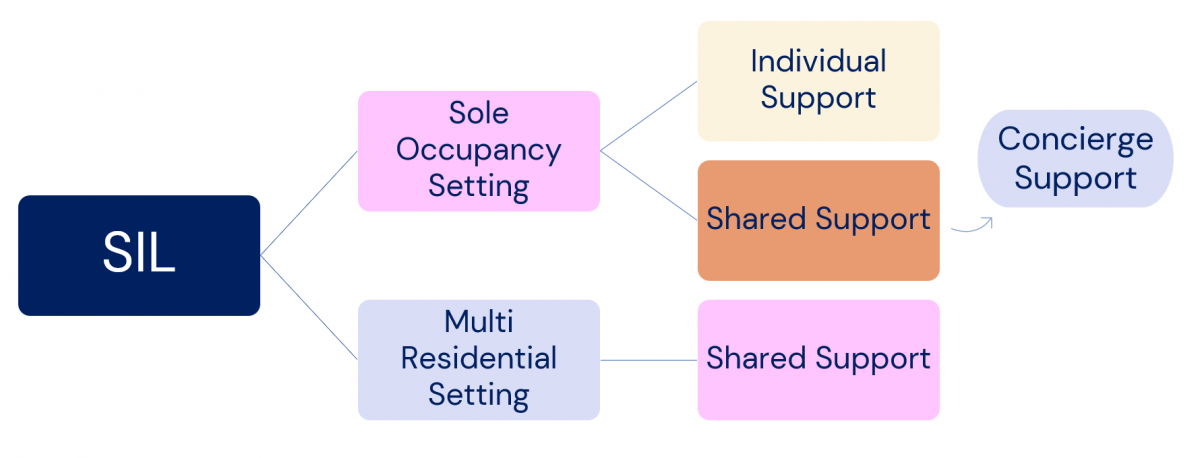
What is a SIL Model of Care?

There are different models of care in which SIL can be provided:

Supported Independent Living Model Of Care Chart


Supported Independent Living in Sole Occupancy Setting

Individual Support in a Sole Occupancy Setting

SIL can be provided to you in a sole-occupancy setting. This means you can live alone and access a SIL service.

In your SIL Roster of Care, you may have some periods where your support needs are increased (i.e. in the morning and evenings), and some periods where SIL support is not required (i.e. you are at work or day program).

Under this model of care, the support you receive is tailored just for you.

Shared Support in a Sole Occupancy Setting

Concierge support is an alternative model of care for people with spinal cord injuries to receive their SIL support.

Concierge support is arranged typically for participants who live in individual SDA dwellings, such as an apartment, within the same setting, i.e. apartment building or complex.

Concierge support staff are set up in an office near the SDA residences occupied by NDIS participants. The office is staffed 24/7 to provide residents with support.

Drop in support is available to residents on a needs basis, or for scheduled supports as arranged by yourself and the SIL provider.

Concierge support may be particularly beneficial to you if you don’t want or need direct support at all times within your home, but require the availability of support at all times. This may be to assist with non-scheduled or incidental tasks that may occur throughout the day and night, such as toileting.

Supported Independent Living in Multi-Residential Setting

SIL can also be provided in a multi-residential setting.

This means support is shared across several participants who live together in a shared accommodation setting.

There can be one or more staff working at one time to support multiple residents.

Shared SIL in a multi-residential setting is provided in a house environment, where each resident has their own bedroom, and access to a shared kitchen, living room, bathrooms etc.

You have choice and control over whether you wish to live in a sole occupancy or multi-residential setting. To live alone, you will require robust evidence to establish why sole occupancy is deemed reasonable and necessary, particularly as the NDIS considers shared living to be more cost effective.

How do I know if Supported Independent Living is right for me?

SIL is typically approved for participants with higher support needs who need some level of help at home all or most of the time. As previously mentioned, this usually includes overnight support.

If SIL isn’t for you, drop-in support (available through Core Supports) is also available.

How do I find a SIL Provider in the NDIS?

You can choose who provides you with SIL once you have SIL funding approved in your NDIS plan. It is important you choose the provider that works best for you.

Need help finding a SIL provider?

Get in touch with the MyCareSpace Connections Team for assistance to find SIL services in your area and navigate the NDIS.

Get Started
 

MyCareSpace resources may be shared provided they are credited to MyCareSpace with backlinks to the original resource.

Resource Author: Bianca S. | NDIS Expert   Last Updated: 11 March 2026
NDIS

Spinal Cord Injury - What is involved?

Spinal Cord Injury (SCI) involves damage to the spinal cord which can impact your:

  • movement
  • sensation
  • breathing
  • organ function
  • bladder and bowel function
  • sexual function

Spinal Cord Injury and High Physical Support Needs

In some cases, people with a spinal cord injury demonstrate high support needs due the severe impact of their injury. High physical support needs involve a high level of person-to-person support and the use of assistive technology. 

Person-to-person support may involve one person or two people helping you with the various routines that make up your day, including showering, eating, drinking, toileting, etc.

These tasks typically involve manual handling, where you may require assistance to transfer or reposition. 

Manual handling involves the practice of safe movements and lifting to reduce the risk of injury to the participant and support workers involved. In this case, using assistive technology may be necessary. This is to keep you and your support workers or carers safe.

Due to the high complexity of your spinal cord injury, you may not have the capacity to operate some of your assistive technology. In these cases, assistance is required to operate devices to ensure your safety and the safety of others.

What Assistive Technology Will Help Participants with a Spinal Cord Injury?

There is a wide range of assistive technology that can support NDIS Participants with a spinal cord injury.

A common question our NDIS Navigators are asked is "What assistive technology can I use my NDIS funds for to help with my spinal cord injury?"

We asked our resident OT to tell us what type of equipment she regularly prescribes to assist NDIS Participants with a spinal cord injury.

Here are the main assistive technology solutions she mentioned:

  • ​Mobility Devices such as a wheelchair
  • Transfer Assistive Technology such as hoists and slings
  • Bedroom Assistive Technology such as adjustable beds and pressure mattresses
  • Bathroom Assistive Technology such as shower commodes and toilet equipment
  • Living and Dining Assistive Technology such as seating and special trays
  • Kitchen Assistive Technology such as tools to help you cut and prepare food

Mobility Devices to Support NDIS Participants with Spinal Cord Injury

Manual and Powered Wheelchairs

If your spinal cord injury has impacted your capacity to walk, you may require the use of a wheelchair.

A manual wheelchair involves a seat and backrest attached to a frame with two large wheels with push-rims. Either the user self-propels the wheelchair, or it is attendant propelled via handlebars positioned at the rear of the backrest.

A manual wheelchair requires the user to have sufficient trunk control to remain seated upright, as well as upper limb function required to propel the wheels.

Most people with a spinal cord injury level below C6 will have the capacity to self-propel a manual wheelchair. In addition to your injury, factors that may impact your capacity to self propel include:

  • weight
  • fitness
  • strength
  • level of pain
  • the environment i.e. flat vs sloped surfaces.

If your injury is above C6, you may find a manual wheelchair does not effectively accommodate your seating and positioning needs. If this is the case, a powered wheelchair may be considered a more appropriate mobility device.

A powered wheelchair involves a base with motorised wheels that are controlled by a joystick. Attached to the base is a cushion, backrest, armrests and any other postural supports required.

A powered wheelchair offers a high level of customisation for seating and postural supports. This is often necessary for individuals with a high level spinal cord injury with a significant impact on their functional capacity.

To operate a powered wheelchair, the joystick can be placed at the front of the armrests for the user to operate, or at the top of the backrest for carers to operate (or both).

If a joystick cannot be operated due to upper limb impairment, alternative controls may be necessary, such as a head array wheelchair control system.

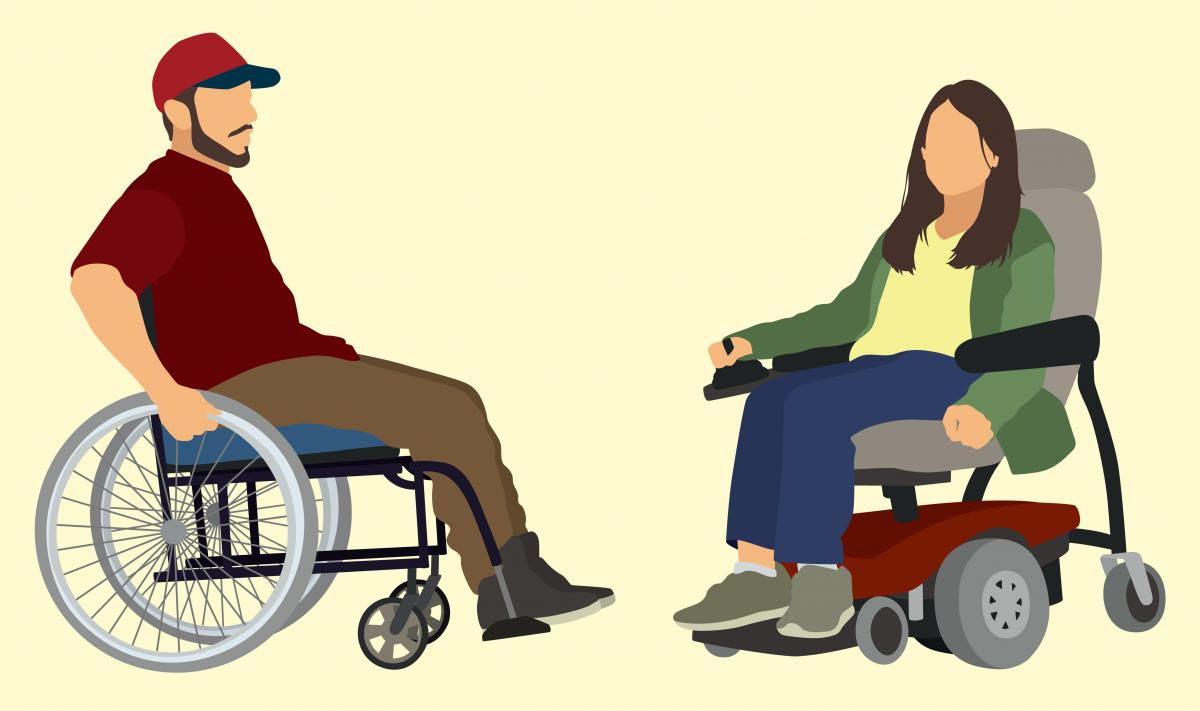
Illustration of male seated in manual wheelchair and female seated in powered wheelchair

Transfer Assistive Technology

Mobile Hoist

A mobile hoist is a device that is designed to lift and carry (transfer) you from one surface to another. This may be from your bed to your wheelchair, or from your wheelchair to shower commode.

It has a mobile base that can be wheeled from room to room, so long as there are no steps inside the home or other obstacles. Typically, two support workers or carers are required to operate a mobile hoist.

Mobile hoist operated by two care workers to lift a man out of bed using a sling


Ceiling Hoist

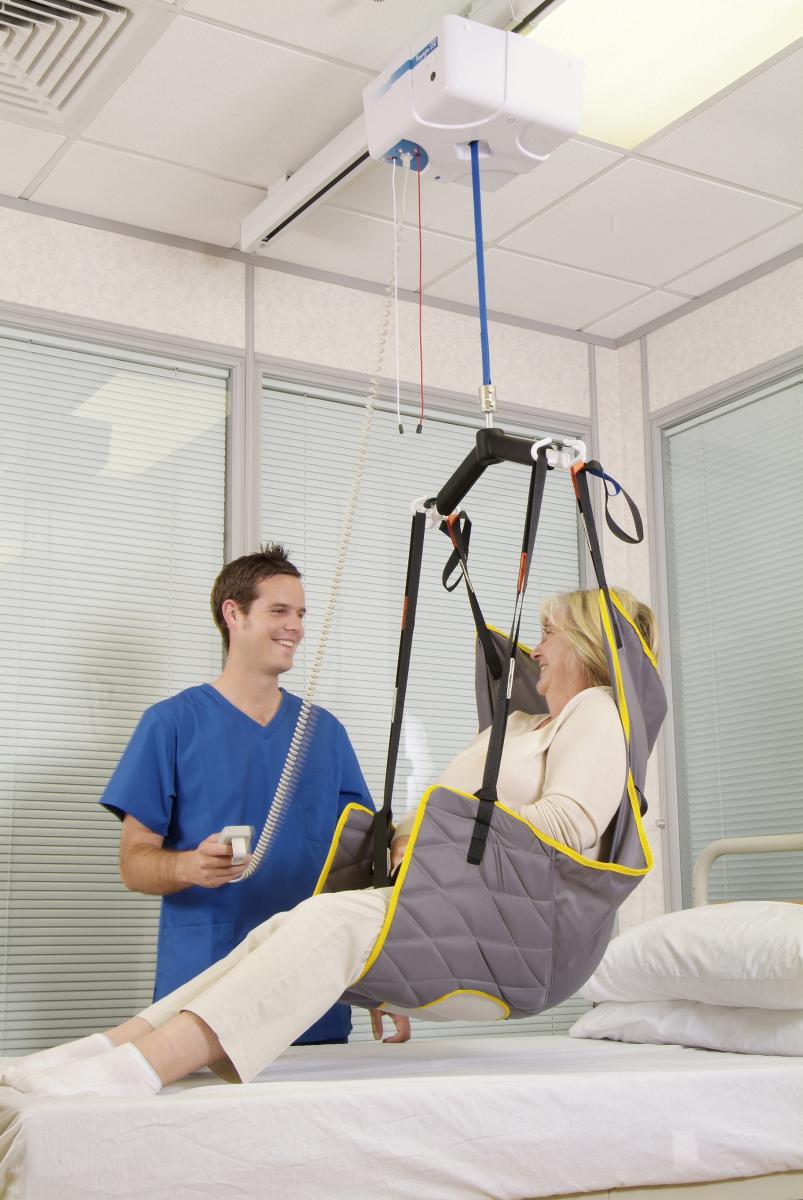
A ceiling hoist is a device attached to a frame that is built into your ceiling. It can transfer you between surfaces, and can sometimes travel between rooms. It is usually easier to handle compared to a mobile hoist and usually requires one or two support workers or carers to operate.

Ceiling hoist operated by one care worker to lift a women out of bed using a sling


Sling

Both a mobile hoist and a ceiling hoist require the use of a sling that attaches to the hoist via straps. A large fabric sling supports your whole body when you are lifted between surfaces.

Slings can come in all different shapes and sizes, and be made of different materials and straps designed for a variety of hoists.

A transfer sling attached to a mobile hoist being operated by two support workers to transfer out of a wheelchair


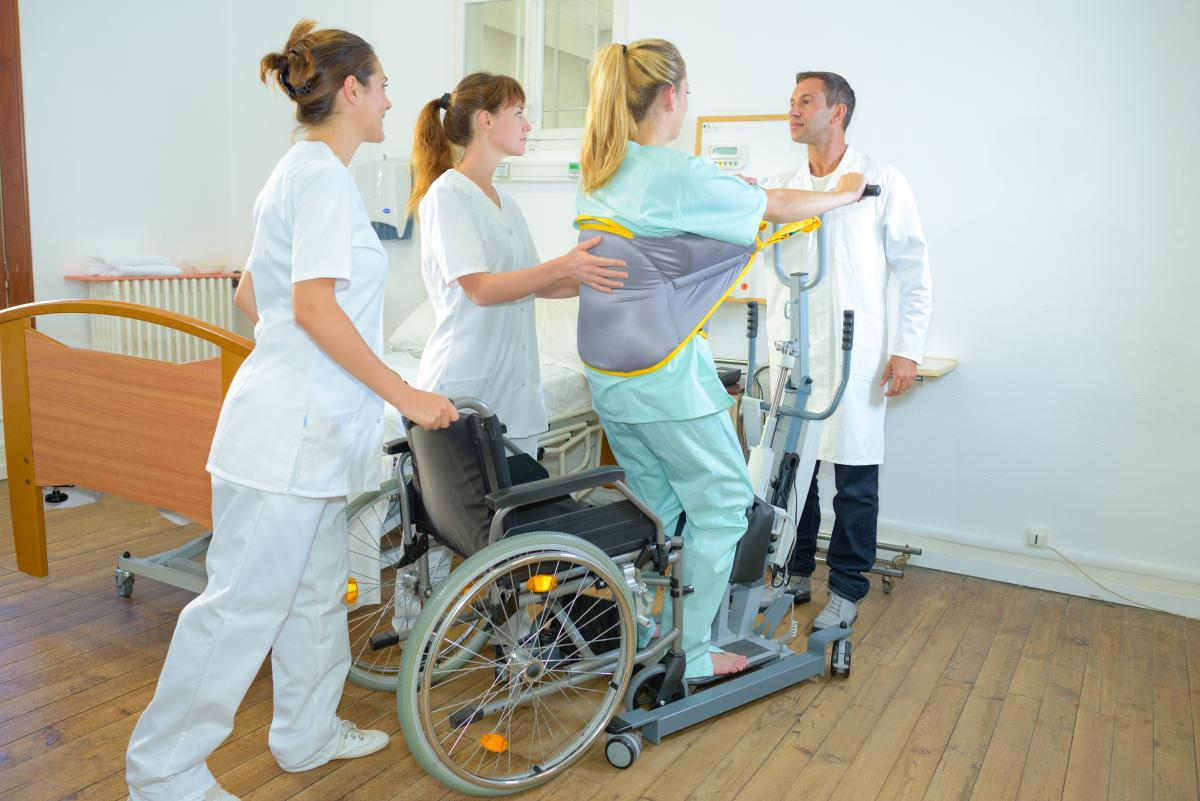
Standing Hoist

If you can weight-bear, but require a bit of additional support to stand up, a standing hoist can help you with completing transfers i.e. standing from sitting at the edge of your bed, wheelchair, or recliner chair.

Various slings and straps are available to assist you in using your standing hoist. Typically, a standing hoist is operated by one support worker or carer, however assistance of two may be necessary depending on the requirements of the transfer.

A standing hoist and sling operated by two support workers and clinician to sit to stand from a manual wheelchair

Bedroom Assistive Technology

Hi-lo Adjustable Bed

Bedroom assistive technology involves a hi-lo adjustable bed.

An electronically powered hand remote is available to adjust the power features of the bed. 

The power features have various benefits, including:

  • Raised back section - elevates the head and body for comfort, positioning, breathing, and eating.
  • Lower limb elevation and knee break - supports the lower limb in an elevated position for comfort, pressure care management, management of swelling etc.
  • Height adjustability - the bed can be lowered to assist you with standing transfers (if completed), or raise the bed to a height best suited for support workers or carers providing care to you in bed.

An adjustable bed is beneficial for someone with a spinal cord injury who has difficulty adjusting, repositioning and sitting up in bed.

Height adjustable bed with foam mattress


Pressure Relieving Mattress

Various pressure relieving mattresses are necessary for individuals with a spinal cord injury.

Pressure-relieving mattresses may be:

  • Foam mattress - consisting of various layers of foam to immerse the body and distribute pressure
  • Alternating air mattress - Air cells within a mattress that are inflated and deflated by an automated pump to redistribute pressure throughout the body for pressure care management
  • Combination of foam and air mattress - a pump-free mattress that combines air cells and foam padding to achieve comfort and pressure care management

Pressure relieving foam mattress

A high level spinal cord injury will impact your ability to reposition in bed, increasing your risk of sustaining a pressure care injury. In these cases, an alternating air mattress which offers a high level of pressure relief may be necessary.

Bathroom Assistive Technology

Mobile Shower Commode

A mobile shower commode is a waterproof wheeled device that has a similar setup to a wheelchair. It may be helpful for you if you cannot stand to shower and/or require support for personal-care routines.

A mobile shower commode typically has an oval gap in the centre of the padded commode seat, similar to the inside of a toilet seat. This is beneficial as the commode can be wheeled over a toilet so that it can also be used for toileting.

A mobile shower commode requires an accessible bathroom. This involves level (flat) access into a shower recess which ideally does not contain glass screens or doors. The toilet seat needs to be low enough for the commode to wheel over.

Mobile shower commodes can be self-propelled by users who would typically self-propel their manual wheelchair. A mobile shower commode with a tilt-in-space function may be more appropriate for a powered wheelchair used that is mobilised by care supports. Emerging assistive technology involves mobile shower commodes that can be manouvered electronially, such as the HMN M2 JOYSTICK mobile shower commode.

mobile shower commode positioned over toilet


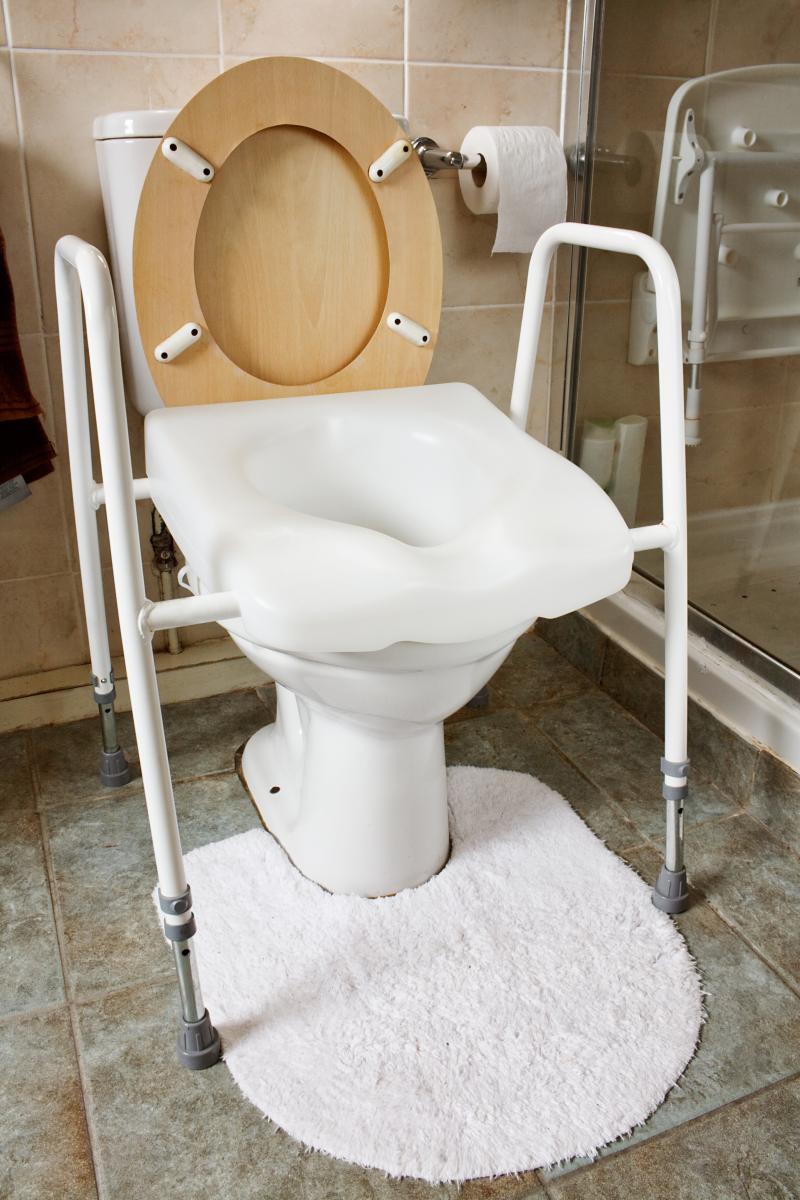
Over Toilet Aid

An over toilet aid is a frame that can be positioned over your toilet to assist with sit to stand transfers. This is beneficial for people with a spinal cord injury who can stand and walk, and need a little more support with transfers.

An over-toilet aid can promote your independence and reduce the need to rely on a support worker or carer to get on and off the toilet.

Raised toilet seat with arm rests positioned over toilet


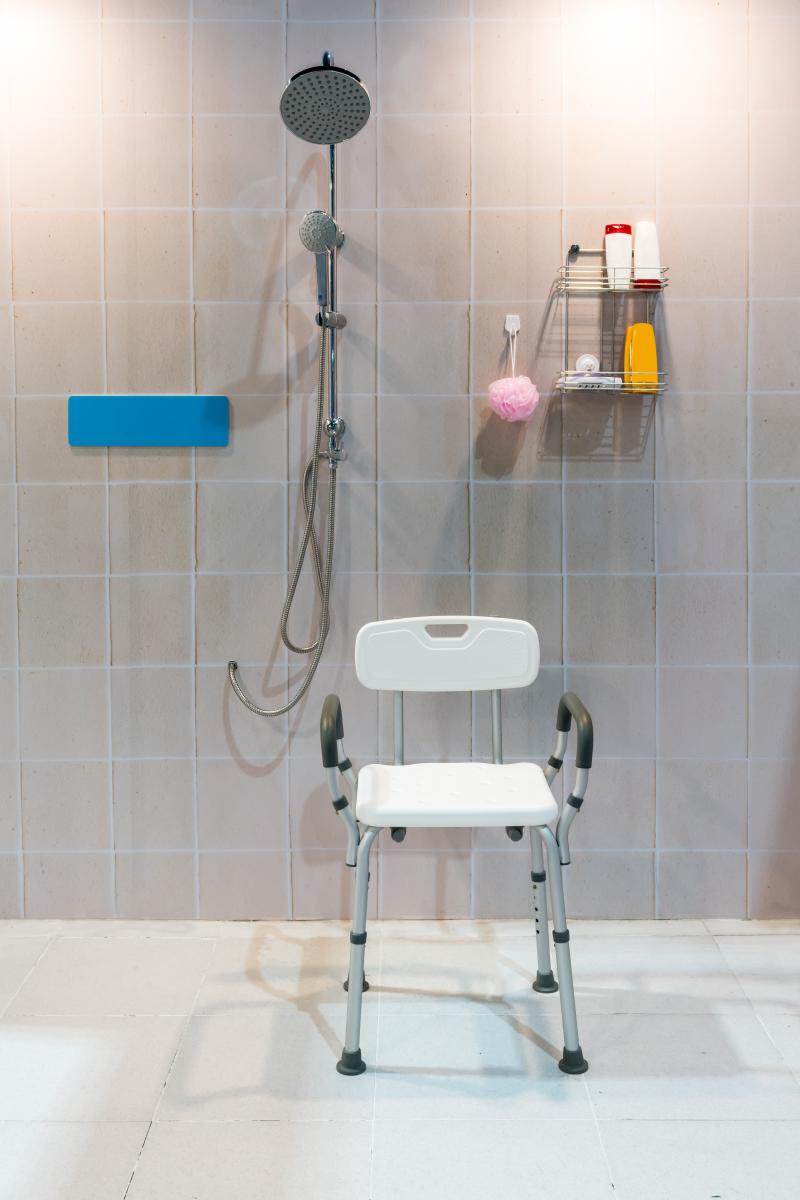
Shower Chair

In some cases, a shower chair may be the support you require in the shower if standing and balancing during your showering activity is difficult.

Shower chairs come in all shapes and sizes, including shower stools with or without backrests and armrests.

Shower chair positioned in accessible shower recess

Living and Dining Assistive Technology

Living and dining supports can often be overlooked when mobility and transfer assistive technology are prioritised. For someone with an spinal cord injury and high physical support needs, a standard couch or armchair is unlikely to meet your needs and sitting upright and maintaining comfort will be a challenge.

In this case, a disability-specific recliner chair with additional positioning features is required, to provide an opportunity to sit somewhere else that isn’t your wheelchair or bed for relaxation, leisure and social engagement.

A tray table on wheels that is compatible with the recliner chair is beneficial for eating meals and performing activities.

Recliner chair with adjustable seating and positioning aids

Kitchen Assistive Technology

Meal preparation aids can be beneficial for individuals with a spinal cord injury that may have difficulties engaging in the kitchen for meal preparation.

Some examples of kitchen and meal preparation aids include:

  • Modified chopping board
  • Spreader boards
  • Modified knives and utensils (thicker or different handle designs)
  • Easy open devices - one-touch bottle, jar and can openers
  • Kettle tipper device
  • Thermomix (in some cases if deemed appropriate following trial with an OT)

Modified chopping board with adaptive features including spokes and a clamp

Summary

There is a wide range of assistive technology available, with only some of the useful daily living aids discussed above. To learn what is right for you, you may benefit from a Functional Capacity Assessment from an Occupational Therapist.

Find an Occupational Therapist

The MyCareSpace NDIS Navigators can connect you with support workers who have experience with spinal cord injuries in your area.

Find a Support Worker

MyCareSpace resources may be shared provided they are credited to MyCareSpace with backlinks to the original resource.

Subscribe to Using your NDIS Funds

Our Preferred NDIS Plan Manager

Plan Hero Plan Management is our preferred NDIS Plan Manager because they are independent and specialist Plan Managers who have both lived experience and expert NDIS knowledge. Plan Management is all they do!

Plan Hero helps you keep your funding organised and on track within each funding period, so you don’t overspend or leave funds unused. They make sure providers are paid on time and help you stay on top of your budget. Their team is easy to reach, with clear, direct communication and no waiting on hold (ever).

Plan Hero gives you the support you need to use your NDIS funding with confidence.